Since the early 70s, the Native Youth Olympics have showcased the traditional games of the Alaska Native people:
Our Alaska Native ancestors developed traditional games in order to test and prove crucial abilities that governed everyday life. Competition was created with each other to hone their ability to hunt and fish for daily survival in the traditional way of life. The creators of the NYO Games wanted an opportunity to demonstrate their favorite traditional Native contests of their forefathers.
I found out about this via a highlight reel on Instagram — here’s last year’s competition highlights:
One-foot High Kick: “In many cultures, the One-Foot High Kick was used for signaling a successful hunt.”
Indian Stick Pull: “The Indian Stick Pull represents grabbing a slippery salmon, and was used traditionally to develop hand and arm strength.”
Kneel Jump: “Historically, the Kneel Jump was a game used to strengthen the leg muscles for jumping from ice floe to ice floe, and for lifting prey after a successful hunt.”
Seal Hop: “The Seal Hop is a variation of the Inuit Knuckle Hop, and used traditionally as a game of endurance and stamina, and for sneaking up on a seal, mimicking the mammal’s movement on the ice.”
Two-foot High Kick: “The Two-Foot High Kick was historically used to communicate the success of a spring hunt.”
I love these events. I think my favorite is a reintroduced event for the 2024 games (just concluded): the Toe Kick, which returned after a 10-year hiatus. Here’s how you do it:
Here’s a short documentary about the NYO and athlete Autumn Ridley from 2013 — her event is the Alaskan High Kick, perhaps the most impressively athletic event:
This is a powerful public service announcement about mental health from Norwich City FC and Samaritans (note the content warning at the start of the video). That’s all I’m going to say about it — just watch it.
This is great: a 25-minute interview with legendary animator Chuck Jones as he sits and draws some of his iconic characters (Bugs Bunny, Porky Pig, Daffy Duck). He told this anecdote about how Steven Spielberg and George Lucas were both influenced by a particular space-themed cartoon of his:
Porky was just a kind of a little third-string Boy Scout and was not very interesting to me. And then when I put him in a picture called Duck Dodgers in the 24th and a Half Century. Spielberg used that picture in Close Encounters the Third Kind - when his kids were watching television in the picture, they were watching Duck Dodgers in the 24th and a Half Century. And Lucas told me that he saw that picture when he was 12 years old and when when he opened Star Wars in San Francisco he told them they couldn’t have Star Wars in San Francisco unless they ran Duck Dodgers in the 24th and a Half Century.
Here is a pleasantly painful trailer for a new movie from the filmmaker Joanna Arnow. It opens this Friday, April 26, at IFC and Lincoln Center in NYC. I don’t know if I’m going to watch it, but I couldn’t really look away.
Arnow also stars as…
an emotionally detached young Brooklynite drifting through unremarkable days and nights. Neither her on-again-off-again BDSM relationship with a mildly disinterested older dom, nor her nondescript corporate job, appear to bring her any satisfaction.
And yet “she finds a core of poignant truth about the ways people search for … emotional happiness and sexual gratification” (per the Lincoln Center summary). It’s currently at a 100% on Rotten Tomatoes, FWIW. (This bit also made me laugh out loud.)
I love this: The Pudding ran an online experiment where they started with a shape (like a straight line or circle) and asked people to trace, as best they could, the tracing of the person before them. This resulted in a series of “flipbook” animation of how the shapes evolved over time — invariably, a squiggle.
One thing I noticed right away was how all the squiggles ended up squished over on the right side of the screen. The Pudding team had a theory on why that happened (the 3:20 mark in this video):
I found this study from like 35 years ago - they were trying to figure out why people kept missing their targets on touch screens. They found people tended to touch below their target and people tended to touch closer to the edges of the screen. And so I figure if it’s like right-handers who are missing, you’re going to be missing to the right. We probably had about half the users on mobile and 90% of the those half are probably going to be right-handed so it would make sense that it would gradually go to the right.
Go read the rest of the post — they also did an experiment about people’s inclination to draw penises on “any free-form drawing project on the internet”. (via waxy)
As someone who is interested in birds but doesn’t know a whole lot about them, this new animated video series from Will Rose is right up my alley. What Bird Is That? is a beginners guide to birding. The second episode, embedded above, is all about how to identify birds from their calls.
What’s that bird that sounds like Star Wars singing on my roof? What bird sings it’s own name? What’s that laughing sound you heard in the woods?
Right now, I “cheat” by using Cornell Lab of Ornithology’s eBird app, which allows you to record a bit of birdsong and it’ll ID the bird for you. (via the kid should see this)
Steve Mould’s videos are always entertaining and informative but this one is also a little bit mind-blowing. If you build a circular trough with just the right dimensions and fill it with lighter fluid, a flame will travel around it. And other shapes will do other things — the effect created by the star/octopus shape is especially cool. The effect is an example of an excitable medium:
An excitable medium is a nonlinear dynamical system which has the capacity to propagate a wave of some description, and which cannot support the passing of another wave until a certain amount of time has passed (known as the refractory time).
A forest is an example of an excitable medium: if a wildfire burns through the forest, no fire can return to a burnt spot until the vegetation has gone through its refractory period and regrown.
Other examples:
Normal and pathological activities in the heart and brain can be modelled as excitable media. A group of spectators at a sporting event are an excitable medium, as can be observed in a Mexican wave (so-called from its initial appearance in the 1986 World Cup in Mexico).
Letterboxd asked Dune director Denis Villeneuve what his four favorite films were and he cheated and listed five (including 2001 and Blade Runner).
First of all, who knows how long Blade Runner has been on his top 5 (or even 10 or 20 list) but getting to do a sequel of one of your favorite films has to be unbelievably rewarding as a director.1
And I’m going to cheat as well here and list a number of other films that Villeneuve has publicly praised, courtesy of this piece from IndieWire: Vertigo, Children of Men, Downsizing (?), There Will Be Blood, Seven Samurai, The Beguiled, Jaws, and three Nolan films (Dunkirk, Inception, Tenet).
I was trying to think of what might be the equivalent to this for me and all I could come up with is getting hired to reboot Suck or something.↩
A family of beavers in Canada has built a dam that’s twice as wide as the Hoover Dam. This huge dam is kind of a click-baity promotion (it worked!) but the essence of the video is how beavers can help make landscapes more resilient to effects of climate change.
It’s so big it can be seen from outer space. But that’s not the only reason NASA is interested in this architecturally minded species… Increasing diversity and resilience, not to mention creating wetlands, are just some of the impacts beavers can have on their surroundings. What does this mean for the wider environment? And how can we humans learn from it?
This is a teenager is an interactive data visualization by Alvin Chang about a group of American teenagers that have been tracked in a longitudinal study since 1997 (they are around 40 years old now). The video version of the visualization is embedded above.
A year from now, in 1998, a researcher named Vincent Felitti will publish a paper that drastically changes the way we think about these kids — and their childhood.
The research will show that these childhood stressors and traumas — called Adverse Childhood Experiences — have a lifelong effect on our health, relationships, happiness, financial security, and pretty much everything else that we value. It will kickstart decades of research that shows that our childhood experiences shape our adulthood far more than we ever thought.
From Factory Monster (great name), a video of how candles are made in a South Korean candle factory. I like that there’s no music or voiceover, so you can hear the sounds of the production. I also enjoyed the charmingly janky English subtitles:
Blah blah powder for hardness. Yellow powder for pure white color. Irony, huh?!
Can someone who knows something about making candles tell me why that hole is made in each of the candles with the metal rods? It was unclear from the video what its purpose is.
Ok, I said no more eclipse posts (maybe) and then posted like two or three more, but really this is the last one — maybe! In 1973, a group of scientists witnessed the longest ever total solar eclipse by flying in the shadow (umbra) of the moon in a Concorde prototype for 74 minutes over the Sahara desert. From the abstract of a paper in Nature about the flight:
On June 30, 1973, Concorde 001 intercepted the path of a solar eclipse over North Africa, Flying at Mach 2.05 the aircraft provided seven observers from France, Britain and the United States with 74 min of totality bounded by extended second (7 min) and third (12 min) contacts. The former permitted searches for time variations of much longer period than previously possible and the latter provided an opportunity for chromospheric observations of improved height resolution. The altitude, which varied between 16,200 and 17,700 m, freed the observations from the usual weather problems and greatly reduced atmospheric absorption and sky noise in regions of the infrared.
Mach 2.05 = 1573 mph = 2531 km/h. 17,700 m = 58,000 ft. They added portholes to the roof of the plane for better viewing and data gathering. This page on Xavier Jubier’s site contains lots of amazing details about the flight, including a map of the flight’s path compared to the umbra, photos of the retrofitted plane, and a graph of the umbra’s velocity across the surface of the Earth (which shows that for at least part of the eclipse, the Concorde was actually outrunning the moon’s shadow).
By flying inside the umbral shadow cone of the Moon at the same speed, the Concorde was going to stay in the darkness for nearly 74 minutes, the time for astronomers and physicists on board to do all the experiences they could imagine to complete during this incredible period of black Sun. They were able to achieve in one hour and fifteen minutes what would have taken decades by observing fifteen total solar eclipses from places that would have not necessarily gotten clear skies.
I’d missed that Philip Glass Solo (previously) came out in January, but I’ve been listening to it while I work this morning and it’s just lovely. He recorded the album in his home on his piano. Here’s a short video of Glass playing on that very piano:
This is my piano, the instrument on which most of the music was written. It’s also the same room where I have worked for decades in the middle of the energy which New York City itself has brought to me. The listener may hear the quiet hum of New York in the background or feel the influence of time and memory that this space affords. To the degree possible, I made this record to invite the listener in.
And here’s a video of him playing the album’s opening piece on his 87th birthday:
When emperor penguin chicks go for their first swim, they usually jump a few feet into the sea. The group of chicks in the video National Geographic video above decided to leap off of a 50-foot ice cliff for their first trip out.
It’s not unusual for emperor penguin chicks to march toward the ocean at a young age, even when they’re just 6 months old. They jump just 2 feet off the ice to take their first swim, according to National Geographic.
Others have jumped from a much a higher altitude, heading to “sheer ice cliffs” knowingly to make the first jump. Satellites have recorded the death-defying jumps since 2009, but what happens next has remained a mystery until now.
Having watched the video, “leap” and “jump” are charitable descriptions of what the penguins are doing here. “Flop”, “plop”, and “fall” might be better…penguins are all kinds of cool, but no one has ever accused them of being graceful out of the water.
Ryan Gosling was on Saturday Night Live this weekend and they did a sequel to one of my favorite SNL sketches (which is completely dorky in a design nerd sort of way) ever: Papyrus. Behold, Papyrus 2:
Avatar spawned worlds, right? Every little leaf of every little flower, every little eyelash of every little creature: thoroughly thought out. But the logo: it’s Papyrus, in bold. Nobody cares. Does James Cameron care? I don’t think so.
My current natural obsession is Mount Etna, a volcano in Sicily that blows perfect smoke rings like it’s frickin’ Gandalf with a pipe-full of Old Toby or something.
It is a relatively rare phenomenon caused by a constant release of vapours and gases. The gaseous mass ascends rapidly through the central part of the conduit, promoting the formation of rings by wrapping the gas upon itself in a vortex motion.
This is wonderful: a collection of video clips of Charles Schulz drawing his iconic Peanuts comic strip — “everything I could find of Charles Schulz drawing his Peanuts characters” in the words of the compiler.
Unfortunately, I’m not highly educated. I’m merely a high school graduate. I studied art in a correspondence course because I was afraid to go to art school. I couldn’t see myself sitting in a room where everyone else in the room could draw much better than I and this way I was protected by drawing at home and simply mailing my drawings in and having them criticized.
I wish I had a better education but I think that my entire background made me well-suited for what I do. If I could write better than I can, perhaps I would have tried to become a novelist and I might have become a failure. If I could draw better than I can, I might have tried to become an illustrator or an artist and would have failed there. But my entire being seems to be just right for being a cartoonist.
Charles Schulz: Unbothered. Moisturized. Happy. In his lane. Focused. Flourishing.
Let’s say the countries of the world most responsible for the changing climate continue to drag their feet on doing something about it. What is the world going to look like in 20 or 30 or 80 years? This TED-Ed video describes that bleak potential future.
Reports on heatwaves and wildfires regularly fill the evening news. Summer days exceed 40 degrees in London and 45 degrees in Delhi, as extreme heat waves are now 8 to 9 times more common. These high temperatures prompt widespread blackouts, as power grids struggle to keep up with the energy demands needed to properly cool homes. Ambulance sirens blare through the night, carrying patients suffering from heatstroke, dehydration, and exhaustion. The southwestern United States, southern Africa, and eastern Australia experience longer, more frequent, and more severe droughts.
Meanwhile, the Philippines, Indonesia, and Japan face more frequent heavy rainfall as rising temperatures cause water to evaporate faster, and trap more water in the atmosphere. As the weather becomes more erratic, some communities are unable to keep pace with rebuilding what’s constantly destroyed.
David Lynch is not having any of that “you need to struggle or be tortured in order to be creative” stuff. In this video compilation, the director talks about how poor mental health inhibits art & creativity.
It stands to reason: the more you suffer, the less you want to create. If you’re truly depressed, they say you can’t even get out of bed, let alone create. It occupies the whole brain, poisons the artist, poisons the environment; little room for creativity.
Open Culture has more on how Lynch uses transcendental meditation to improve his mental health…and a great anecdote about the one time Lynch tried therapy:
In one Charlie Rose interview, a clip from which appears in the video, he even tells of the time he went to therapy. The beginning of this story makes it in, but not the end: Lynch asked his new therapist “straight out, right up front, ‘Could this process that we’re going to go through affect creativity?’ And he said, ‘David, I have to be honest with you, it could” — whereupon Lynch shook the man’s hand and walked right back out the door.
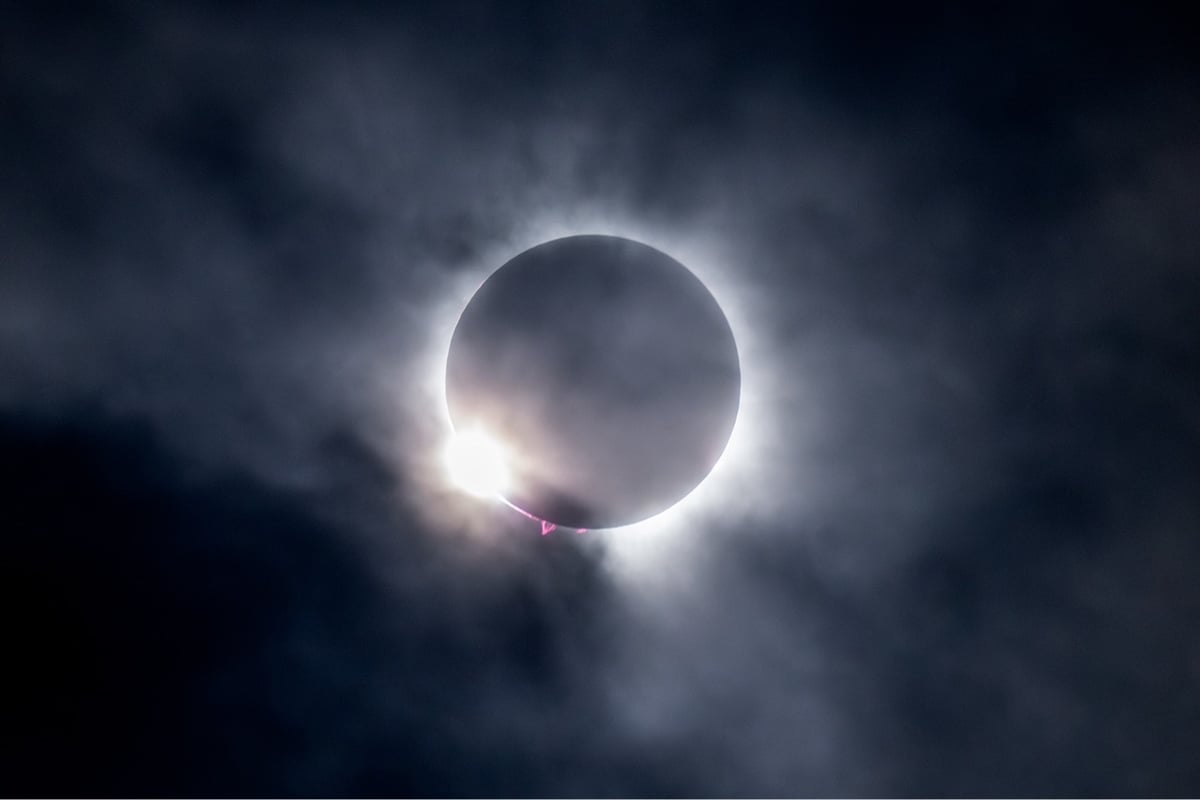
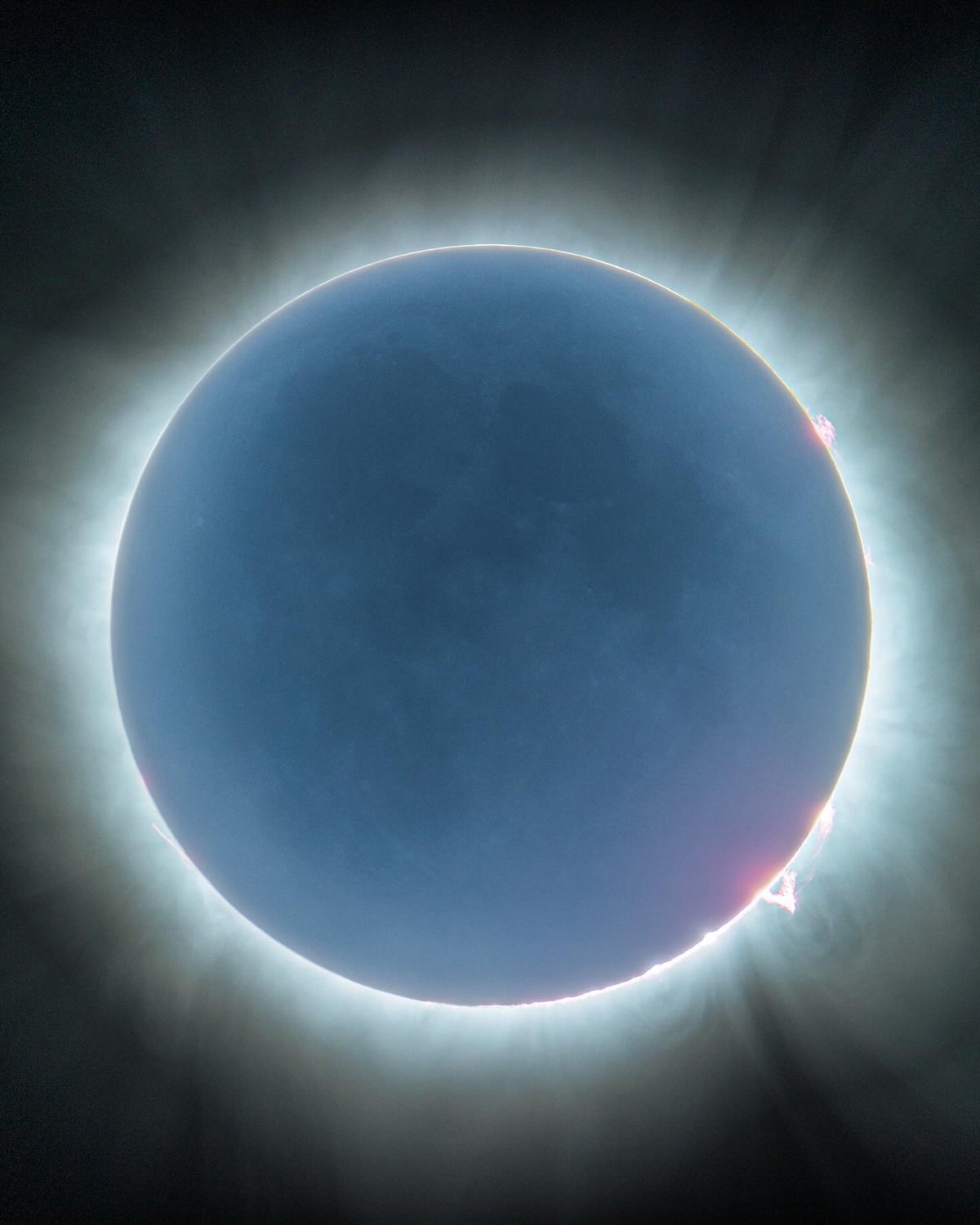
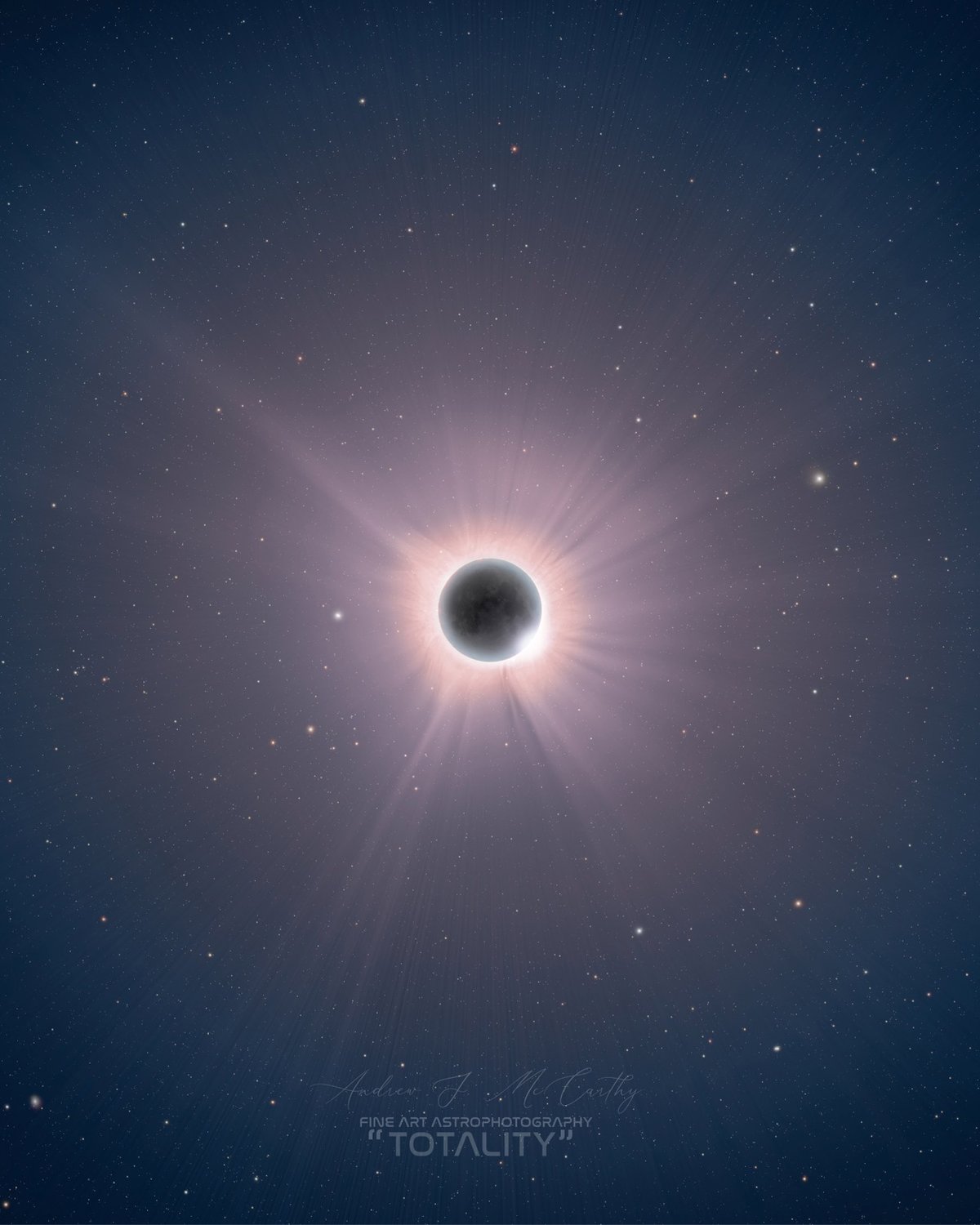
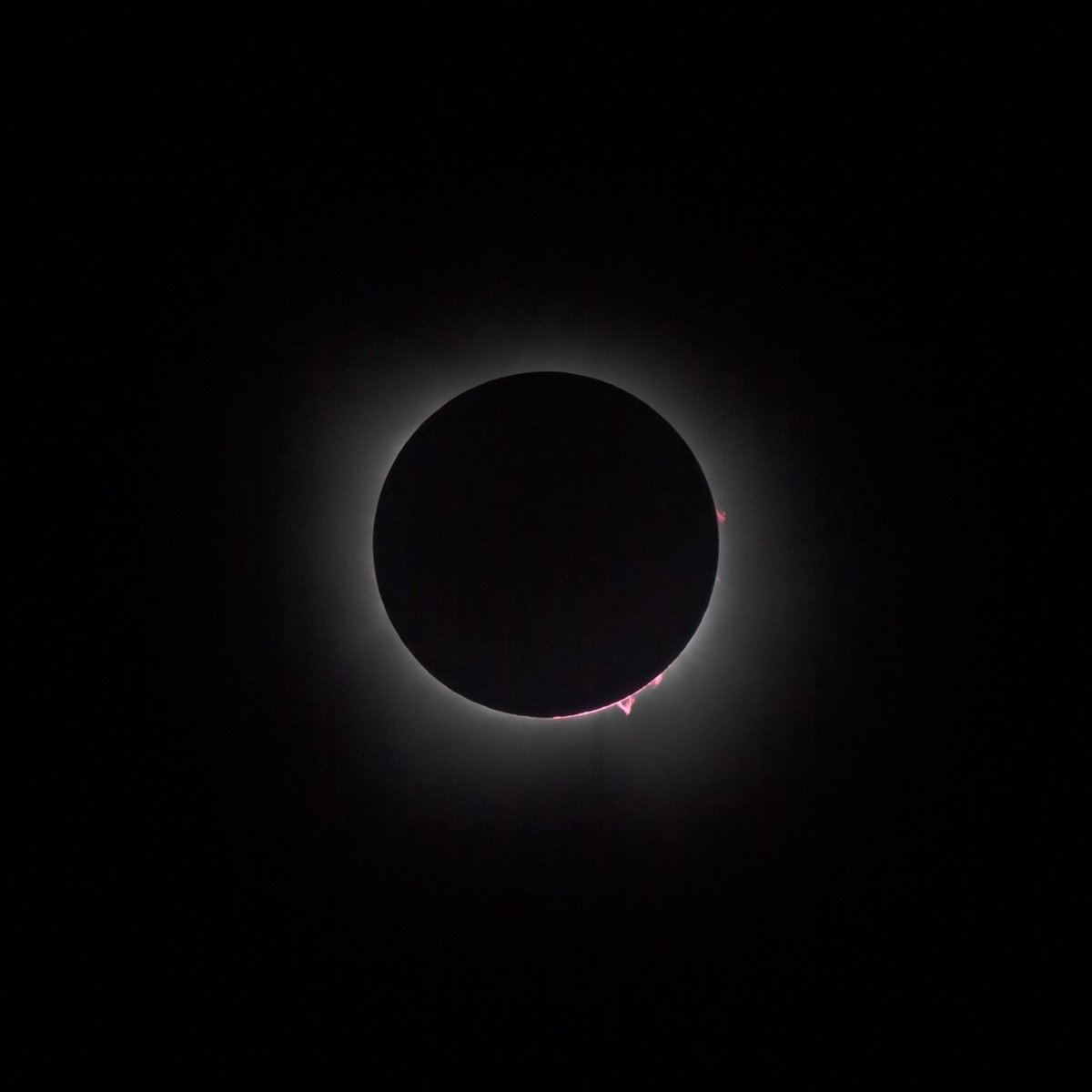
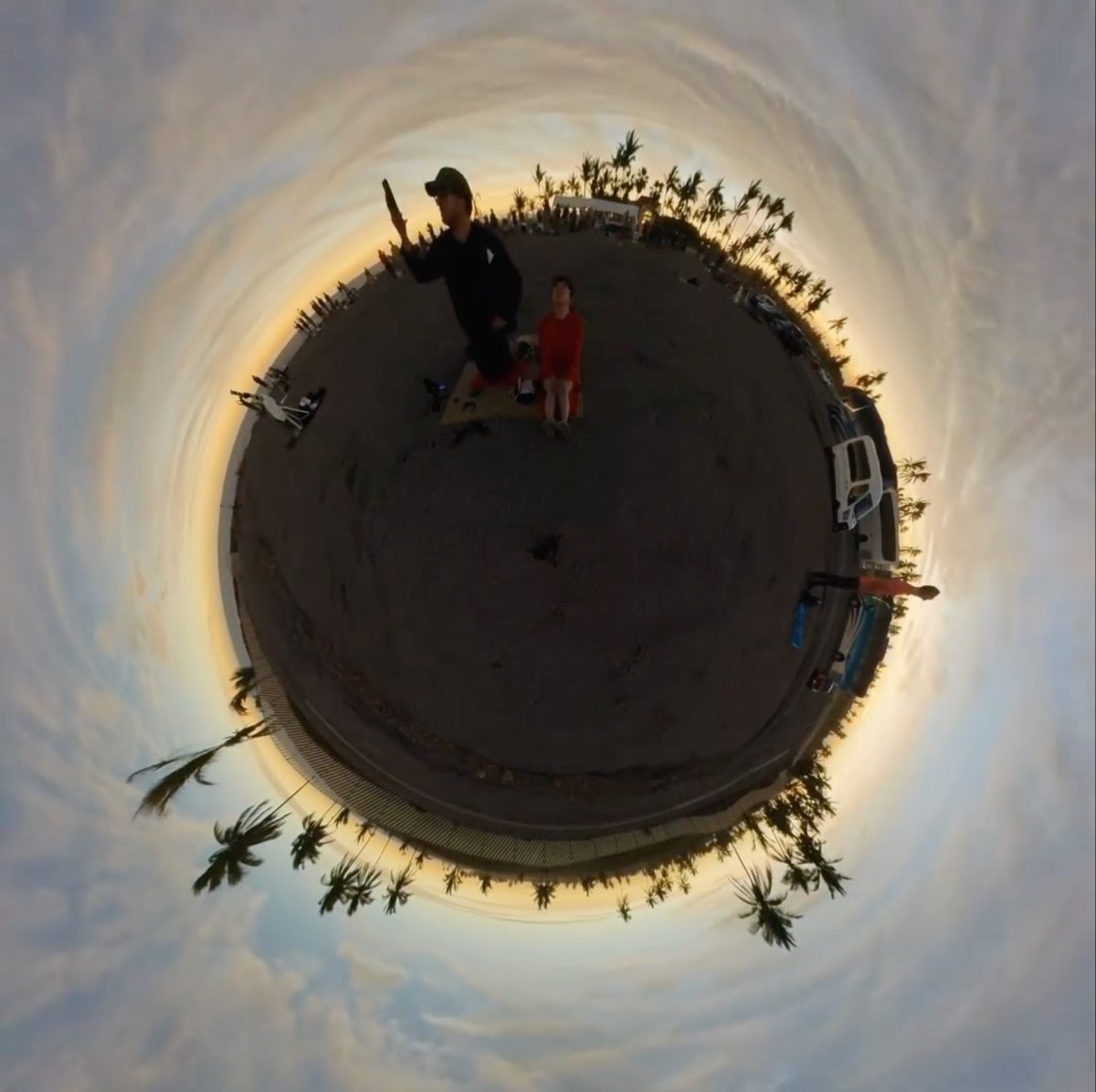
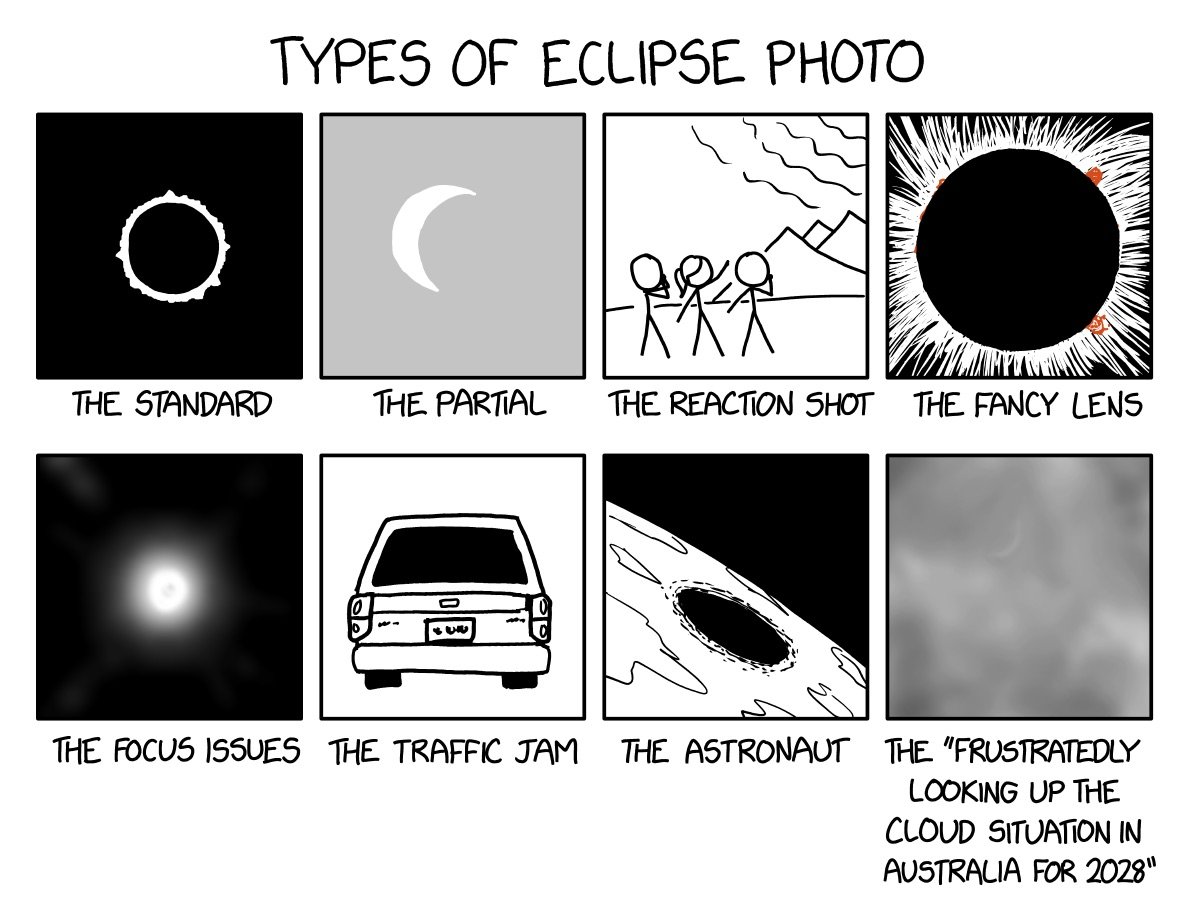
Well, the total solar eclipse was once again completely awesome. I didn’t have to go chasing all over tarnation this time, the telescope worked out amazingly well, and I got to share it with a bunch of first-timers, both in-person and via text. I’m going to share some thoughts, photos, and videos from others around the internet in an even bloggier fashion than usual. Here we go.
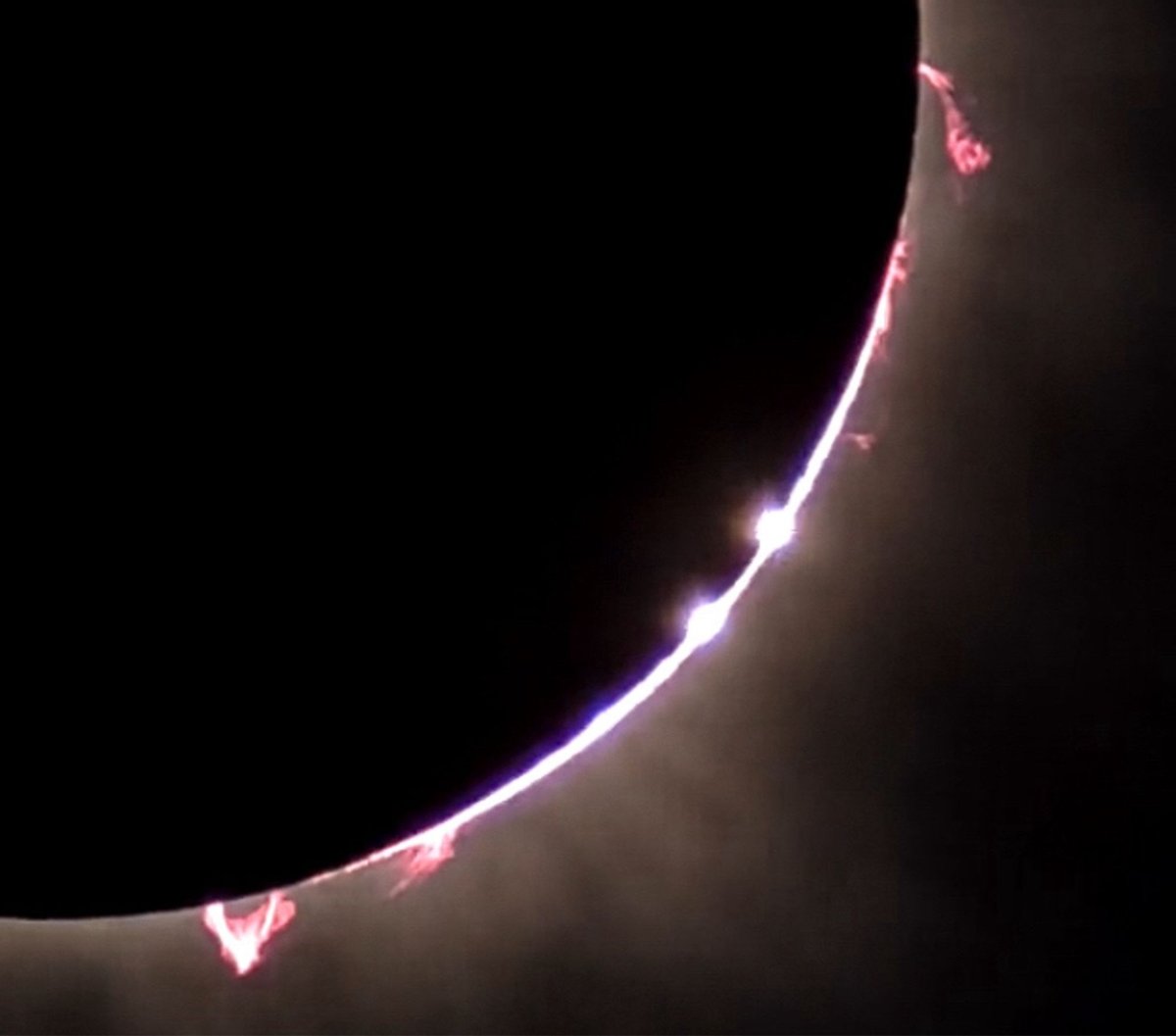
Quick solar prominence explainer interlude: if you had a clear look at totality, you may have noticed some orange bits poking out around the moon. NASA: What is a solar prominence?
A solar prominence (also known as a filament when viewed against the solar disk) is a large, bright feature extending outward from the Sun’s surface. Prominences are anchored to the Sun’s surface in the photosphere, and extend outwards into the Sun’s hot outer atmosphere, called the corona. A prominence forms over timescales of about a day, and stable prominences may persist in the corona for several months, looping hundreds of thousands of miles into space. Scientists are still researching how and why prominences are formed.
The red-glowing looped material is plasma, a hot gas comprised of electrically charged hydrogen and helium. The prominence plasma flows along a tangled and twisted structure of magnetic fields generated by the sun’s internal dynamo. An erupting prominence occurs when such a structure becomes unstable and bursts outward, releasing the plasma.
A timelapse video of totality from Scientific American:
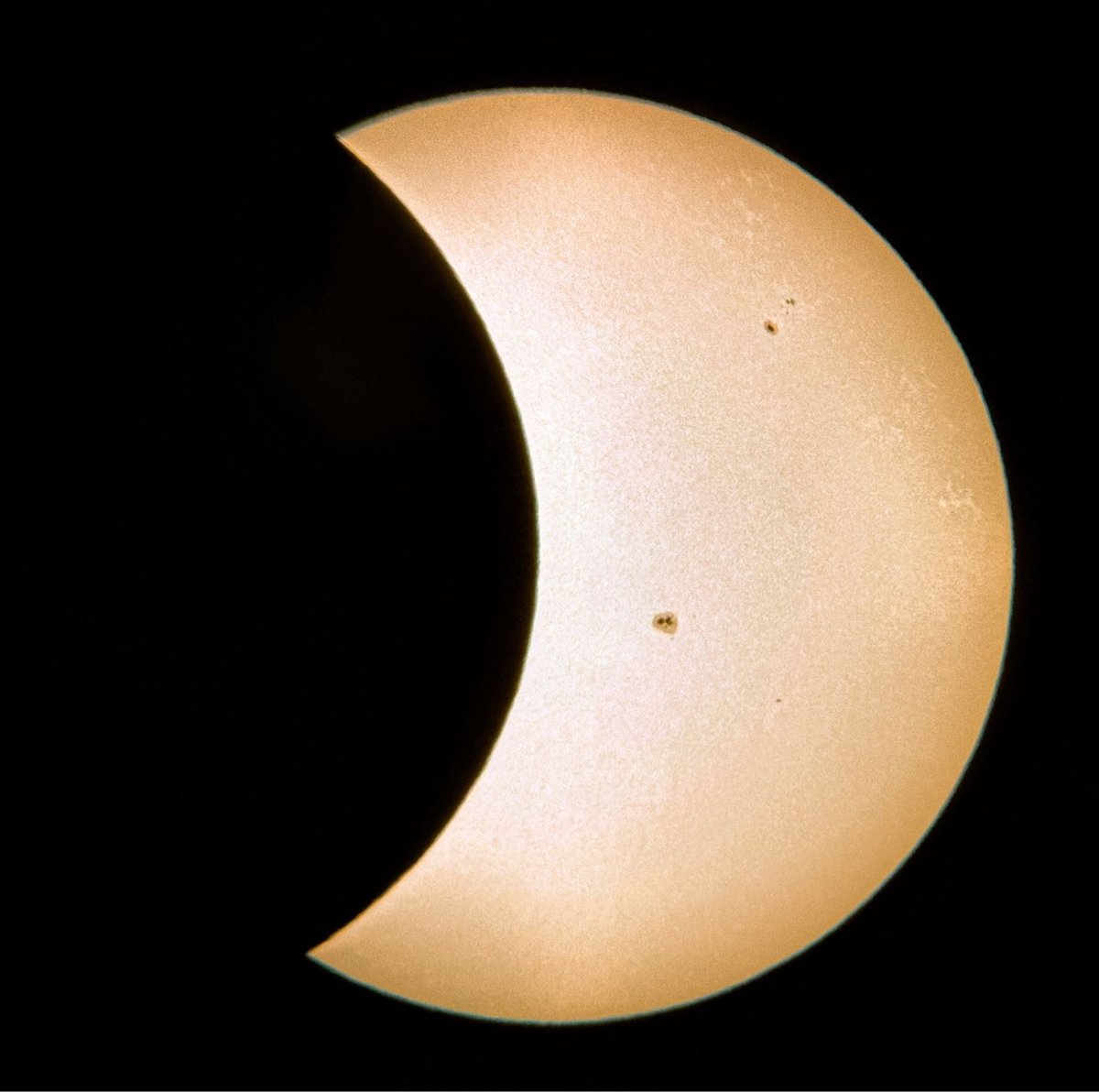
A sunspot is simply a region on the surface of the sun-called the photosphere-that is temporarily cool and dark compared to surrounding regions. Solar measurements reveal that the average surface temperature of the sun is 6000° Celsius and that sunspots are about 1500° Celsius cooler than the area surrounding them (still very hot), and can last anywhere from a few hours to a few months. Sunspots expand and contract as they move across the surface of the sun and can be as large as 80,000 km in diameter.
Sunspots are magnetic regions on the sun with magnetic field strengths thousands of times stronger than the Earth’s magnetic field, and often appear in pairs that are aligned in an east-west direction. One set will have a positive or north magnetic field while the other set will have a negative or south magnetic field. The field is strongest in the darker parts of the sunspots — called the umbra. The field is weaker and more horizontal in the lighter part-the penumbra. Overall, sunspots have a magnetic field that is about 1000 times stronger than the surrounding photosphere.
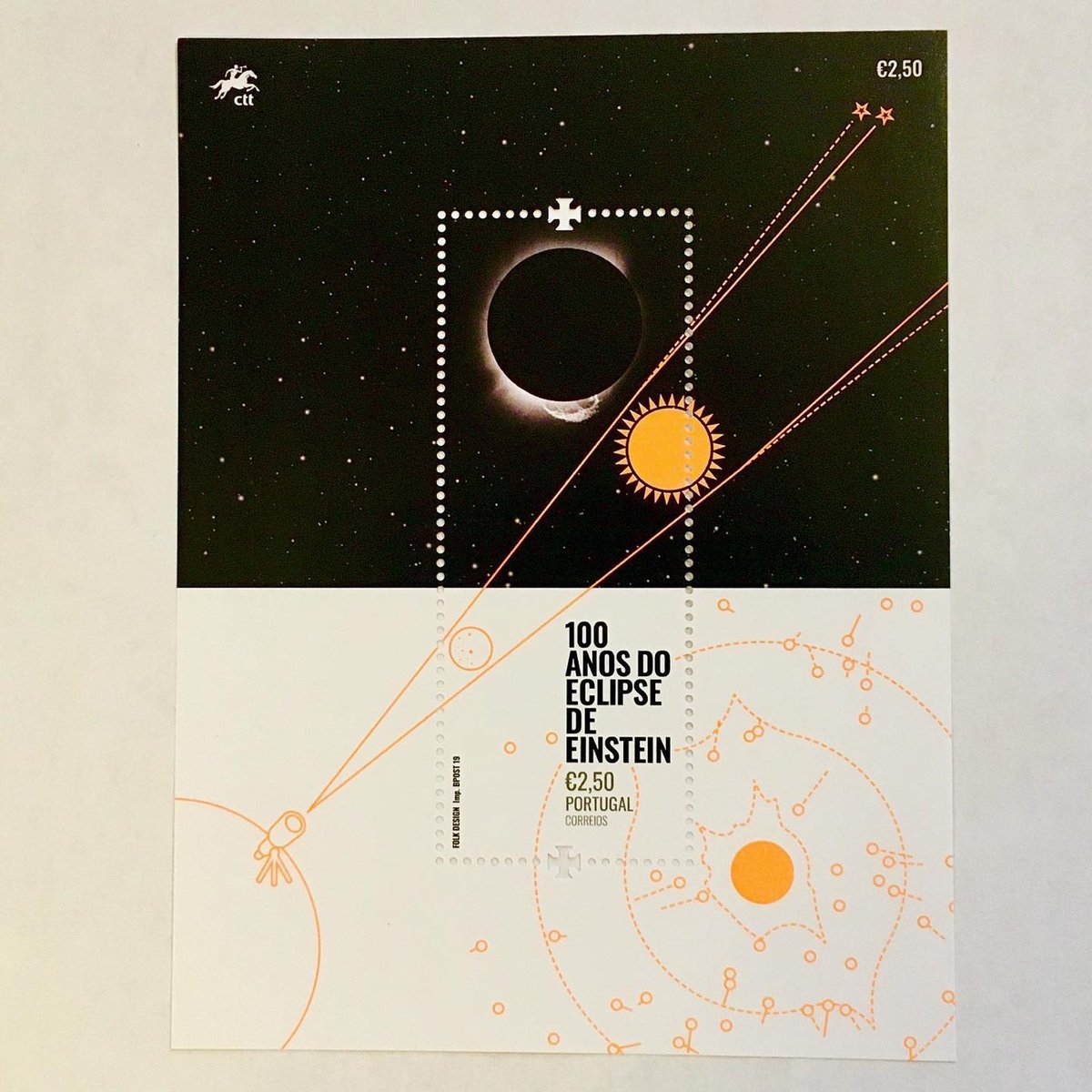
This Instagram account has a lovingly assembled collection of solar eclipse stamps from around the world (Aruba, Bhutan, Chile, Romania, Kenya, and even North Korea).
Total solar eclipses occur because the moon and the sun have the same apparent size in Earth’s sky — the sun is about 400 times wider than the moon, but the moon is about 400 times closer.
But the moon is slowly moving away from Earth by about 1-1/2 inches (4 centimeters) per year, according to the NASA statement. As a result, total solar eclipses will cease to exist in the very distant future, because the apparent size of the moon in Earth’s sky will be too small to cover the sun completely.
“Over time, the number and frequency of total solar eclipses will decrease,” Vondrak said in the statement. “About 600 million years from now, Earth will experience the beauty and drama of a total solar eclipse for the last time.”
Ok, that’s all for now. Depending on what else I come across, I might update this post periodically throughout the day. I know some of you who were lucky enough to see the total eclipse shared your experiences in the comments of yesterday’s post but feel free to do so here as well.
In 1900, celebrated magician (and astronomy enthusiast) Nevil Maskelyne travelled to North Carolina to film a solar eclipse on May 28, 1900. The Royal Astronomical Society and the British Film Institute reckon this is “the first surviving astronomical film in the world”.
In 1898 he travelled to India to photograph an eclipse. He succeeded but the film can was stolen on his return journey home.
It was not an easy feat to film. Maskelyne had to make a special telescopic adapter for his camera to capture the event. This is the only film by Maskelyne that we know to have survived.
The original film fragment held in The Royal Astronomical Society’s archive has been painstakingly scanned and restored in 4K by conservation experts at the BFI National Archive, who have reassembled and retimed the film frame by frame. The film is part of BFI Player’s recently released Victorian Film collection, viewers are now able to experience this first film of a solar eclipse since the event was originally captured over a century ago.
This video is more than 10 years old, but I hadn’t seen it before: a version of Bonnie Tyler’s music video for Total Eclipse of the Heart where the lyrics describe what we literally see.
Pan the room
Random use of candles, empty bottles, and cloth,
and can you see me through this fan?
Slo-mo dove
Creepy doll, a window, and what looks like a bathrobe.
Sophia Bogle is an expert at restoring old books and I was riveted by this video of her taking viewers through the deconstruction and restoration process, including a tour of her workshop and some of the tools she uses (e.g. a repair knife she designed herself to resemble a fingertip).
But reader, I gasped when she signed her work…I don’t think I could do that! (via boing boing)
Wolfgang Amadeus Mozart’s first surviving musical composition was created at age five and in this video visualization, you can hear and see how his music evolved from that early piece to those created in his 20s and 30s. Not knowing a whole lot about music or of Mozart in particular, I was shocked at how incredible his compositions were at ages five, six, and seven. Sheesh.
In this Crash Course video, author and “TB-hater” John Green takes a deep dive into tuberculosis.
This is the story of the deadliest infectious disease of all time. It’s been with us for 3 million years, since before humans were homo sapiens. We have evidence of it in the mummies of ancient Egypt, and it’s mentioned in the Hebrew Bible.
We’ve made extraordinary medical advances. Vaccines, antibiotics, and clean water have saved millions of lives. And yet despite that, in 2022, this disease killed more people than malaria, typhoid, cholera, homicide, and war…combined.
It has gone by many names. In ancient China, it was known as huaifu, meaning “destroyed palace.” In ancient Hebrew, “schachepheth,” meaning wasting away. The 19th-century term: “consumption,” for the way it seemed to consume the body. Today, we call it tuberculosis.
My teen daughter doesn’t care for crosswords or the Spelling Bee, but she does try to play Connections every day. We were working on this one together a few days ago and when I suggested SNAIL GALAXY CYCLONE SUNFLOWER as a group, she said “I was thinking spirals but sunflowers are round”. Which prompted a discussion about the Fibonacci sequence and the golden ratio (which she’d covered in math class) and a search for videos that explained how the sequence pops up in nature and, specifically, sunflowers.
As beautiful as the sunflower is, isn’t it even lovelier knowing there is a deep mathematical order to it?
I have a friend who’s an artist and has sometimes taken a view which I don’t agree with very well. He’ll hold up a flower and say “look how beautiful it is,” and I’ll agree. Then he says “I as an artist can see how beautiful this is but you as a scientist take this all apart and it becomes a dull thing,” and I think that he’s kind of nutty.
First of all, the beauty that he sees is available to other people and to me too, I believe. Although I may not be quite as refined aesthetically as he is … I can appreciate the beauty of a flower. At the same time, I see much more about the flower than he sees.
I could imagine the cells in there, the complicated actions inside, which also have a beauty. I mean it’s not just beauty at this dimension, at one centimeter; there’s also beauty at smaller dimensions, the inner structure, also the processes. The fact that the colors in the flower evolved in order to attract insects to pollinate it is interesting; it means that insects can see the color. It adds a question: does this aesthetic sense also exist in the lower forms? Why is it aesthetic? All kinds of interesting questions which the science knowledge only adds to the excitement, the mystery and the awe of a flower. It only adds. I don’t understand how it subtracts.
Games, language, mathematics, the beauty of flowers, science, time spent together — Connections indeed.
Pub Choir is an Australia-based organization that gets large crowds singing popular tunes, in three-part harmony no less.
Everybody can sing. Like, not well, but literally. Why should being average at something stop you from doing it!? It hasn’t yet… Singing is good for you, it’s EASY, and Pub Choir is here to show you how.
With a show that is equal parts music, comedy, and beer, Pub Choir is a euphoric sensation that transforms a crowd of tipsy strangers into a legendary choir.
By the end of the show the YOU will be belting out a popular song in three-part harmony.
In the video above, they get a crowd of 1600 people signing Creep by Radiohead. Beautiful.
You can find more of their performances on their YouTube channel, including Tina Turner’s The Best, Africa by Toto, and Free Fallin’ by Tom Petty.
Using a scale model of the solar system the size of New York City and some dazzling visual effects, Epic Spaceman explains that black holes are generally smaller than you might think (because they’re so dense) — even the supermassive black hole at the center of our galaxy. But when you consider some of the biggest black holes we’ve discovered…wow.
I thought for sure that I’d previously written about the secret jelly packet & pickle-based system that chefs at the Waffle House use to “store” all of the orders that come in for food during service, but I can’t find it in the archive. But no matter — the Waffle House training video above runs us through their whole system, including a detailed explanation of their Magic Marker System, which involves zero actual Magic Markers and instead is about arranging condiment packets and other items on plates in a code:
Now let’s talk about our breakfast sandwiches. Just like omelettes, these sandwiches have the same four positions: ham, sausage, bacon, and plain. To mark a sandwich, place two pickle slices in the appropriate position. Here you can see I put two pickle slices in the number three position, which tells me this is a bacon sandwich. If I add a slice of cheese to the plate, I know this is a bacon cheese sandwich. To make this a bacon, egg, and cheese sandwich, I’ll add this right side up mayo packet to the right side of the plate.
Don’t let this mayo pack confuse you - as long as you see two pickles on the plate you know this is a sandwich. When marking a sandwich, this mayo packet and pickles means a sandwich with eggs. If a customer wanted the eggs on their sandwich to be scrambled instead of the standard over well egg, I’d move this mayo pack down to the bottom of the plate to show that the egg is scrambled.
That sounds pretty complicated and they’ve likely faced pressure to change the system over the years, but I bet it works really well in practice and cuts down on errors. I love stuff like this…seeing how different organizations manage their core processes, especially in non-conventional ways. See also Nightclub Hand Signals and The Quarryman’s Symphony. (thx, erik)





Stay Connected