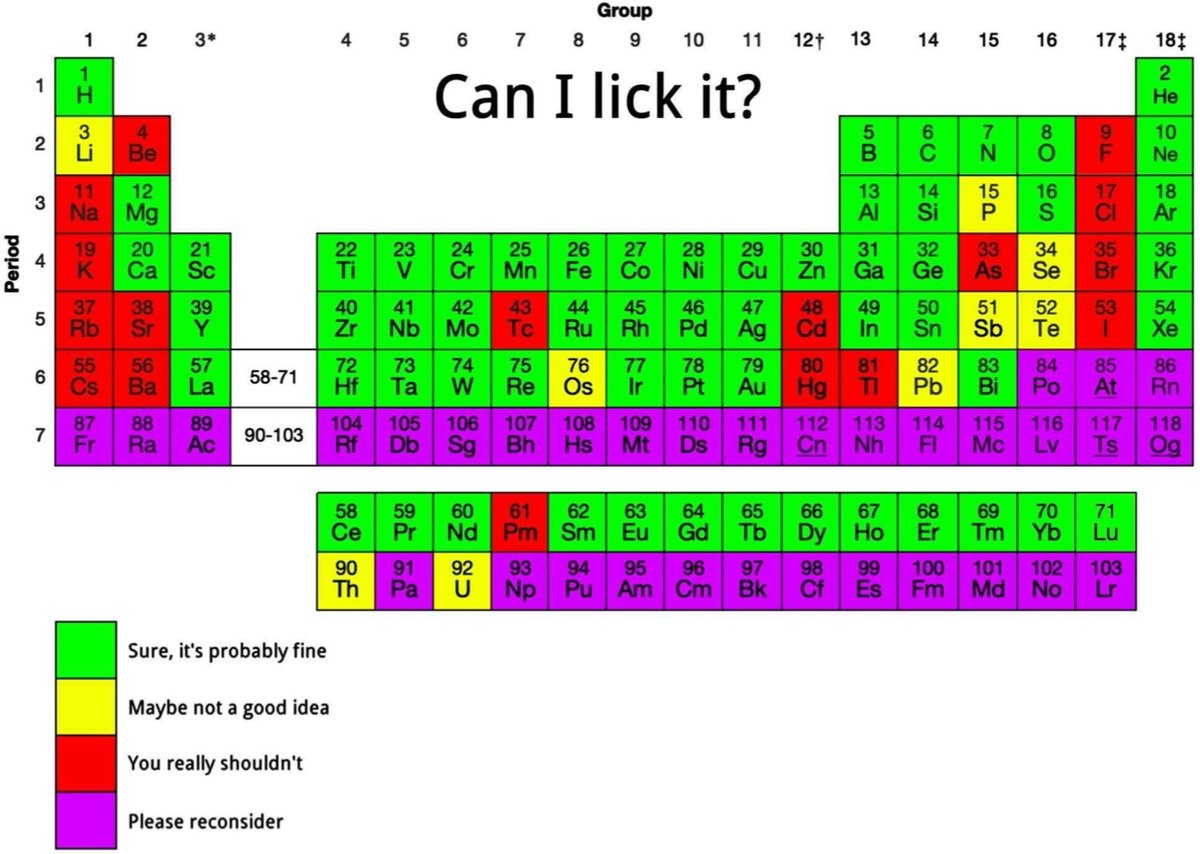
Is the periodic table yummy? Well, it depends on the element. But if you’ve ever wondered if a little taste of xenon or iridium would do you any harm, this periodic table is for you.
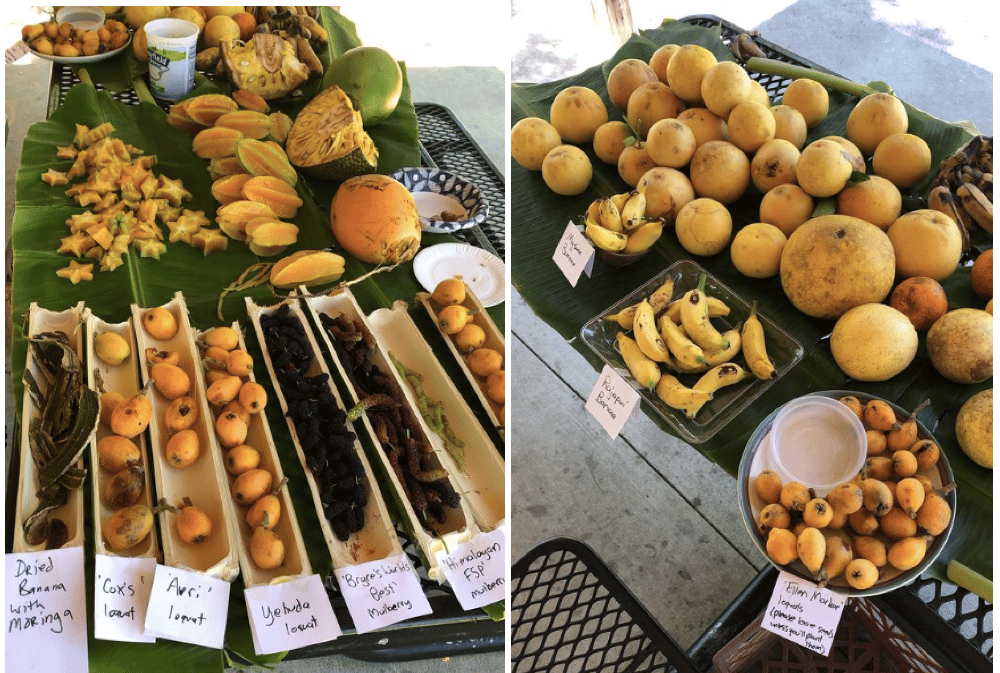
I’m really interested in fruit, especially ones I’ve never tried, and I’ve loved following Florida Fruit Geek, aka Craig Hepworth, on Instagram, where he posts photos and info about the unusual fruits he grows (in Gainesville). Hepworth recently hosted a “fruitluck,” where gatherers shared…
…half a dozen varieties of loquat, four kinds of mulberry, carambola/starfruit, sweet oranges, Seville oranges, grapefruit, jackfruit, guava, grapes, apples, sweet tamarind, dried jujube, strawberries, blueberries, Mysore bananas, Rajapuri bananas, Cavendish bananas, green coconuts, homegrown pineapple, dried carambola, tangerine, dried sweet cherries, pomelo and more.
I’d love to have a fruitluck! Maybe I need to make a trip to Florida.
The concept of roasting as a general vegetable technique seems to have originated in a famous Italian restaurant: Johanne Killeen and George Germon’s Al Forno, which opened in Providence, Rhode Island, in 1980. Forno means oven in Italian, and the critically acclaimed chefs made ample use of that apparatus.
This is a fact, which makes me feel old because I lived through it and makes me feel young because I lived through it. Old because I can remember a time before roasting vegetables was how anyone who is anyone prepared them, and young because what other cooking techniques are we going to invent during my lifetime? It’s a little like watching cities develop. For example, I used to work down in Fort Point in Boston and there were a ton of parking lots and then the guy who owned the parking lots sold them, bought the Los Angeles Baseball Dodgers and those parking lots have become a huge and glitzy neighborhood (?) with condos and offices and commerce
As another aside, there’s a 1993 NYT article quoted in the Slate piece and I’m quoting the first three sentences here for reasons I will expound upon afterward.
Roasting wafts through the senses. In culinary terms it is freighted with mouthwatering aroma, comforting warmth, a crisping sizzle and anticipated succulence. And lately it is more appreciated than ever.
Anyway, the use of “freighted” just reminded me of the Emily Dickinson quotation, “The freight should be proportioned to the groove” from the poem That Love is all there is. It’s a delightful poem and you can read it in about 3 seconds and think about it for the rest of your life.
A couple of years ago, frustrated by a takeout Italian sandwich with unevenly distributed fillings, I had a wonderful, life-changing idea: chopped sandwiches. It’s like what you get at those chopped salad places but instead of chopping up all the ingredients and putting them into a bowl, you put them between two slices of bread or in a hoagie roll or whatever. That way, you get all of the elements of the sandwich — cheese, tomato, lettuce, dressing/mayo, onion, whatever — in every single bite. Yum.
Chopwiches already exist — tuna salad, Philly cheesesteaks, chicken salad, egg salad — and they’re amazing because you get all of their deliciousness in every bite. I just wanted to extend that enjoyment to many other types of sandwich: banh mi, BLT, Italian sub, gyro, turkey club, and even the humble ham and cheese. Great idea, right? I wanted to open a chopped sandwich restaurant and change the world.
Then I made a mistake: I told people about my idea. And every single one of them laughed at me. To my face! My friends, my kids, everyone. It was a heartbreaking moment but as an entrepreneur, I knew I had to persist and follow my dream. Like Wayne Gretzky said: “First they ignore you, then they laugh at you, then they fight you, then you win.” And I was going to win.
But the whole thing became a joke for awhile and I had to play along, biding my time. My friend Caroline came up with a name: Choppke’s. We brainstormed slogans and things the sandwich artists could say to patrons:
Choppke’s. You’ll Love It to Bits.
Welcome to Choppke’s, your wich is my command.
As you wich. [In response to any customer query.]
Welcome to Choppke’s! What can I get chopping for you today?
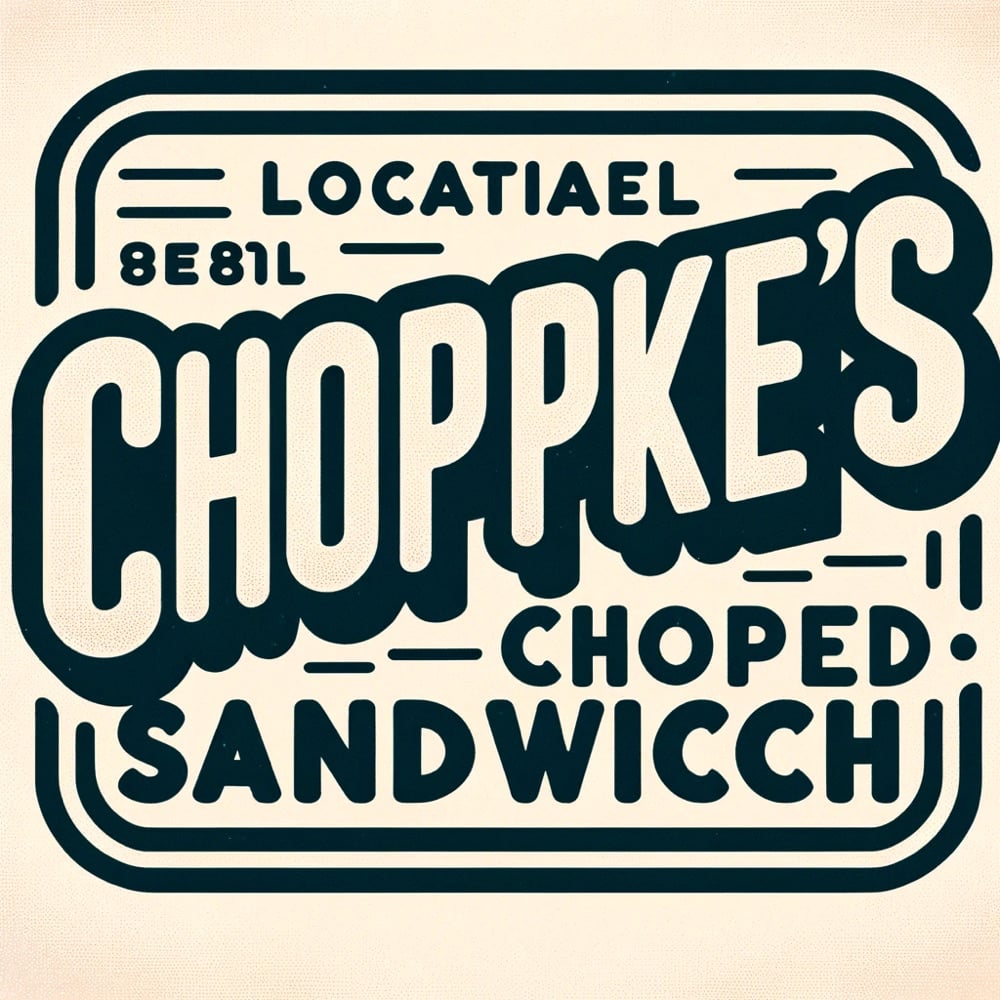
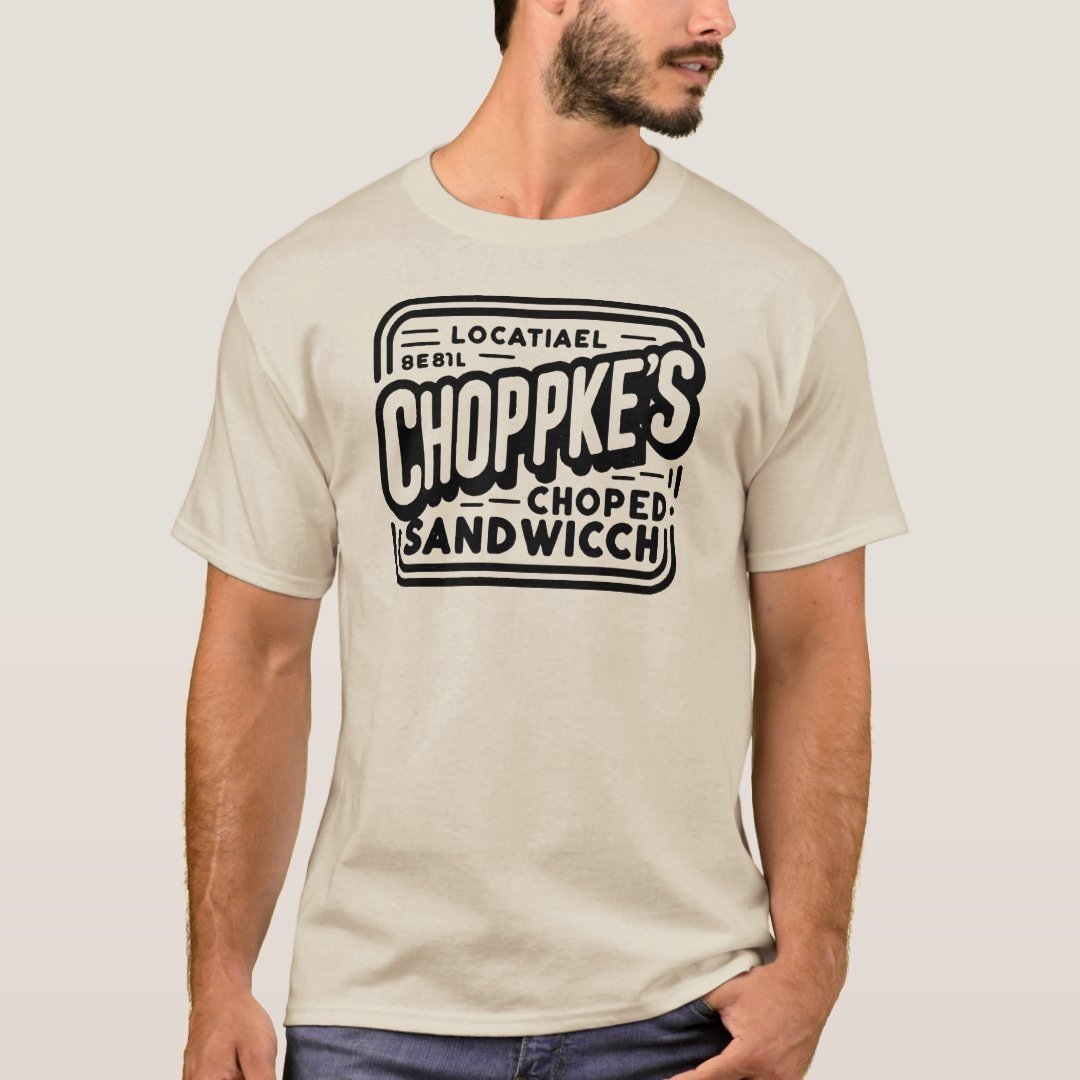
I asked ChatGPT to come up with a logo; this was my favorite one:
When (not if!) Choppke’s gets huge, there’s gonna be a corporate jet, so I wanted to see what that was going to look like:
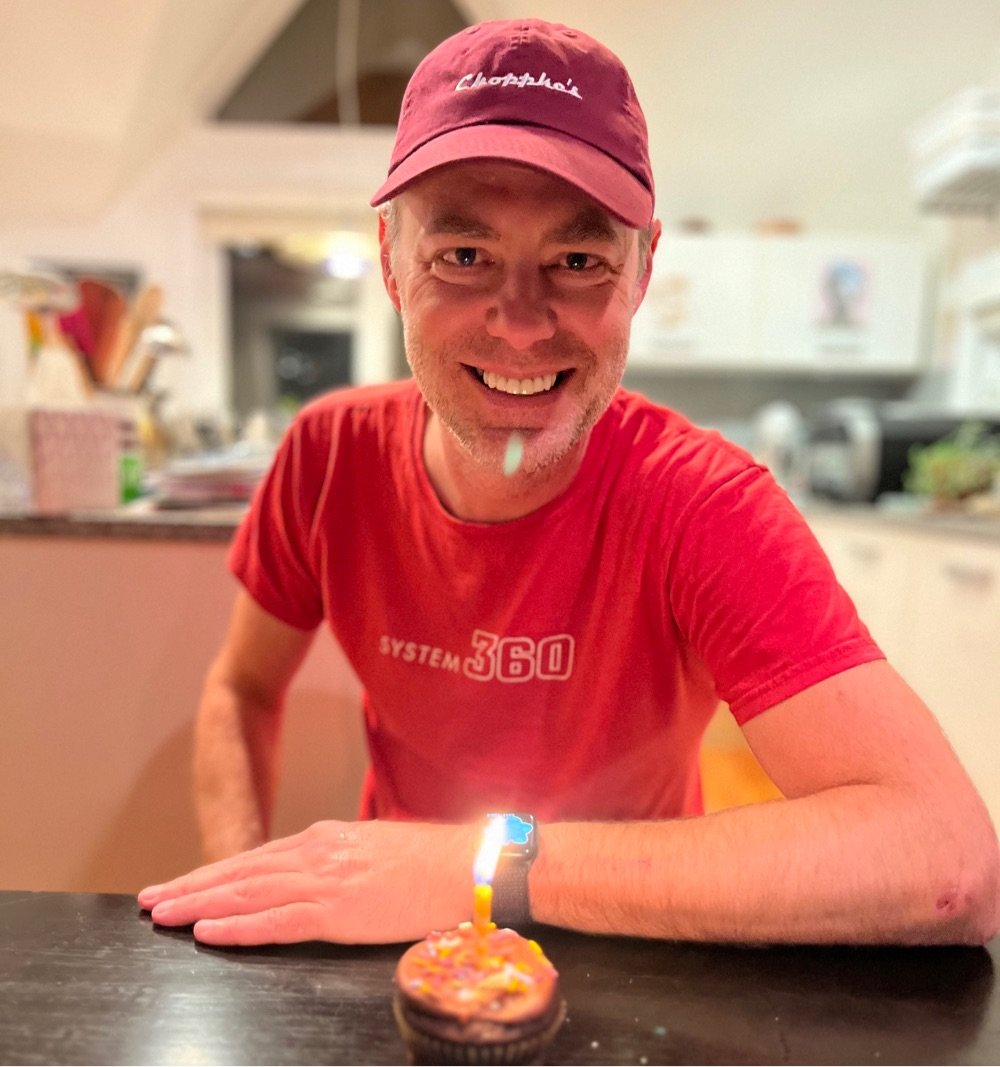
Caroline got me a custom-made hat for my birthday (actual hat and actual dopey human wearing it, not AI-generated):
Ever so slowly, I was winning her over, despite every fiber of her being telling her that a chopped sandwich restaurant was the stupidest idea she’d ever heard and causing her to question the entire basis of our relationship. And if I could get one person on my side, a person who thought I was an idiot, the rest of the world would surely follow. Ideas + persistence = manifesting your reality.
I think it was the legendary management guru Michael Scott (quoting IBM founder Steve Jobs) who said “skate to where the puck is going to be, not where it has been”. Well, my long chopped sandwich skate has finally paid off — the puck is here! According to The Takeout, the chopped sandwich is all the rage on TikTok!
If you enjoy a good chopped salad, the kind where every component (veggies, cheese, protein) is chopped into uniformly forkable bites and then tossed in dressing, you’re halfway to a chopped salad sandwich, sometimes just referred to as a chopped sandwich. It’s simply any version of that same salad, just stuffed into a hinge-cut roll. The shape of the roll is crucial, as it prevents all the fillings from falling out the sides.
Yes, exactly. Wow. I’ve never felt so seen. What’s that smell? No, not a delicious chopped sandwich…it’s the sweet smell of V-I-N-D-I-C-A-T-I-O-N.
Nearly any filling is a candidate for a chopped salad sandwich, and that’s the part that appeals most to TikTok users. Beyond the go-to Italian sub, you can create chopped salad sandwiches that contain Vietnamese banh mi ingredients, wedge salads, Caesar salads, whatever your heart desires. And that versatility means it’s a goldmine for social media content.
A goldmine! You’re goddamn right it’s a goldmine! The time is right, the market is PRIMED, Gen Z is on board, it’s now or never. We’re gonna do it, Choppke’s is a go!
Now, just to properly calibrate expectations, I haven’t looked at any commercial real estate nor have I made a single chopped sandwich of any kind at home to test out whether they actually taste better or not because I just know they will. What I do have is the idea (which is amazing, as we’ve agreed), a janky misspelled AI logo, and a dream.
Right now, you’re probably wondering how you can help, how you can climb aboard this rocket ship, how you can secure a place in a better future for us all. Well, I’m happy to announce that you can join the movement for better, tastier sandwiches today by zhuzhing yourself up with an exclusive Choppke’s t-shirt!
All proceeds from shirt sales will be pumped into developing the Choppke’s franchise (or, if that doesn’t work out, buying myself sandwiches from the local deli). Thanks for the support everyone — even though I could have done it without you, I definitely couldn’t have done it without you.
I thought for sure that I’d previously written about the secret jelly packet & pickle-based system that chefs at the Waffle House use to “store” all of the orders that come in for food during service, but I can’t find it in the archive. But no matter — the Waffle House training video above runs us through their whole system, including a detailed explanation of their Magic Marker System, which involves zero actual Magic Markers and instead is about arranging condiment packets and other items on plates in a code:
Now let’s talk about our breakfast sandwiches. Just like omelettes, these sandwiches have the same four positions: ham, sausage, bacon, and plain. To mark a sandwich, place two pickle slices in the appropriate position. Here you can see I put two pickle slices in the number three position, which tells me this is a bacon sandwich. If I add a slice of cheese to the plate, I know this is a bacon cheese sandwich. To make this a bacon, egg, and cheese sandwich, I’ll add this right side up mayo packet to the right side of the plate.
Don’t let this mayo pack confuse you - as long as you see two pickles on the plate you know this is a sandwich. When marking a sandwich, this mayo packet and pickles means a sandwich with eggs. If a customer wanted the eggs on their sandwich to be scrambled instead of the standard over well egg, I’d move this mayo pack down to the bottom of the plate to show that the egg is scrambled.
That sounds pretty complicated and they’ve likely faced pressure to change the system over the years, but I bet it works really well in practice and cuts down on errors. I love stuff like this…seeing how different organizations manage their core processes, especially in non-conventional ways. See also Nightclub Hand Signals and The Quarryman’s Symphony. (thx, erik)
I don’t know exactly what this is, but it appears to be an ad for Lay’s potato chips made by Jimmy Kimmel Live? But whatever, it’s great: a Groundhog Day-inspired clip starring Ned Ryerson (Stephen Tobolowsky) himself that’s perfect for hawking a bajillion different flavors of potato chips. (via @ironicsans)
In this video, a pair of YouTubers from Mongolia show us a glimpse of the nomadic lifestyle in their country as they gather ice from the river to make their hearty breakfast, a hot milk tea combined with meat, flatbread, and clotted cream.
If the vibe of this commercial for the Coca-Cola Company seems familiar, perhaps it’s because Christopher Storer directed it — Storer is the creator of The Bear and wrote & directed Fishes, the intense season two Christmas episode. No homemade Sprite in this video though…they got to use the real stuff! (via matt)
This is completely impractical for the home cook but I kinda want to try it anyway? The final step of frying the lasagna core sample in butter and serving it topped with a bunch of pecorino is some next-level deliciousness.
The other day I posted a quick note of appreciation for my trusty rice cooker. I have what you might call a fancy rice cooker — it has all sorts of different settings and “advanced Neuro Fuzzy logic technology” — and it cooks my rice perfectly, every time. I am sure it is an engineering marvel.
But this $20 one-button rice cooker also cooks rice perfectly, every time. And it does so using some very simple and clever engineering involving magnets:
This button thing is made of an alloy that has a Curie temperature just a bit higher than the boiling point of water. This allows it to function as a temperature-dependent kill switch. Thanks to the outer spring, it’s always held firmly in contact with the bottom of the pot, which ensures it and the pot are at nearly equal temperatures. So long as there’s liquid water sitting in that pot, the pot itself cannot get hotter than water’s boiling point.
This means that the button remains magnetic, and the magnet is able to overcome the force of the inner spring, so the device stays in cook mode. But, once the rice has absorbed all of the water (and/or once all the remaining water has boiled away) the energy being added to the pot by the heating element is no longer being absorbed as latent heat.
Now, the pot can quickly start to exceed the boiling point of water. And once it gets past the Curie point of that little sensing button, the magnet is no longer attracted to it, so the spring overcomes the magnet and… *click* the rice cooker switches back to the warming mode.
Vice News visited the Mountain View Correctional Facility in Maine, where incarcerated people eat food that they’ve grown and cooked themselves, augmented by other locally grown and raised food (beef, chicken, etc).
Mark McBride is the culinary director at Mountain View Correctional Facility, a 350-person prison where inmates don’t eat processed chicken fingers and sloppy joes.
“When I started 6 years ago, the majority of the food was processed foods, and I wanted to try to see if we couldn’t replicate more homestyle cooking - scratch cooking - using raw local ingredients. But the truth is, by taking these raw products from farmers and putting the work into breaking this down, we’re actually able to save money. In 2018, our two kitchens saved $142,000 off of their budget.
It’s heartening to see an American prison that takes seriously the well-being and rehabilitation of the people in its care. (via neatorama)
In a video for Bon Appétit, the judges from the Great British Bake Off weigh in on a host of American snacks, from the Snickers bar to Thin Mints to Ruffles potato chips to Combos. I’ll excuse them for eliminating my favorite Reese’s Peanut Butter Cups in the first round (even though their holiday-themed eggs, trees, and pumpkins are better) because their finalists were correct. Some of their reactions:
As the bulk of 2023 recedes from memory, I wanted to share some of the things from my media diet posts that stood out for me last year. Enjoy.
Succession. I did not think I would enjoy a show about extremely wealthy people acting poorly, but the writing and acting were so fantastic that I could not resist.
25 years of kottke.org. Very proud of what I’ve accomplished here and also genuinely humbled by how many people have made this little site a part of their lives.
Antidepressants + therapy. I was in a bad way last spring and it is not too strong to say that finding the right antidepressant and arriving at some personal truths in therapy changed my life.
The Bear (season two). I don’t always love it (especially when the intensity ramps up) but there’s definitely something special about this show.
Crossword puzzles. A few times a week, a friend and I do the NY Times crossword puzzle together over FaceTime. It’s become one of my favorite things.
AirPods Pro (2nd generation). Am I ever going to shut up about these? Possibly not. The sound quality is better than the first-gen ones and the sound cancelling is just fantastic. I used these on several long flights recently and you basically can’t hear much of anything but your music.
The Kottke Hypertext Tee. Might be bad form to put your own merch on a list like this, but I’m just tickled that these exist. Putting an actual physical good out into the world that people connect with is somehow satisfying in a way that digital media is not.
ChatGPT. This very quickly became an indispensable part of my work process.
Downhill mountain biking. I did this a couple years ago and it didn’t click for me. But my son and I went last summer and I loved it…it’s one my favorite things I did all year. Gonna try and get out more in 2024!
Once Upon a Time in Northern Ireland. Probably the best TV thing I watched last year. Listening to survivors of The Troubles talking about their experiences was unbelievably compelling.
Au Kouign-Amann. One of my all-time favorite pastries. Looks like a boring cake, tastes like magic.
Democracy Awakening: Notes on the State of America by Heather Cox Richardson. An extremely clear-eyed explanation of how Trumpism fits in with the Republicans’ decades-long project of weakening American democracy.
The Creator. I liked this original sci-fi a lot — more stuff that’s not Star Wars and Marvel pls.
BLTs. I could not get enough of this simple sandwich at the end of last summer — I was eating like 4-5 a week. When the tomatoes are good, there’s nothing like a BLT.
The little hearts my daughter put on the backs of the envelopes containing her letters from camp. Self explanatory, no notes.
Over the past few months, I’ve had some time away from the computer and have taken several very long plane trips and some shorter car rides, which means a bit more reading, TV & movie watching, and podcast listening than usual. Oh, and holiday movies.
Anyway, here’s my recent media diet — a roundup of what I’ve been reading, watching, listening to, and experiencing over the past few months.
The Killer. The excellent Michael Fassbender portrays a solitary, bored, and comfortable killer for hire who has a bit of a midlife crisis in fast forward when a job goes wrong. (A-)
Fortnite OG. I started playing Fortnite in earnest during Chapter 3, so it was fun to go back to Chapter 1 to see how the game worked back then. (B+)
Edge of Tomorrow. Speaking of video games… Still love this under-appreciated film, despite a third act that falls a tiny bit flat. (A)
The Vaster Wilds by Lauren Groff. I did not enjoy this quite as much as Matrix — especially the last third — but Groff is one hell of a writer. (B+)
New Blue Sun. Good on André 3000 for not doing the expected thing and instead releasing an instrumental album on which he plays the flute. (A-)
Songs of Silence. I can’t remember who clued me into this lovely instrumental album by Vince Clarke (Erasure, Depeche Mode), but it’s been heavily in the rotation lately. (B+)
Trifecta. A.L.I.S.O.N.’s Deep Space Archives is a favorite chill work album for me and this one is nearly as good. (B+)
Shoulda Been Dead. I had no idea that Kevin Kelly appeared on an early episode of This American Life until someone mentioned it offhand on our Thailand walk. What a story…listen all the way to the end. (A)
Train Dreams by Denis Johnson. Oh the writing here is exquisite. (A)
The Mountain in the Sea by Ray Nayler. Are AGI robots intelligent? Are octopuses? Are humans? This novel plays entertainingly with these ideas. (A-)
Myeongdong Kyoja. I stumbled upon this place, extremely cold and hungry, and after a brief wait in line, I was conducted to an open seat by the no-nonsense hostess running the dining room. The menu only has four items, conveniently pictured on the wall — I got the kalguksu and mandu. The hostess took my order and then, glancing at my frozen hands, reached down and briefly gave one of them a squeeze, accompanied by a concerned look that lasted barely half a second before she returned to bustling around the room. A delicious meal and a welcome moment of humanity in an unfamiliar land. (A)
Barbie. Second viewing. Entertaining and funny, but this is a movie that has Something To Say and I still can’t figure out what that is. (B+)
Emily the Criminal. There were a few hiccups here and there, but I largely enjoyed this Aubrey Plaza vehicle. (A-)
Midnight in Paris. Not going to recommend a Woody Allen movie these days, but this is one of my comfort movies — I watch it every few months and love every second of it. (A)
Gran Turismo. Extremely predictable; they could have done more with this. (B)
The Rey/Ren Star Wars trilogy. I have lost any ability to determine if any of these movies are actually good — I just like them. 🤷♂️ (B+)
Loki (season two). This was kind of all over the place for me but finished pretty strong. Glorious purpose indeed. (B)
Home Alone. First time rewatching this in at least a decade? This movie would have worked just as well if Kevin were 15% less annoying. (B+)
The Grinch. My original review stands: “I wasn’t expecting to sympathize so much with The Grinch here. The social safety net constructed by the upper middle class Whos totally failed the most vulnerable member of their society in a particularly heartless way. Those Whos kinda had it coming.” (B+)
Past installments of my media diet are available here. What good things have you watched, read, or listened to lately?
At the beginning of the ninth episode of his 13-part series Cosmos: A Personal Voyage, Carl Sagan says:
If you wish to make an apple pie from scratch, you must first invent the universe.
Taking a page from Sagan’s book, Zack Scholl made a site called Recursive Recipes, which allows you to drill down into the ingredients of some common foods, replacing them with other recipes.
A recursive recipe is one where ingredients in the recipe can be replaced by another recipe. The more ingredients you replace, the more that the recipe is made truly from scratch.
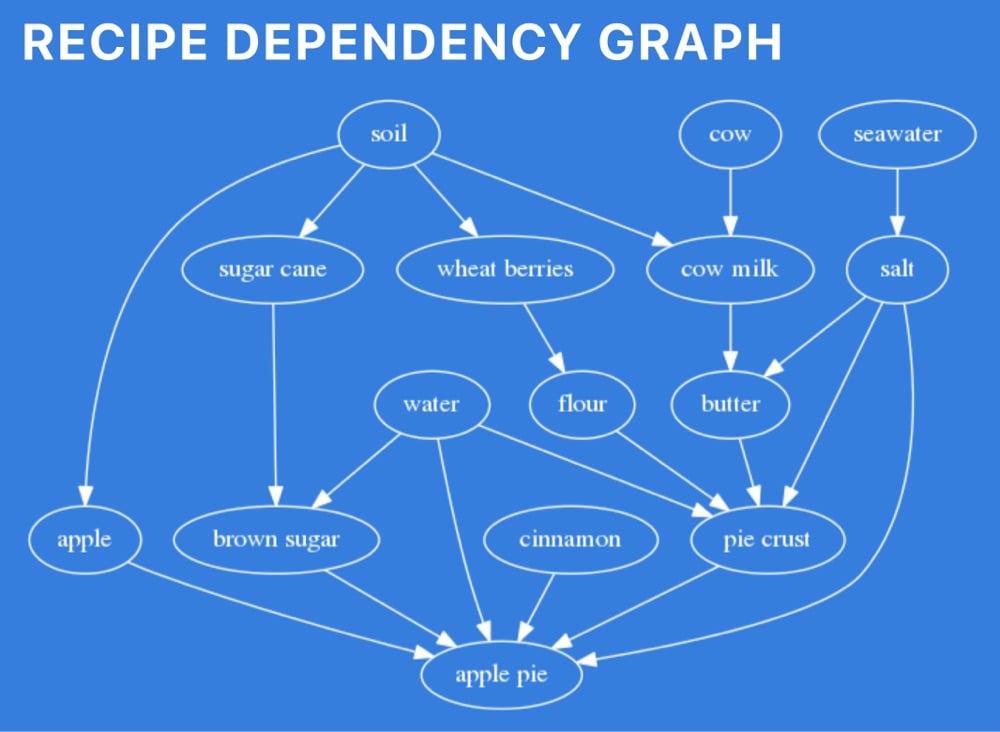
Here’s what the apple pie recipe looks like when you make everything you can from scratch:
You don’t quite begin at the Big Bang, but if you start with soil, a cow, and some seawater, it’s still going to take you almost 8 years to make that pie. The wheat needed for the flour, for instance:
Plant winter wheat in fall to allow for six to eight weeks of growth before the soil freezes. This allows time for good root development. If the wheat is planted too early, it may smother itself the following spring and it could be vulnerable to some late-summer insects that won’t be an issue in the cooler fall weather. If winter wheat is planted too late, it will not overwinter well.
Thwaites reverse engineered a seven dollar toaster into 400 separate parts and then set about recreating steel from iron ore rocks, plastic from microwaved potatoes and copper from homemade bromide mush.
I know I always say this, but I didn’t mean for so much time to elapse since the last installment of the media diet. But I have a slightly different reason for the delay this time: I have been really busy with work and family stuff, so much so that I haven’t been reading or watching as much as I usually do. So I needed to wait a couple of months to collect enough stuff.
Anyway. Here’s my recent media diet, a roundup of what I’ve been reading, watching, listening to, and experiencing over the past few months. ✌️
The Creator. Original, engaging sci-fi with good action, heart, and something to say. Madeleine Yuna Voyles is the best child actor I’ve seen in years. (A)
Democracy Awakening: Notes on the State of America by Heather Cox Richardson. I’m still making my way through this one but I’m going to review it now because Virginia Heffernan was absolutely correct in saying that the first part of the book is “the most lucid just-so story for Trump’s rise I’ve ever heard”. Richardson ties so many things together so succinctly that by the end of it, Trump feels not like an abberation but more like the result of a plan that conservatives have been striving towards for decades. (A+)
Mission: Impossible – Dead Reckoning Part One. Watched this twice: once in the theater and once at home. I didn’t like this quite as much as Fallout (or Top Gun: Maverick tbh), but this is a top-notch action movie. The tiny car chase on the streets of Rome is 💯. (A-)
The ocean. Still undefeated. (A+)
Harry Potter and the Half-Blood Prince and Harry Potter and the Deathly Hallows Parts 1 & 2. *sigh* Like many of you, I am extremely disappointed with the weird & harmful anti-trans crusade the author of the Harry Potter book series has embarked on over the last few years and it’s prompted me to attempt a reevaluation of my relationship to these movies and books. But I’ve had some difficulty doing so because the Potter wizarding world is so wrapped up in spending quality time with my kids (particularly after their mom and I separated) that it’s hard to have anything but extremely fond feelings for it all. Over a period of five or so years, we read the whole series together at bedtime and I can’t even put into words how meaningful that time together was. We’re listening to the series on audiobook in the car right now…it’s one of the few things my two teens and I really enjoy doing with one another.
Anyway, all that is to say that when some recent changes in our schedule together — good, developmentally appropriate changes for them but changes nonetheless — caused some parental melancholy, I watched these three films on back-to-back-to-back nights just to feel close to my kids in some way. It was just the thing. (A)
American Prometheus by Kai Bird and Martin J. Sherwin. Perhaps not the beach read I needed, but the one I deserved. I liked this maybe a bit better than the movie, but still not nearly as much as Richard Rhodes’ The Making of the Atomic Bomb (and its sequel, Dark Sun). (A-)
Once Upon a Time in Northern Ireland. This was excellent. Listening to actual people who lived and worked in Northern Ireland during the Troubles — victims, murderers, police officers, bystanders, family members of those who were killed — was completely enthralling and brought the 30-year conflict to life in a way that Patrick Radden Keefe’s Say Nothing couldn’t, as good as it was. I’ve been thinking about this series a lot over the past few weeks as the latest tragedy unfolds in Gaza. (A+)
The Repair. Another excellent podcast series from Scene on Radio, this one on climate crisis. I’ve read quite a bit about the climate over the past decade or two, so I thought I knew what to expect going in, but this takes a pretty unique angle. For one thing, they don’t start with the Industrial Revolution…their lead-in to the topic is the Book of Genesis. And it keeps going in unexpected directions from there. I think even a seasoned observer of the crisis will find something interesting here. (A)
The Belan Deck by Matt Bucher. Maybe a better choice of beach read than American Prometheus…I finished this slim, creative tome in one sitting on my final day at the ocean. Here’s a better review than this one. (B+)
The mashed potato pizza from Bar. I’d tried this once before and found it kinda meh. But not this time around…I couldn’t stop eating it. (A)
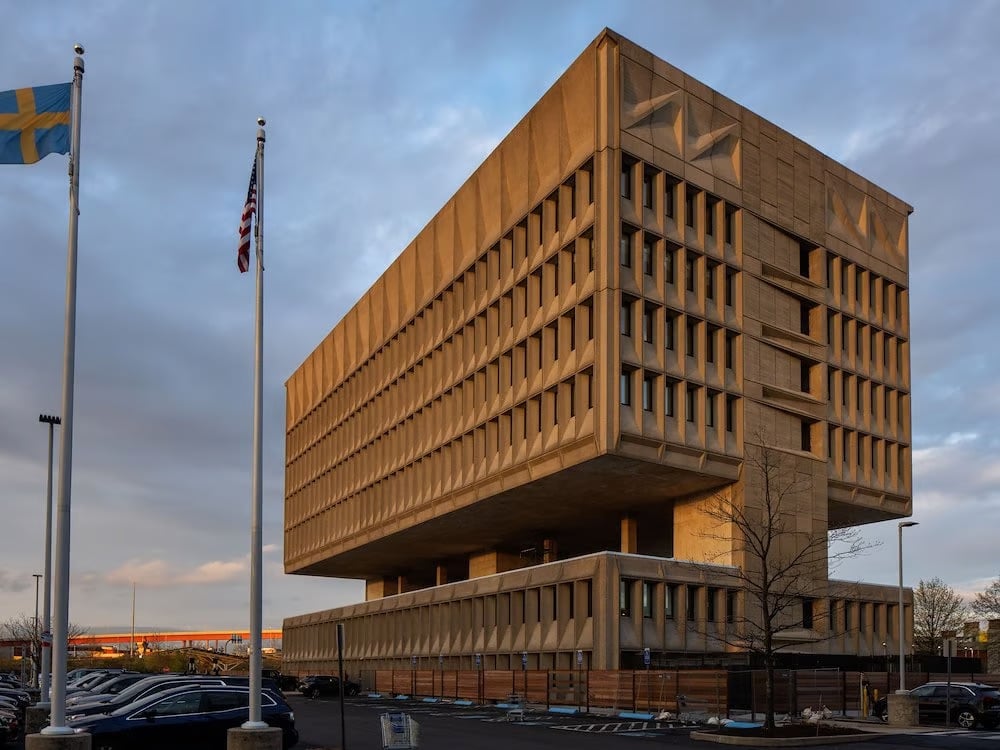
Hotel Marcel. If you’ve ever driven on I-95 through New Haven, you’ve probably noticed the brutalist building unceremoniously situated in the Ikea parking lot. Designed by Marcel Breuer, the former Armstrong Rubber Company Building was placed on the National Register of Historic Places in 2021 and converted to the Hotel Marcel a year later. Pretty cool to be able to stay in such a well-designed building. (B+)
The Super Mario Bros. Movie. This was perfectly fine. But it had that tightly controlled and over-engineered feeling that many franchise movies have these days. (B)
Arrival. Still an absolute banger and one of my all-time faves. And I notice a little something new every time I watch it. (A+)
The Flash. Better than I expected! And I bought the Quick Bite emote in Fortnite. Can we staaaahpp with the multiverse tho? (B+)
Ahsoka (season one). Hmm. This was slow, enjoyable, boring, engaging — sometimes all at once. Space whales tho? (B)
The Wonderful Story of Henry Sugar. This is Wes Anderson, unplugged: simple sets, lots of acting, spare-but-precise cinematography, and a meta narrative. (A-)
Boundaries, Burnout and the ‘Goopification’ of Self-Care. For the Ezra Klein Show, guest host Tressie McMillan Cottom (one of America’s leading public intellectuals) interviewed Pooja Lakshmin about what she calls Real Self-Care. Not yoga and juice cleanses but more like setting boundaries and practicing self-compassion. An excellent listen. (A-)
Wool by Hugh Howey. After really enjoying the Apple TV+ series, I was looking forward to dipping into the first book of the trilogy. But I preferred the show…and was also surprised when the book, well before the end, continued on past the events of the show. I stopped reading at that point and will revisit after the show’s second season. (B)
Killers of the Flower Moon. I wanted to like this more than I did. Great acting (particularly by De Niro, Gladstone, and Plemons) and it looked amazing but it lacked oomph. Plus I didn’t have a clear sense of what Scorsese was trying to say… (B+)
Batman Begins, The Dark Knight, The Dark Knight Rises. I watched these with my son (a budding Nolan fan) and I know this is sacrilege, but my favorite of the series is The Dark Knight Rises. Heath Ledger’s performance though… 🤡🔥. (A-)
I also have a bunch of stuff in progress, including The Vaster Wilds (good so far, need to make more time for it), the new season of The Great British Bake Off (my fave got eliminated in the first episode 😢), and Loki (skeptical this can match the style & weirdness of the first season). I stalled out on season three of The Great but I’m going to go back to it. I’m two episodes into Reservation Dogs (after many recommended it) and I love it already. And I haven’t even started Emily Wilson’s translation of The Iliad!
How about you? What have you been into lately? Anything you would particularly recommend? Let us know in the comments! (Just don’t argue with my grades…we all already know they don’t make any damn sense!)
In this SNL sketch featuring host Nate Bargatze as George Washington, the commander of the Continental Army gives a rousing speech to a group of his soldiers about…measurement systems. So good.
Also good from the same episode: a soul food cooking competition:
This is great and I loved it to bits: a 15-minute video from the Life Where I’m From YouTube channel about a tiny izakaya (13 seats!) in Tokyo owned and operated by a woman called “Mama” by her regulars.
When Mama is busy, regulars at this izakaya will serve themselves, get their own beers, get their “bottle-keep” and make their own drinks. They’ll also help out Mama-san by serving other customers as well. […] Bottle keep is when a customer buys a bottle and the shop holds on to it for them. Then the next time they visit they can drink from that bottle again.
I’ve got lots of thoughts about this and connections to make! The izakaya’s casual help-yourself atmosphere reminded me of a post I made here more than 20 years ago called Business Lessons From the Donut and Coffee Guy.
“Next!” said the coffee & donut man (who I’ll refer to as “Ralph”) from his tiny silver shop-on-wheels, one of many that dot Manhattan on weekday mornings. I stepped up to the window, ordered a glazed donut (75 cents), and when he handed it to me, I handed a dollar bill back through the window. Ralph motioned to the pile of change scattered on the counter and hurried on to the next customer, yelling “Next!” over my shoulder. I put the bill down and grabbed a quarter from the pile.
I get my occasional donut in another part of town now, but I noticed something similar with my new guy. Last Friday, the woman in front of me didn’t order anything but threw down a $20, received a coffee with two sugars a moment after she’d stepped to the window, and no change. As they chatted, I learned that the woman pays for her coffee in advance. The coffee guy asked her if she was sure she owed today. “Yep,” she replied, “It’s payday today; I get paid, you get paid.” Handy little arrangement.
Get to know your customers and trust them — it’s a simple thing that even some small businesses never master.
If this place was on my commute home, I would definitely be a regular — it seems more like someone’s living room than a bar. But there are definitely spots with similar vibes in all sorts of places in the world. Last year, I went to a restaurant in Philadelphia called Her Place that also felt like this. From my sabbatical media diet:
A unique dining experience that’s not unlike going over to someone’s house for a dinner party. There are two seatings a night, at 6:00 and 8:30; all parties are seated at the same time. It’s a set menu with no substitutions and everyone in the restaurant is served at the same time. Every course or two, the chef quiets the diners to explain what’s coming up, who cooked it, where the ingredients are from, and anything else she thinks is relevant. It’s operationally smart and creates a great dining environment. Esquire just named it one of the best new restaurants in America.
Great meal and experience. I felt like a regular even though I’d never been there before. Speaking of, I wrote about being a regular back in 2013:
This is a totally minor thing but I love it: more than once, I’ve come in early in the evening, had a drink, left without paying to go run an errand or meet someone somewhere else, and then come back later for another drink or dinner and then settle my bill. It’s like having a house account without the house account.
I really miss that place — I moved away several years ago now but went back to visit as often as I could. But Covid (and an asshole landlord) killed it.
While I waited for my food, I noticed an order of köfte going out of the kitchen…to a diner at the restaurant across the street. When he was finished, the staff at that place bussed the dishes back across the way. Meanwhile, my meal arrived and the köfte were flavorful and tender and juicy, exactly what I wanted…no wonder the place across the street had outsourced their meatballs to this place. I’d noticed the owner, the waiter, and the cook drinking tea, so after I finished, I asked if I could get a tea. The owner nodded and started yelling to a guy at the tea place two doors down. A few minutes later, a man bearing a tray with four glasses of tea arrived, dropping one at my table and the other three for the staff. Just then, a server from the place across the street came over to break a 100 lira bill. Me being a big nerd, this all reminds me of Unix and the internet, all of these small pieces loosely joined together to create a well-functioning and joyous experience. There’s only one thing on the menu at Meşhur Filibe Köftecisi, but you can get anything else within yelling distance. I declined dessert…who knows where that would have come from.
(via andy, who correctly guessed this was up my alley)
In this ASMR stop motion cooking video, a chef butchers a huge Lego salmon and prepares a salmon and rice bowl. This video is surprisingly visceral, what with the sound effects and the (Lego) blood.
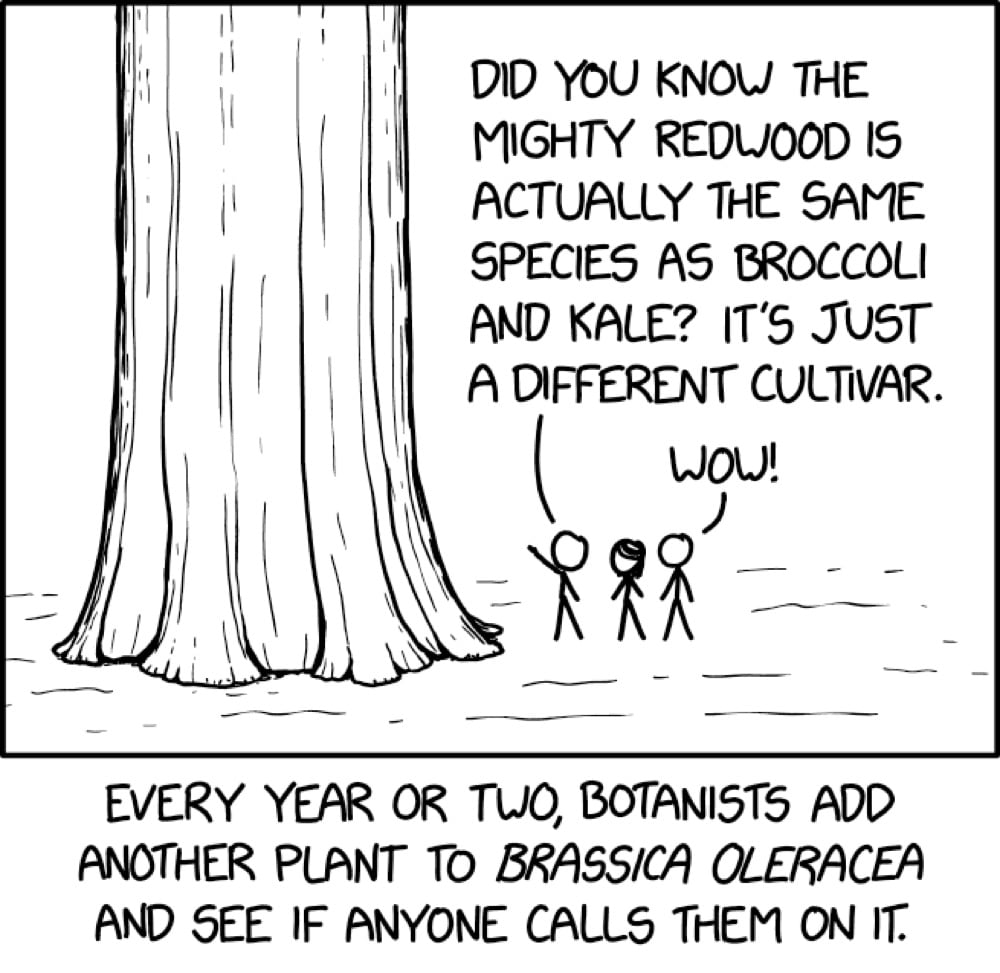
Brassica oleracea is a species of plant that, like the apple, has a number of different cultivars. But these cultivars differ widely from each other: cabbage, kale, broccoli, brussels sprouts, kohlrabi, collard greens, and cauliflower.
A McDonald’s restaurant apparently appears in season two of Loki on Disney+ and to mark the occasion, the fast food giant made a commercial featuring a number of other appearances by the brand in movies and TV, including The Office, The Fifth Element, Coming to America (“They’re McDonald’s. I’m McDowell’s.”), and Seinfeld. (Perhaps the most famous McDonald’s reference in cinema history, Jules’ Royale with Cheese bit in Pulp Fiction, is conspicuously missing.)
The ad was created to introduce their As Featured In Meal promotion, which seems to consist of 1100-calorie meals from their usual menu paired with a packet of Sweet ‘N Sour Sauce with the Loki logo on it. I thought the commercial was fun and clever but that promotion is a bit Sad Meal.
Jan Hakon Erichsen does weird things with dried pasta, mostly spaghetti but also lasagna. This is goofy and fun. Check out his Instagram and YouTube for more artistic hijinks. (thx, clarke)
Hey folks. I’m trying to get into the habit of doing these media diet posts more frequently than every six months so they’re actually, you know, somewhat relevant. Here’s what I’ve been watching, reading, listening to, and experiencing over the last two months.
Deep Space Archives. Been listening to this album by A.L.I.S.O.N on heavy rotation while working recently. (A-)
Parable of the Sower by Octavia Butler. Bleak and powerful, science fiction at its finest. (A)
Asteroid City. I liked Wes Anderson’s latest effort quite a bit. Not quite as much as The French Dispatch but more than many other folks. (A-)
Dunkirk. Rewatched for the 5th time. For my money, this is Nolan’s best movie. (A+)
Beef. I wanted to like this but I only lasted two episodes. Not for me, YMMV. (C)
Antidepressants. It took a bit to home in on the right one, but even my relatively low dose has helped me out of a particularly low point over the last few months. (A)
The Diplomat (season one). Burned through this one in just a few days — an entertaining political thriller that doesn’t take itself too seriously. (B+)
Ooni Volt 12. Ooni was kind enough to send me this electric pizza oven to test out, so take this with a grain of salt, but I’ve been having a lot of fun making no-fuss pizza. Need to work on my dough game tho. (A-)
Silo. This hooked me right away and didn’t let go, although it got a little bit ridiculous in places. I’m eager to see where things go in season two. (B+)
Interstellar. Watched this with the kids and we all enjoyed it. The musical score does a lot of heavy lifting in all of Nolan’s films but in this one especially. (A-)
The Age of Pleasure. My only complaint about this album from Janelle Monáe is that it’s too short. (A-)
Barr Hill Gin & Tonic. The best canned cocktail I’ve had. And it’s turned me into a G&T fan. (A)
VanMoof S3. *sigh* Figures that I finally pull the trigger on getting an e-bike and the company that produces it files for bankruptcy. No matter: this thing is fun as hell and has flattened all the hills out around here. (A)
Átta. You always know what you’re going to get with Sigur Rós: atmospheric, ambient, abundant crescendos, ethereal vocals. (B+)
Air. Ben Affleck has a bit of a mixed record as a director, but this Air Jordan origin story is really solid and entertaining. Viola Davis is great as Michael Jordan’s mother Deloris. (A-)
The Bear (season two). There are aspects of The Bear that I don’t like (the intensity seems forced sometimes, almost cheesy) but the highs are pretty high. Forks was a fantastic episode. More Sydney and Ayo Edebiri in season three please. (A-)
Indiana Jones and the Dial of Destiny. Solid Indy adventure and I love Phoebe Waller-Bridge as the sidekick/partner. I know some folks didn’t like the climax but seeing Jones get what he’s always wanted was satisfying. (B+)
Rebranding beloved brands. Max? X? No. So dumb. (F)
65. Oh dear. Adam Driver needs to choose his projects more wisely. Interesting premise but the rest was pretty lifeless. (C+)
Pizzeria Ida. The pizza is expensive (esp for Vermont), the ingredients top-notch, and the service rude (if you believe the reviews). We had a great time and this is probably the best pizza you can get in VT; it wouldn’t be out of place in NYC. (A)
Oppenheimer. Epic. Almost overwhelming at times. Don’t see this on anything but a big screen if you can help it. Perhaps not Nolan’s best but it still packs a wallop. (A-)
Barbie. I enjoyed this very much but found it uneven in spots. And no more Will Ferrell please. But it was great seeing people dressed up for the occasion — Barbenheimer felt like the first time since before the pandemic that you could feel the buzz in the audience, an excitement for what we were about to experience together. (B+)
Currently I’m reading American Prometheus (on which Oppenheimer is based) and Wool (on which Silo is based), so I’ll have those reviews for you next time hopefully. I don’t have a TV series going right now and nothing’s really catching my eye. Maybe I’ll dig into season three of (the underrated) The Great — I’ve heard it’s back to top form after a s02 dip.
In this video from Architectural Digest, architect Michael Wyetzner runs us through why American diners look the way they do. Early diners took their cues from trains:
So let’s take a look at a typical American diner. So the outside has a shape that’s reminiscent of a train. In fact, that’s how diners got their name. They’re named after the dining car on a train.
Many of the design elements in a diner are based on the necessities of dining on a train in a railroad car, like booth seating and counter seating, and an open kitchen.
So I like these two photos because they show all the elements that go into the classic American diner. On the exterior, you have that stainless steel smooth curvature, you’ve got that Art Deco typography. And then on the interior you have the checkered floor, you have the booths, you have the globes, and you have the jukebox.
In the early part of the 20th century, trains were the dominant form of travel. If you look at some of the earliest diners, they were in fact, actual train cars that were placed permanently on the ground.
Later, cars and space travel provided inspiration in the diner’s evolution.
If you were left hungry by the food in season two of The Bear, Binging With Babish has got you covered. In this video, he recreates the potato chip omelette that Sydney makes in the second-to-last episode of the season. And then, he makes an adjacent dish, José Andrés’s tortilla española with potato chips. Just to contrast, here’s Andrés making it:
There’s a small moment in second-to-last episode of the season two of The Bear (extremely mild spoilers) that I liked even though you blink and you’ll miss it. One of the new chefs is tentatively salting some steaks and Sydney says “I need you to salt that like a sidewalk”. Cut to Carmy, who walks up muttering “Where’d you grow up, Arizona?”, takes the salt, and absolutely just drenches the steaks in salt. And I was like, yeah, that’s how you salt a steak!
Several years ago, I started noticing in various cooking videos how much salt chefs put in & on food, particularly meat. I already knew that ample salting was important to the flavor, but I hadn’t realized that I wasn’t going far enough. I was being timid with my salting, afraid of oversalting and ruining dinner. Around this time, I read a Wired piece by chef David Chang about his Unified Theory of Deliciousness and I’ve been following his recommendation about salting food ever since:
My first breakthrough on this idea was with salt. It’s the most basic ingredient, but it can also be hellishly complex. A chef can go crazy figuring out how much salt to add to a dish. But I believe there is an objectively correct amount of salt, and it is rooted in a counterintuitive idea. Normally we think of a balanced dish as being neither too salty nor undersalted. I think that’s wrong. When a dish is perfectly seasoned, it will taste simultaneously like it has too much salt and too little salt. It is fully committed to being both at the same time.
This is the way. You’ll screw it up sometimes and go overboard, but if you can consistently get right up to that edge, your food will taste the best it possibly can. This works particularly well with steaks and burgers…my burger went from “pretty good” to “holy shit” solely on the application of the proper amount of salt.
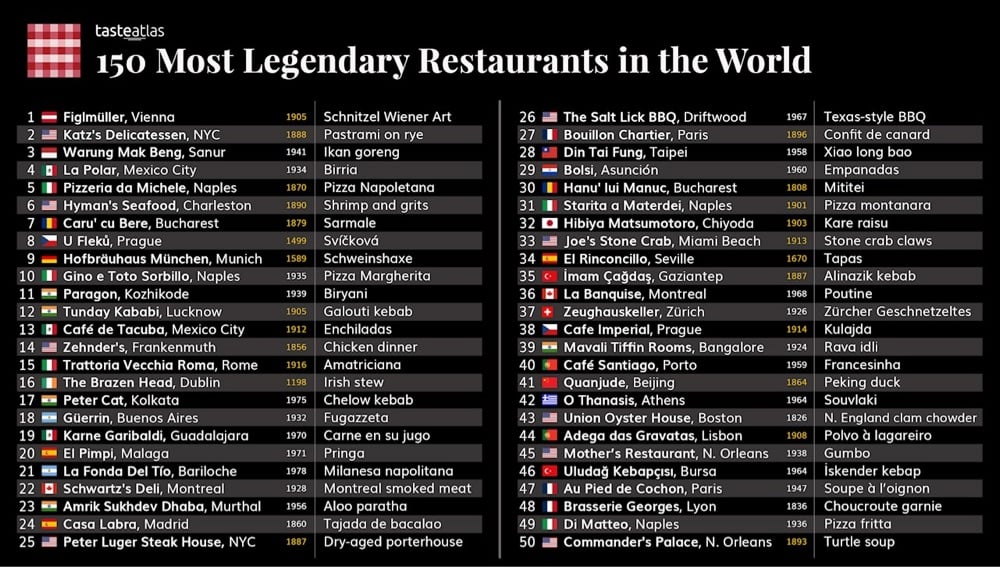
From TasteAtlas, a listing of the 150 Most Legendary Restaurants in the World & Their Iconic Dishes. These aren’t necessarily the best restaurants on Earth, but places that have “withstood the test of time, eschewing trendy gimmicks in favor of traditional, high-quality cuisine”.
Here are a few of the entries from the list that I’ve either been to or would like to go to someday (ok, almost the whole list would have qualified for that):
2. Katz’s Delicatessen (pastrami on rye)
10. Gino e Toto Sorbillo (pizza margherita)
22. Schwartz’s Deli (Montreal-style smoked meat)
25. Peter Luger Steak House (dry-aged porterhouse)
34. El Rinconcillo (tapas)
42. O Thanasis (souvlaki)
47. Au Pied de Cochon (soupe à l’oignon)
95. Le Relais de l’Entrecote (steak frites)
Schwartz’s is iconic, but I think Snowdon Deli has better smoked meat. In the same vein, I’ve had good steak and not-so-good steak at Luger’s — as far as an iconic NYC steakhouse goes, I would have gone for Keen’s.
I’m sure any food fan worth their (don’t say it, don’t say it) salt (ugh) could come up with a few dozen restaurants that could/should be on this list, but 150 is certainly a good start! Soba, bratwurst, ćevapi, udon, churrasco, kofte, phở, ramen, ceviche, sushi, risotto, bouillabaisse, dim sum, BBQ, Peking duck, biryani, xiao long bao…man, I’m so hungry now!
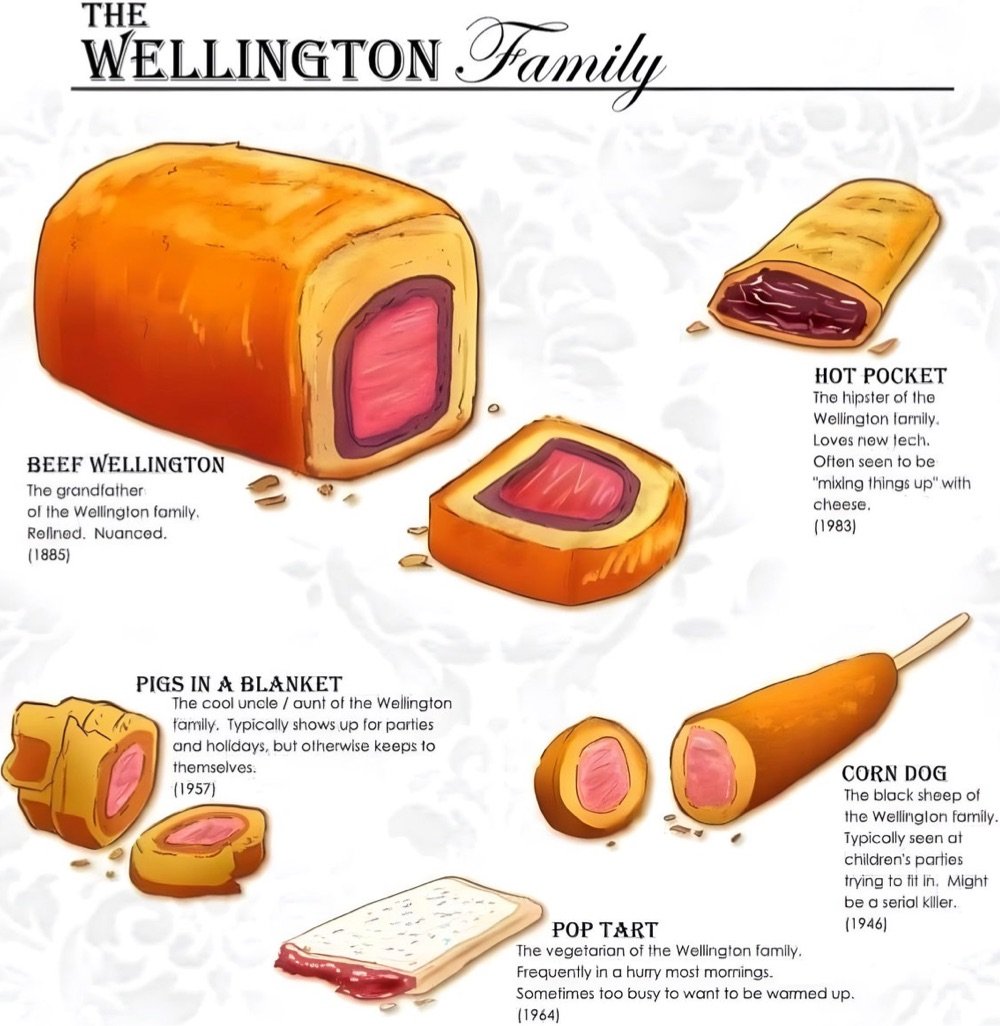
Meet the members of the Wellington Family, foods related in spirit and structure to Beef Wellington: pigs in a blanket, Hot Pockets, corn dogs, and Pop Tarts.
See also The Cube Rule of Food, which suggests that the Wellington Family actually belongs to the larger Calzone Clan but sadly that pigs in a blanket are actually sushi.
P.S. I found this illustration herebut couldn’t trace the original source. Happy to give credit is anyone knows where this is from…







Stay Connected