kottke.org home archives + xml about kottke.org contact me
kottke.org - home of fine hypertext products

kottke.org posts about 'photography'

The Morning News has an interview with photographer Barbara Probst. I've seen her work at the MoMA but this one is new to me and a definite favorite.

The Image Fulgurator is an ingenious device that detects the flash from nearby cameras and quickly inserts a message onto whatever is being photographed so that it shows up in any photos being taken.

It operates via a kind of reactive flash projection that enables an image to be projected on an object exactly at the moment when someone else is photographing it. The intervention is unobtrusive because it takes only a few milliseconds. Every photo another photographer takes of an object at which the Fulgurator is also aimed is affected by the manipulation. Hence visual information can be smuggled unnoticed into the images of others.

Check out the results. (thx, red)

I'm fascinated by early color photography...it takes a time we think of being in black & white and makes it accessible and modern. In the hands of Auguste and Louis Lumière, the "lowly, lumpy potato" made color photography possible in the early 1900s. The photos were called autochromes.

The Lumière brothers gathered up their potatoes and ground them into thousands of microscopic particles; they separated this powder into three batches, dying one batch red-orange, one violet and one green; the colored particles were thoroughly mixed and sifted onto a freshly varnished, clear glass plate while the lacquer remained tacky; excess potato bits were swept from the plate, which was pressed through steel rollers to flatten the colored grains, transforming each into a minuscule color filter measuring from .0006 to .0025 millimeters across. Gaps between the colored particles were filled in with carbon black, the plate was varnished again and a thin, light-sensitive emulsion of silver bromide was brushed over that. Now the plate was ready for the camera. When the shutter was opened, light filtered through the translucent potato grains, and a multicolored image was imprinted on the emulsion. After the negative plate was developed in the lab, it was washed and dried, covered with another piece of glass to protect the emulsion and bound with gummed tape. Et voilà! A color photograph unlike any seen before.

Here's a slideshow of some photos taken by this process. Here's some autochromes of Mark Twain from 1908.

More early color photography (not necessarily autochromes): Sergei Mikhailovich Prokudin-Gorskii's stunning photographs of Russia circa 1909-1915, photos of WWI, photos of WWII, and photos of America in the late 30s/early 40s (color corrected). (thx, david)

Jun 30, 2008    tags: photography

I've not been paying enough attention to Bill Cunningham's street fashion photography slideshows. Each week, Cunningham goes out on the streets of NYC to find out what people are wearing. Even better than the photos are his enthusiastic descriptions of what he's found.

This week he looks at women's handbags, which he calls "the engine carrying the fashion world". Cunningham finds that bags are growing almost "cartoonishly large" and discovers a unique glove/bag combo. Last week, he looked at the glittery belts that some men are wearing with their saggy jeans. If this was the type of fashion that filled the pages of Vogue, I would subscribe in a second. (thx, alaina)

Of all the things that Flickr has done, The Commons project might be the most significant. If, in two years, there are tens or even hundreds of thousands of old photographs previously unavailable to the general public from collections all over the world -- all tagged, geocoded, annotated, contextualized, and available to anyone with a web browser -- that would be an amazing resource for exploring our recent history.

Daniel Barron makes photographs of things that look human but aren't. Maybe. Sorta. I don't really know! Can you tell? (via that's a negative)

Here is today's dose of surreality.

Eddie Murphy Giant Head

The iconic photo from 1978 of Microsoft's founders and early employees has been reshot.

Present for the reunion was office manager Miriam Lubow (center of new picture), who missed the original sitting due to a snowstorm. (When Lubow, now retired, first met Gates, she couldn't believe that disheveled kid was the president.) Absent for the reshoot was Bob Wallace (top center), who died in 2002; after leaving Microsoft in 1983, he pioneered the idea of shareware.
They should submit this to Ze Frank's Youngme/Nowme.

Andy Baio interviews Alan Taylor, the fellow behind The Big Picture, the journalistic photo blog that's taken the web by storm.

Internally, externally, everywhere, people are being really thankful to me. I need to make sure (with some link-love in my upcoming blogroll) that the response gets directed to the photographers as well. I'm just a web developer with access to their photos and a blog - they're the ones out there working hard to get these amazing images. "Photographers" here is a loose term, encompassing photojournalists, stringers, amateurs, scientific imaging teams and more.

A whole bunch of old photos of NYC. More here.

Jun 20, 2008    tags: nyc photography

For its July 2008 issue, Vogue Italia is featuring only black models and feature articles about black women in arts and entertainment.

Having worked at one time with nearly all the models he chose for the black issue -- Iman, [Naomi] Campbell, Tyra Banks, Jourdan Dunn, [Liya] Kebede, [Alek] Wek, Pat Cleveland, Karen Alexander -- [photographer Steven] Meisel had his own feelings. "I thought, it's ridiculous, this discrimination," said Mr. Meisel, speaking by phone from his home in Los Angeles. "It's so crazy to live in such a narrow, narrow place. Age, weight, sexuality, race -- every kind of prejudice."

Here's a slideshow of some of the images from the magazine. As I've said before, Vogue Italia is doing some interesting things with the editorial nature of the magazine's photography (see State of Emergency and Super Mods Enter Rehab, both by Steven Meisel).

Three things I saw at the MoMA today

1. Perhaps the most playful art I've ever seen in a major museum is Olafur Eliasson's Ventilator, a fan hung on a long cord in the main atrium in the museum. Watching it blow around the huge room, chased by children, is hard-to-beat fun.

2. The rest of Eliasson's show on the third floor. His art seems so conceptually and constructurally simple yet, I dunno, I just wanted to hang out in the gallery all day, like I was required to remain part of the experience. Left me wishing I'd made it to London to see The Weather Project.

3. The typology photos of Bernd and Hilla Becher. Recommended if you like photography and multiples of things.

Irritated that I missed: van Gogh's Starry Night (out on loan to Yale until Sept...I've seen it 20 times at least but still like checking it out whenever I'm there), the exhibition of George Lois' Esquire covers, and lunch at Cafe 2.

I have to hold off linking to every single entry on Big Picture (best new blog of the year so far, hands down), but these photos of the flooding in Iowa are amazing. I went to college in Cedar Rapids and my mind is boggled seeing so much of downtown under so much water.

Photos of singing/talking stuffed animals, dressed and undressed.

I've always been curious about stuffed animals that sing, dance, light up, or talk back. There must be a fascinating robot underneath the fur and fluff, right? Surely the robot hiding in the bear's clothing, vestimentis ursum, is impressive. So: armed with my childish curiousity and the spurious excuse of 'product design research,' I set out to discover what, exactly, these creatures are hiding.

(thx, janelle)

Jun 17, 2008    tags: photography

The "american gothic" tag on Flickr is quite interesting; I like the ketchup and mustard one myself.

Slideshow of photos of phone sex operators by Phillip Toledano. (via waxy)

Photographer Sam Haskins, well known for doing in-camera montage, briefly describes how composite photos were made in the time before Photoshop.

Its a single exposure with the model viewed through optical glass at 45° and the fabric positioned to the side. At the time there was zero retouching after the event. Now of course I have the luxury of scanning the transparency to clean and refine the image in Photoshop - God bless its digital socks.

It's been hot in NYC for the past few days, but I don't know if it was ice-lickin' hot.

Jun 10, 2008    tags: photography nyc

Beautiful photos of the Space Shuttle lifting off and of earth from space. Check out the cloud wake and the thunderheads.

Robert Kennedy funeral train photos

In July 1968, a train delivered the body of Robert Kennedy from NYC to Washington D.C. so that he could be buried in Arlington National Cemetery next to his brother. Photographer Paul Fusco was on that train and shot a bunch of photos of the hundreds of thousands of people that spontaneously turned up along the train route to mourn Kennedy, photos that were recently rediscovered. Fusco narrates a slideshow of the photos.

Paul Fusco, Robert Kennedy Funeral Train Photos

The amazing photos will be on display at Danziger Projects from June 6 - July 31...Danziger has more about the photos -- which he calls "my favorite body of work in photography" -- on his blog.

I'll let the pictures speak for themselves, but I'll also tell you the only area where Paul and I disagreed. For Paul, the event and the photographs represented the end of hope. To me they represent the indomitability of the American spirit.

Either way, the photos are powerful but also show the ordinary American-ness of that time period.

Five ways to spot a faked photo. Comparing the light reflection in the various eyes in a photograph is an especially clever technique.

Big Picture is a fantastic and dead-simple new site from boston.com. Each entry tells a story through high-quality newswire images displayed at large sizes; recent entries include a look at Saturn from the Cassini space probe and the daily lives of soldiers in Afghanistan. If you're frustrated by the tiny news imagery we get spoon-fed to us on the web, this site will be a welcome addition to your daily browse. Alan Taylor, the project's instigator, has a post on his blog about Big Picture.

The sizes of the photographs are deliberately large - taking advantage of the majority of web users who have screens capable of displaying 1024x768 or larger. The long-held tradition of keeping images online tiny and lightweight is commendable still - when designing a general purpose site. But one dedicated to quality imagery should take full advantage of the medium, and I hope I've struck a good balance with The Big Picture.

When I see quality photography consigned to the archives, or when I see bandwidth readily given up to video streams of dubious quality, or when I see photo galleries that act as ad farms, punishing viewers into a click-click-click experience just to drive page views - those times are the times I'm glad I was able to get this project off the ground (many thanks to my friends within boston.com)

Photos of pajamas as outerwear in Shanghai.

The prevalence of pyjamas, Guariglia explained to me, was due to both the extreme summer heat and the lack of plumbing. Most Shanghaians share outdoor communal toilets and thus the boundaries of what was considered one's home have expanded past people's houses to the public bathrooms. Once that relaxation of the dress code became acceptable (starting around the 1980s) the perimeter for p.j.-wear just kept expanding until many people were wearing them day in day out.

Absolutely incredible photos of a wedding and then an earthquake.

Can you imagine what it was like to have been photographing a wedding in Sichuan, China when 7.9 earthquake hit and shakes for three minutes? From what I understand, there were thirty-three missing guests in this church.

Fantastic collection of photos by James Mollison of music fans who tend to dress like their idols. A book featuring the photos is due out in October.

Over a three-year period, James Mollison attended pop concerts across Europe and the United States with a mobile photography studio, inviting fans of each music star or band to pose for a portrait on their way into the concert. The result is The Disciples, an original and highly entertaining series of fifty-seven panoramic images, each featuring eight to ten music fans mimicking the manners and dress of their particular heroes. Featuring fans of Dolly Parton, Iggy Pop, Madonna, Marilyn Manson, the Rolling Stones, Bob Dylan, Snoop Dogg, and Motorhead, among many others, The Disciples is a surprising, sharp, and hilarious take on popular culture.

(via waxy)

The NY Times' City Room blog has a short profile of photographer Nikola Tamindzic.

He uses long exposures, then shakes the camera while the shutter is still open, causing colors to blur and lights to streak. "I'm not recording what is really happening, but it's something like what the brain is seeing late at night, especially if maybe you're drunk or very excited," he said. "I like that hour between 3 and 4 in the morning when desperation sets in, when you see all the anticipation of going out starting to fade. The masks drop and everybody realizes the night is not going to be everything they were hoping for."

You may have seen Tamindzic's photos on Gawker or on his own site, Home of the Vain. Here's the photo with Huffington, Murdoch, et al. An archive of his photography is available at Ambrel.

A collection of photos of a cleaning crew washing Seattle's Space Needle with high pressure washers (scroll down a bit).

Even though the sprayers use half the flow of a garden hose, the water shoots out at 3,000 pounds per square inch -- more than enough power to send the guy behind the hose flying. "One thing we say is, it doesn't necessarily have to be fun to be fun. There are definitely times when I'm spinning in free space and I'm like, holy cow this is terrifying and I can't believe this is my job," said Matt Henry, rope technician.

The company doing the work, Karcher GmbH & Co., has done similar high-profile jobs around the world, all at no cost...their web site says that these projects are good publicity for their cleaning products. Here's a sampling of some other projects they've done, including the Statue of Liberty and Berlin's Brandenburg Gate. (via girlhacker)

Yeondoo Jung does real-life recreations of children's drawings. (via quips)

Related to yesterday's post about photo retouching is this article about how challenging high definition is to makeup artists and actors alike (via house next door) .

John Toll is an Academy Award-winning cinematographer who has had limited exposure to HD photography, but who understands the impact of it on the business. "Film tends to be more kind," he said. "Now with HD, they're doing things like more filtration, or softening of the light, or degrading the image so it's not so highly defined. It's sort of what they used to do in movie star close-ups, an over-diffused style to try to make them look glamorous. Now they do it so you don't see every pore in a close-up on skin."

Also related, James Danziger weighs in on the Dove/Dangin/Leibovitz controversy the latter of whom is represented by Danziger's gallery.

Any photograph used in a magazine, a billboard, an album cover, whatever -- can only be presumed to be a photo-based illustration. The issue, which Dove's well-intentioned campaign addressed, is the effect these illustrations have on the psyche, self-esteem, and well-being of women (in particular) not to mention the unrealistic view men might have of women. It brings to mind the shock the eminent Victorian art critic John Ruskin experienced upon discovering his wife's pubic hair, after which he was unable to consummate the marriage. Divorce followed shortly.

May 14, 2008    tags: hd movies photography

Now-and-then photos of people who drive the same cars for long periods of time.

Approaching the uncanny valley from the other direction

Fashion photo retouching (i.e. high-brow Photoshopping) gets the New Yorker treatment with this story on retoucher Pascal Dangin, one of the best in the business.

In the March issue of Vogue Dangin tweaked a hundred and forty-four images: a hundred and seven advertisements (Estée Lauder, Gucci, Dior, etc.), thirty-six fashion pictures, and the cover, featuring Drew Barrymore. To keep track of his clients, he assigns three-letter rubrics, like airport codes. Click on the current-jobs menu on his computer: AFR (Air France), AMX (American Express), BAL (Balenciaga), DSN (Disney), LUV (Louis Vuitton), TFY (Tiffany & Co.), VIC (Victoria's Secret).

The article touches too briefly on the tension between reality and what ends up in the magazines and advertisements. As Errol Morris points out on his photography blog, it is often difficult to find truth in even the most vérité of photographs. Even so, the truth seems to be completely absent from Madonna's recent photo spread in Vanity Fair that was retouched by Dangin, especially this one in which a 50-year-old Madonna looks like a recent college graduate who's never lifted a weight in her life.

The uncanny valley comes into play here, which we usually think of in terms of robots, cartoon characters, and other pseudo anthropomorphic characters attempting and failing to look sufficiently human and therefore appearing creepy and scary. With an increasing amount of photo retouching, postproduction in film, plastic surgery, and increasingly effective makeup & skin care products, we're being bombarded with a growing amount of imagery featuring people who don't appear naturally human. People who appear often in media (film & tv stars, models, cable news anchors & reporters, miscellaneous celebrities, etc.) are creeping down into the uncanny valley to meet up with characters from The Polar Express. I don't know about you but a middle-aged Madonna made to look 24 gives me the heebie-jeebies. Perhaps the familar uncanny valley graph needs revision:

New Uncanny Valley

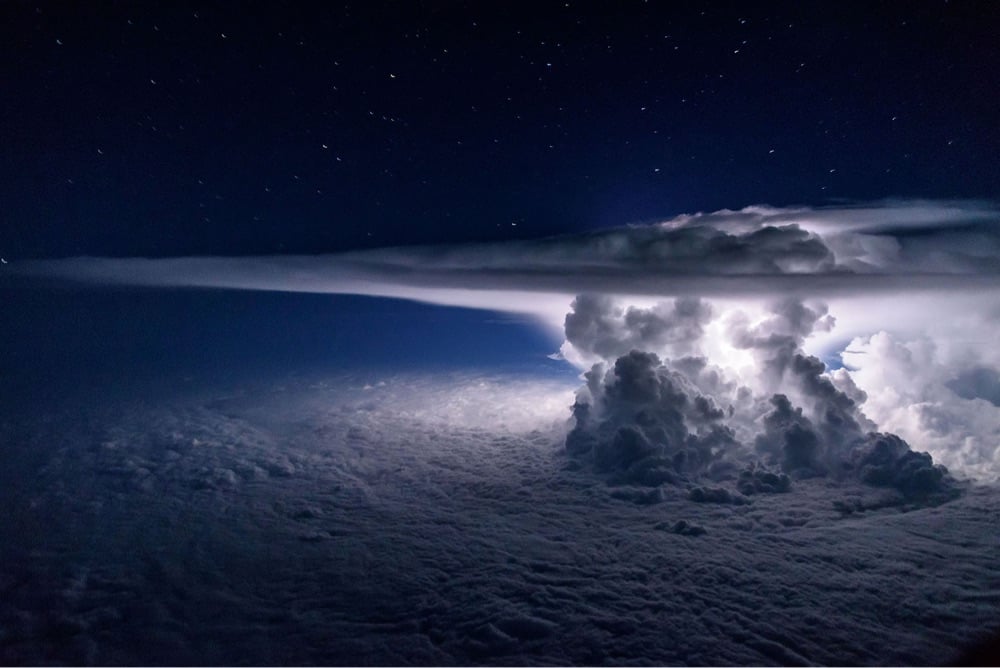
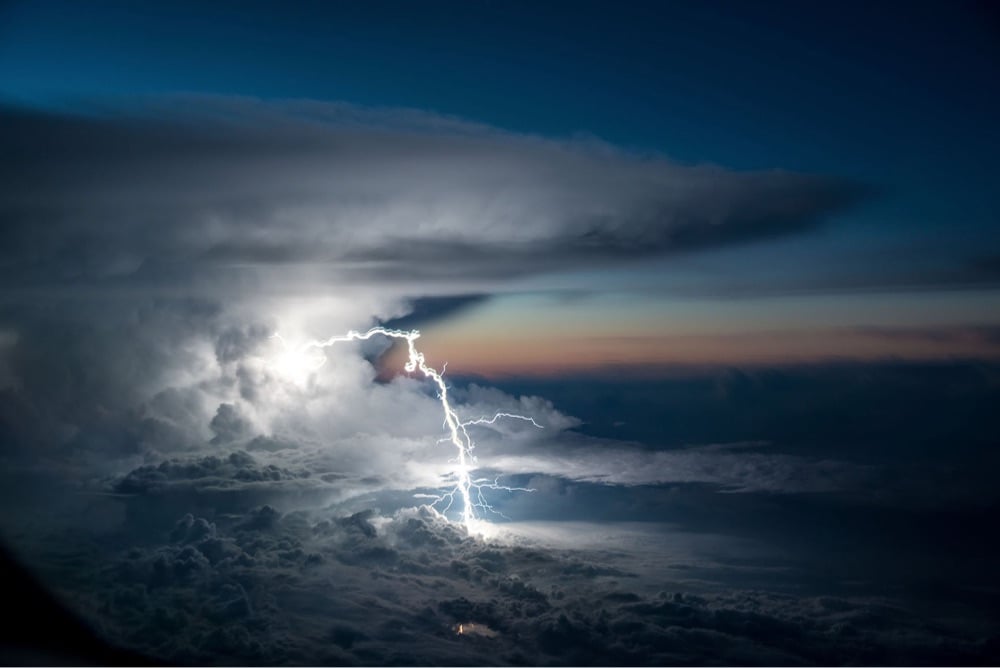
Truly awesome photos of the plume from Chile's recently reactivated Chaitén volcano merging with a lightning-infested thunderstorm.

Bill Henson's photos of people at the opera, including a short interview with the photographer.

What I was interested in terms of Paris Opera series was that whole strange business of finding oneself with a whole lot of other people gathered in a darkened space, such as the opera, awaiting some special event. There is something quite magical about it. I've always found that people sitting in the dark just waiting for something is the most haunting sort of experience. It seemed to me it was a common experience, a universal thing that everyone feels, really, at some point or another.

More of Henson's opera photos here. (via conscientious)

Curbed has some photos of the construction progress on the High Line. Compare and contrast with some photos I took in early 2004.

Photos of people jumping out of swings. (via clusterflock)

May 6, 2008    tags: photography

Marginal Revolution's Tyler Cowen occasionally asks his readers to suggest topics for him to write about. Stump the polymath, as it were. I posted a suggestion that I'd been wondering about recently:

Is taking a photo or video of an event for later viewing worth it, even if it means more or less missing the event in realtime? What's better, a lifetime of mediated viewing of my son's first steps or a one-time in-person viewing?

and he answered it today:

If you take photos you will remember the event more vividly, if only because you have to stop and notice it. The fact that your memories will in part be "false" or constructed is besides the point; they'll probably be false anyway. In other words, there's no such thing as the "one-time in-person viewing," it is all mediated viewing, one way or the other. Daniel Gilbert's book on memory is the key source here.

I take a lot less photos than I used to -- even though cameras are easier to use and carry around than ever -- and prefer to experience the moment rather than fiddle with the camera. But that seems to swim against tide these days...camera irises seemingly outnumber real ones at photo-worthy events and places.

A list of 21 ways to shoot better photographs. I can hear my photographer friends snickering about the cliches on the list, but if you don't know much about photography but are interested in learning, you could do worse than to explore some of these techniques.

Wonderful timelapse photos by Alexey Titarenko of "shadow" people in St. Petersburg just after the collapse of the Soviet Union. This one is stunning. (via heading east)

The Velocouture group on Flickr collects photographs of bicycle fashion fashion, on a bicycle. The best ones are of people who try to coordinate their outfits with their bikes. This gal is particularly fashionable. See also this NY Times slideshow.

James Danziger presents a short history of subway photos, starting with photos of sleeping Japanese salarymen on trains and then moving to Walker Evans, Bruce Davidson, etc. Some of my favorite subway photos are from the Moscow subway...Stalin look-a-likes, huge guitars, and many sleeping people.

Photos of a Masonic handbook from 1920 called King Solomon and His Followers -- A Valuable Aid to the Memory. The text is written in shorthand. (via clusterflock)

A collection of photos taken from space of cities at night. Beautiful. (via ben fry)

The Hubble Space Telescope was launched into space 18 years ago and to celebrate, NASA has put up a photo gallery of merging galaxies, galaxies as in love with each other as NASA is with the Hubble. Aww.

@ the movies
rating: 4.0 stars

Standard Operating Procedure

To be honest, I was a little disappointed in Standard Operating Procedure...but the fault is my own, not the film's. My expectation was that the film would start with the photos of Abu Ghraib & misdeeds of the lower ranking soldiers and then move up the chain of command, both militarily and thematically speaking, to explore the issues of truth in photography and culpability. To Morris' credit, he didn't do that. It's too easy these days to attempt arguments about Iraq or the Bush Administration that connect too many dots with too little evidence...essentially propaganda that sings to the choir.

SOP has a surprisingly small depth of field; it's the story of those infamous photos, the people who took & appeared in them, and what they have to say about the photos & the actions they purport to show. And in that, the movie succeeds. Morris leaves plenty of negative space into which the audience can insert their own questions about what the photographs ultimately depict and who's responsible in the end.

Incidentally, Morris generated a bit of controversy recently when he admitted that he'd paid some of the interviewees in SOP. The criticism of this practice is that "the credibility of interviewees diminishes when money changes hands and that these people will provide the answers they think are desired rather than the truth". That is a concern but no more so than every other reason for being untruthful, including not telling the truth out of spite for lack of payment. People have so many better reasons to lie than money.

Tree People, a series of photos of the Korowai of Papua New Guinea.

BLDGBLOG has some photos of luxury hotels that were abandoned mid-building.

With images by Sabine Haubitz and Stefanie Zoche of Haubitz+Zoche, the show looks at "the concrete skeletons of five-star hotel complexes" abandoned on Egypt's Sinai Peninsula. They are resorts that never quite happened, then, with names like Sultan's Palace and the Magic Life Imperial. This makes them "monuments to failed investment."

Tree photography by Stuart Franklin. There's more photography by Franklin on his site and on Magnum's site. Franklin took the iconic photo of the man staring down the tanks in Tiananmen Square. (via snarkmarket)

A photograph of the newest possible moon, one that's only about 15 hours old.

Finding the Moon when its slim crescent is still less than about 24 hours past the New Moon phase requires careful timing and planning, a challenging project even for experienced observers. In this sighting, only about 0.8 percent of the Moon's disk appears illuminated.

(via airbag)

A photogenic drawing** that was assumed to have been made in the late 1830s may have actually been created 40 years earlier, making it one of the oldest photographic prints in existence.

Like the lost plays of Aeschylus that were written about but did not survive themselves, no known examples of the work of Wedgwood and his circle have ever been found. But Dr. Schaaf, in looking deeper into the leaf image, realized that these legendary lost images had something else in common: their creators were all part of the close social circle of the family of Henry Bright.

"The reason that I got so excited about this was that it was the most solid, indicative collection I've seen," he said. "I'm fully prepared for 'The Leaf' to have been made by Henry Bright, or by his father, after the 1790s. But I've never seen a story that fits together so neatly."

** A photogenic drawing is a precursor to the photograph and is created by placing an object on a piece of photosensitive paper and exposing it to light.

Apr 18, 2008    tags: photography

Aerial photo of a lumberyard.

Apr 18, 2008    tags: photography

The abandoned supply shacks of Antarctic explorers Robert Falcon Scott and Ernest Shackleton are still intact and have been preserved by the cold.

While the preservation of food in the freezing temperatures and dry climate has been noted, bacterial decay still occurs. Besides, the World Monuments Watch describes it as one of the hundred most endangered sites in the world, and New Zealand's Antarctic Heritage Trust (AHT) has been working in the last years to preserve it from corrosion.

These structures and the supplies contained within are almost 100 years old.

Photography of Star Wars characters in contemporary urban settings. (Pardon the stupid Flash interface...click on "series" to see the photos.) (via vitamin briefcase)

Recreations of childhood photos. This pair are my favorites. (via waxy)

Apr 16, 2008    tags: photography remix
@ the movies
rating: 3.5 stars

Manufactured Landscapes

Manufactured Landscapes opens with an eight-minute tracking shot of a gigantic factory in China, the camera moving past row after row of workers assembling widgets until you feel like the factory floor circumnavigates the globe. The point of the shot, as with Edward Burtynsky's photography, is to encourage the viewer to do some rudimentary mathematics about the scale of industry in the world:

eight minutes to move across one factory + look at all those employees + how many factories like this are there in China? = wow, that's a lot of widgets

While it's unfair to say that the movie goes downhill from there, the tracking shot packs such a punch that the rest of the film seemed lacking in comparison. It was the only shot in the film that really felt like the cinematic equivalent of Burtynsky's photography...a long photograph, if you will.

Extensive series of photographs of a pig being butchered.

The pig is Berkshire, from a small farm in upstate NY. It was slaughtered at a small family slaughterhouse nearby, on the Thursday before the class. So this pig had been dead for less than a week before being butchered.

If you want to know where your bacon or ham-related food comes from, here's your chance. (thx, derrick)

Apr 15, 2008    tags: food photography

James Danziger on the photographs of the Florida teens accused of beating a classmate and filming it for YouTube.

The pictures of the accused are startling in the banality of the faces. (While the spelling of many of the names -- April, Britney, Brittini, Cara, Kayla, Mercades, Stephen, Zachary bring to mind a revived Mouseketeers.) A number of the girls look surprisingly similar, but minus the prison garb, they could just as easily be reacting to a berating for poor schoolwork. The boys, who were posted as lookouts while the girls carried out the beating, look a little more ready for jail.

The pictures are fascinating in the narrow range of emotion they convey, from self-pity to sullenness, but to my mind all stop before genuine contriteness. (I'm reading this in, of course, but I have a hunch I'm right.) Yet there's an all-American look to these kids that can only remind us how narrow the line is between good and evil.

The original photos are here.

Matt Jones argues that short looping videos are the real long photographs.

A loop would be a captured action or situation rather than a narrative, where the duration of the loop is set but the loop goes on forever so you can study the layers, the detail, the figure and the ground in the same way you can a photo. A bottled system not a short story. Think about all the tiny clips you've played again and again on the internet just to see one aspect, one moment, act out -- a goal or a dramatic chipmunk. Not stories, but toy moments.

Photo series of food that takes the shape of its container. The peas are my favorite.

Update: Irving Penn did a well-known series of frozen foods in the 1970s. One of the prints was recently sold for $85,000. (thx, rob)

Apr 14, 2008    tags: photography food

Awesome collection of folk graphics and photography protesting Flickr's decision to let members post short videos. But without the video, we'd miss out on stuff like this. (via waxy)

Some great photos of Americans commuting by Vincent Laforet using a tilt shift lens. (via dryden is home)

Photographer Eric Etheridge alerted me to a new series he recently started on his WordBlog called Photography: The Missing Criticism, "which aims to bring great writing on photography back into print". The series currently consists of a 1981 essay by Tod Papageorge on Walker Evans and Robert Frank and a 2002 essay by Papageorge on Robert Adams.

Apr 7, 2008    tags: photography

Great set of photographs showing how the Space Shuttle gets ready for takeoff, from the Vehicle Assembly Building all the way to the launch pad.

Errol Morris returns to his Times blog for the first time since his examination of the Roger Fenton photographs and covers re-enactments in documentary films, a technique he pioneered in the excellent The Thin Blue Line, and how it applies to truth in photography.

Critics argue that the use of re-enactments suggest a callous disregard on the part of a filmmaker for what is true. I don't agree. Some re-enactments serve the truth, others subvert it. There is no mode of expression, no technique of production that will instantly produce truth or falsehood. There is no veritas lens -- no lens that provides a "truthful" picture of events. There is cinema verite and kino pravda but no cinematic truth.

And then:

Is the problem that we have an unfettered capacity for credulity, for false belief, and hence, we feel the need to protect ourselves from ourselves? If seeing is believing, then we better be damn careful about what we show people, including ourselves -- because, regardless of what it is -- we are likely to uncritically believe it.

Based on a paper about "copy-move forgery", a couple of programmers have come up with a program that algorithmically detects whether a photograph has been photoshopped using the cloning technique. It works very well on Adnan Hajj's doctored Reuters photo of an attack on Beirut.

See also: how to detect photo forgeries.

Visual conversation layers

From Joerg's Colberg's search for the most wanted photo on the web, perhaps the most heavily annotated photo on Flickr:

Most Annotations

Apr 2, 2008    tags: photography

A collection of pairs of photos, one taken just before a person's death and one after. I wish they displayed the pairs side-by-side.

Apr 1, 2008    tags: photography death

Regal

Leslie Hall by Noah Kalina

The Rainbow Portrait of Queen Elizabeth I

Top: Leslie Hall by Noah Kalina.

Bottom: The Rainbow Portrait of Queen Elizabeth I by Isaac Oliver. (thx, adriana)

Flickr photoset of an abandoned amusement park in Ohio called Chippewa Lake.

Hidden on a lakeshore in Medina County is one of the state's most unique forgotten treasures: the abandoned amusement park called Chippewa Lake. What you'll find there today is the tragic shell of a once-glorious family fun park, one with a history going back to the 1840s. The crying shame is that it's been reduced to an inadequately-fenced-off stretch of acres, overgrown with every imaginable form of vegetation native to this state and festooned with faded NO TRESPASSING signs.

(via maggie)

Mar 27, 2008    tags: photography

A NY Times reporter was assaulted while taking photos of some men putting up illegal posters near Madison Square Park. The rationale for his inclination not to press charges is an interesting one:

While my assailant's actions were frightening, they resulted in part from what he interpreted as provocation: that is, my taking pictures after he had explicitly warned me not to. He did not take my wallet, cash or briefcase; something he could easily have done while I was on the ground. Nor do I recall him using much more force than was needed to wrest the camera from me. He didn't kick me gratuitously when I was down. He did what he threatened to do, but no more.

In the greater scheme of things, my quarrel isn't with him, anyway. It's with the suits who made the decision in the first place to undertake an illegal marketing campaign.

Update: Maybe Rocko got his logo from the Rocky comic strip? (thx, joakim)

Mar 25, 2008    tags: photography crime

Peeping shrubbery

Peeping Shubbery

I *love* this photo. Found it here; it was taken by Mindy Meyers.

Mar 25, 2008    tags: photography

Interview with Errol Morris in the Columbia Journalism Review about Standard Operating Procedure.

Somebody comes up to you and says, "I'm a postmodernist; I don't care about truth; it's subjective." My answer is, "So it doesn't matter who pulled the trigger? It doesn't matter whether someone committed murder, or whether someone in jail is innocent or not?" I believe that it does matter. What happens in the world matters a great deal.

Morris also says that there will be a web site that accompanies the film where you can view all the Abu Ghraib photos in the order that they were taken.

You can click on a photograph and an iris opens up -- you go into the photograph, and inside of the photograph is context. Take, just for example, the Gilligan photograph, the one on the box, with the wires. I rubber-band that photograph with the other ones taken at the same time, so that it becomes a group of related photographs. There's software that allows you to reconstruct the room from the different angles of the photographs. Then I have biographies that you can click on for all the people who were in the room, and their own accounts. Plus you can see stuff that I recorded for this movie. In other words, you can really enter the world of the photograph.

Photos of people in their beds by Thierry Bouet. Dumb Flash interface alert: click on "au lit" to see the beds. (thx, juliette)

Mike Johnston on the camera he would like to own, a decisive moment digital (DMD) camera.

So there you have it: a small, light, unobtrusive carry-around camera with great handling and world-class responsiveness, capable of being used in all manner of lighting conditions and yielding DSLR-quality results on the gallery wall. The 21st-century equivalent of Henri Cartier-Bresson's stealthy street-shootin' Leica.

Mar 21, 2008    tags: photography cameras

If you tell photographer Izaz Rony where you'll be at a particular time, he'll come and take your picture without you knowing it.

Using information provided earlier about their weekly routine, the photographer will arrive on the scene, and unseen, take shots of the subject. The subject will be photographed walking through the streets, going about their daily business. Without posing and artifice, the camera captures only the natural beauty of the person.

Andrew Hearst calls it "surveilling yourself".

The Desire Paths Flickr pool. Desire paths are improvised paths built collectively by pedestrians trying to find the shortest way across the grass, like ants laying down pheromone trails to food. I've heard of some clever institutions who wait for desire paths to be laid down by pedestrians and then put permanent sidewalks in those places.

The Abu Ghraib article by Errol Morris and Philip Gourevitch which I wrote about here and was subsequently taken down is back online. For now. Get it while you can. (thx, tom)

Powerful and disturbing article by Philip Gourevitch and Errol Morris from this week's New Yorker about the photographs taken at Abu Ghraib.

Later, when the photographs of crimes committed against Iraqi prisoners at Abu Ghraib were made public, the blame focussed overwhelmingly on the Military Police officers who were assigned to guard duty in the Military Intelligence cellblock -- Tiers 1A and 1B -- of the hard site. The low-ranking reservist soldiers who took and appeared in the infamous images were singled out for opprobrium and punishment; they were represented, in government reports, in the press, and before courts-martial, as rogues who acted out of depravity. Yet the abuse of prisoners at Abu Ghraib was de facto United States policy. The authorization of torture and the decriminalization of cruel, inhuman, and degrading treatment of captives in wartime have been among the defining legacies of the current Administration; and the rules of interrogation that produced the abuses documented on the M.I. block in the fall of 2003 were the direct expression of the hostility toward international law and military doctrine that was found in the White House, the Vice-President's office, and at the highest levels of the Justice and Defense Departments.

Never mind liberty, it would seem that we're giving up our humanity for security.

Update: Nuts, they took the article offline for some reason...

Update: Looks like the article is back up. For now.

Photo slideshow of an architecture office fashioned out of the rusted carcass of an auto repair shop.

A hundred and twenty year old photo of a young Helen Keller has been found.

The photograph, shot in July 1888 in Brewster, shows an 8-year-old Helen sitting outside in a light-colored dress, holding Sullivan's hand and cradling one of her beloved dolls.

The Earth and Moon as seen from Mars.

psp_005558_9040.jpg

My friend, the incredibly talented photographer, Barry Stone is exhibiting an outdoor installation of large photographs of Galaxies made from flour at the BBAP in Houston.

Rob Haggart, aka A Photo Editor, does a great job introducing this video of Annie Leibovitz photographing Queen Elizabeth.

What I find interesting in photo shoot videos is not the 11 assistants or the lighting setup but watching the photographer interact with the subject.

As Rob says, "Annie really shows her tenacity in this video when she immediately tries to get the Queen to remove her crown after deciding it doesn't look good in the first shot and not giving up on an original request to shoot the Queen on horseback inside the state apartments."

Simultaneously fascinating and terrifying -- like watching a trapeze artist at work.

2point8 points us to the portraiture and street photography of Arlene Gottfried:

"You get the sense that Gottfried didn't necessarily leave her house to go get the picture wherever that picture might be, but that she lived her life with gusto and was ready for the pictures when the pictures came to her."

Kind of a good metaphor for blogging.

Slideshow of photos of North Korea.

Nice collection of photographs of Pakistan's elaborately decorated motor vehicles.

The most striking thing in Pakistan is the vision of trucks and buses completely covered in a riot of color and design. They might spew diesel fumes, they may take up all of the winding, narrow, under-maintained road one is trying to negotiate, but they are certainly noticeable, like so many mechanical dinosaurs adorned in full courtship colors.

(via david archer)

Some bootleg scans of these were linked around the web last week, but here's the real thing: photos of current Hollywood celebrities photographed in scenes from Hitchcock films. Click on the photos to see the originals.

Photos of kids with their science experiments, including Juicy Beans, Garlic: The Silent Killer, and Extreme Wood.

Feb 20, 2008    tags: photography science

Photos of all 521 chairs at the Visual Studies Workshop building. This would make a great poster, not unlike the Vitra Design Museum Chairs poster.

Feb 20, 2008    tags: photography

This photo shoot of Lindsey Lohan as Marilyn Monroe only serves to underscore how unlike (and inferior) Lohan is compared to Monroe. Lohan is the Meet the Spartans version of Monroe. Some of the originals are here, lots more thumbnails here. NSFW.

Update: Here's an accompanying article. And Goldenfiddle had this to say:

This is, without a doubt, the saddest, stupidest, ugliest, most pointless thing ever. Bert Stern should be ashamed of himself.

Demo film of the Polaroid SX-70 made by Charles and Ray Eames but set to a soundtrack of The Cramps performing Garbageman. Wot? (via spurgeonblog)

Photos by Taryn Simon of hidden and unfamiliar places in the US, like the marijuana crop grow room at the National Center for Natural Products Research in Mississippi. Here's a somewhat overlapping selection of photos at Wired and another at The Morning News, which includes a great letter from Disney denying Simon access to their theme park's underbelly.

After giving your request serious consideration, even though it is against company policy to consider such a request, it is with regret that I inform you that we are not willing to grant the permission you seek...As you are aware, our Disney characters, parks and other valuable properties have become beloved by young and old alike, and with this comes a tremendous responsibility to protect their use and the protection we currently enjoy. Should we lapse in our vigilance, we run the risk of losing this protection and the Disney characters as we know and love them...Especially during these violent times, I personally believe that the magical spell cast on guests who visit our theme parks is particularly important to protect and helps to provide them with an important fantasy they can escape to.

Richard Mosse's Air Disaster, a series of photographs of air disaster simulations, on-the-ground training exercises for airport fire-fighting crews. BLDGBLOG has a short interview with the photographer.

The firemen have put out the fire in seconds. That's their job, after all. They do this with decisive brevity and great courage, sometimes walking right into flames -- but it doesn't make for an easy photograph. It's all a bit like the sexual act: the flames come up and men run in and spray everything with a high power water hose and then it's all over.

Math and science-themed tattoos. More info here. (via random foo)

Short interview with photographer Helmut Newton.

Q: Your about to be published autobiography stops in 1982. What have the readers missed?

A: Nothing! People who reach their goals are very uninteresting. What could I have written about the last 20 years? I met a lot of awfully boring Hollywood bimbos. I earned a lot of money. I fly only first class.

NSFW if tasteful nudes aren't safe to view at your place of employ. Oh, and here's another interview with Newton with a bit more about his work.

Polaroid is going to stop manufacturing film for their instant cameras, which they stopped making a year ago.

The company, which stopped making instant cameras for consumers a year ago and for commercial use a year before that, said today that as soon as it had enough instant film manufactured to last it through 2009, it would stop making that, too. Three plants that make large-format instant film will close by the end of the quarter, and two that make consumer film packets will be shut by the end of the year, Bloomberg News reports.

Hopefully someone else will pick up where they left off; Polaroid is willing to license the manufacturing technology to other companies. (via clusterflock)

Feb 9, 2008    tags: polaroid photography

Crazy macro shot of a dew-covered bug.

Feb 7, 2008    tags: photography
@ the movies
rating: 3.0 stars

Many photographers, curators, bloggers, etc. answer the question: What makes a good portrait?

I do have specific ideas of what a good portrait may consist of, but I am often amazed at the portraits I come across that do not abide by any of these "rules." Many of these images are truly spectacular. And it further reminds me that good art is made up of many things, and this question can almost never really be answered, at least not with any certainty.

Feb 6, 2008    tags: photography

B&H is selling a used Canon Super Telephoto 1200mm lens for $99,000.

As for image quality, even wide open it's quite lovely. Stopped down to f/8 and f/11 it's actually quite remarkable. How remarkable? From midtown Manhattan we were able to read the street signs on the corner of JFK Boulevard East and 43rd St. in Weehawkin New Jersey when viewing image files at pixel resolution.

The lens weighs 36 pounds and there are probably less than 20 of them in existence. (thx, rob)

Update: Carl Zeiss designed a 1700mm lens for a 6x6 medium format camera. It weighs 564 pounds! (thx, jonathan, who notes that it looks like a Star Trek shuttle)

Update: There's also a Nikon 1200-1700mm lens and a Nikon 2000mm lens. (thx, markus)

Update: Canon even made a 5000mm lens. (thx, sadat)

Update: Ok, last one and then we're on to telescopes. (I'm kidding...please do not send me links to telescopes.) The Panavision 300x HD Lens...2100mm. (thx, philip)

Feb 5, 2008    tags: photography

Time merge media

Someone made a video overlay of the 134 times it took him to get through one level of hacked version of Mario World.

Oh, and how that relates to quantum mechanics:

But, we can kind of think of the multi-playthrough Kaizo Mario World video as a silly, sci-fi style demonstration of the Quantum Suicide experiment. At each moment of the playthrough there's a lot of different things Mario could have done, and almost all of them lead to horrible death. The anthropic principle, in the form of the emulator's save/restore feature, postselects for the possibilities where Mario actually survives and ensures that although a lot of possible paths have to get discarded, the camera remains fixed on the one path where after one minute and fifty-six seconds some observer still exists.

Some of my favorite art and media deals with the display of multiple time periods at once. Here are some other examples, many of which I've featured on kottke.org in the past.

Averaging Gradius predates the Mario World video by a couple years; it's 15 games of Gradius layered over one another.

Averaging Gradius

I found even the more pointless things incredibly interesting (and telling), like seeing when each person pressed the start button to skip the title screen from scrolling in, or watching as each Vic Viper, in sequence, would take out the red ships flying in a wave pattern, to leave behind power-ups in an almost perfect sine wave sequence. I love how the little mech-like gunpods together emerge from off screen, as a bright, white mass, and slowly break apart into a rainbow of mech clones.

According to the start screen, Cursor*10 invites the you to "cooperate by oneself". The game applies the lessons of Averaging Gradius and multiple-playthrough Kaizo Mario World to create a playable game. The first time through, you're on your own. On subsequent plays, the game overlays your previous attempts on the screen to help you avoid mistakes, get through faster, and collaborate on the tougher puzzles.

Moving away from games, several artists are experimenting with the compression of multiple photographs made over time into one view. Jason Salavon's averaged Playboy centerfolds and other amalgamations, Atta Kim's long exposures, Michael Wesley's Open Shutter Projekt and others. I'm quite sure there are many more.

Dozens of frames of Run Lola Run racing across the giant video screen in the lobby of the IAC building.

The same kind of thing happens in this Call and Response video; 9 frames display at the same time (with audio), each a moment ahead of the previous frame.

Related, but not exactly in the same spirit, are projects like Noah Kalina's Noah K. Everyday in which several photos of the same person (or persons) taken over time are displayed on one page, like frames of a very slow moving film. More examples: JK Keller's The Adaption to my Generation, Nicholas Nixon's portraits of the Brown sisters, John Stone's fitness progress, Diego Golberg's 32 years of family portraits, and many more.

Update: Another video game one: 1000 cars racing at the same time. (thx, matt)

Update: More games: Super Earth Defense Game, Time Raider, and Timebot. (thx, jon)

Update: Recreating Movement is a method for making time merge photos (thx, boris):

With the help of various filters and settings Recreating Movement makes it possible to extract single frames of any given film sequence and arranges them behind each other in a three-dimensional space. This creates a tube-like set of frames that "freezes" a particular time span in a film.

How You See It overlays three TV news programs covering the same story. (via waxy)

Update: James Seo's White Glove Tracking visualizations. The Slinky one is mesmerizing once you figure out what to look for. Seo also keeps a blog on spilt-screen media.

Photo of audio amplifiers used to listen for approaching aircraft. A precursor to radar.

Feb 5, 2008    tags: photography

The sound of a Leica shutter.

When you take a picture with an S.L.R., there is a distinctive sound, somewhere between a clatter and a thump; I worship my beat-up Nikon FE, but there is no denying that every snap reminds me of a cow kicking over a milk pail. With a Leica, all you hear is the shutter, which is the quietest on the market. The result -- and this may be the most seductive reason for the Leica cult -- is that a photograph sounds like a kiss.

That's Anthony Lane in the New Yorker.

Leica is offering a "perpetual update program" for its M8 digital camera.

In keeping with these proud traditions, but now in the age of digital technology, Leica introduces it's perpetual update program which makes the LEICA M8 a digital camera in which, uniquely, owners will be able to incorporate the latest refinements and developments in technology. While other digital cameras quickly become outdated and are replaced by new models, Leica's new concept allows it's customers to invest in the photographic equipment they need sure in the knowledge that they will not miss out on improvements and technological developments in the future.

The first upgrade adds a hard-to-scratch sapphire glass LCD screen cover and a quieter shutter.

Update: Just to be clear, the upgrade program costs money. According to Gizmodo, the first upgrade is $1800. On the plus side, each time you upgrade, they extend the warranty on the whole camera for two years.

Feb 5, 2008    tags: leica