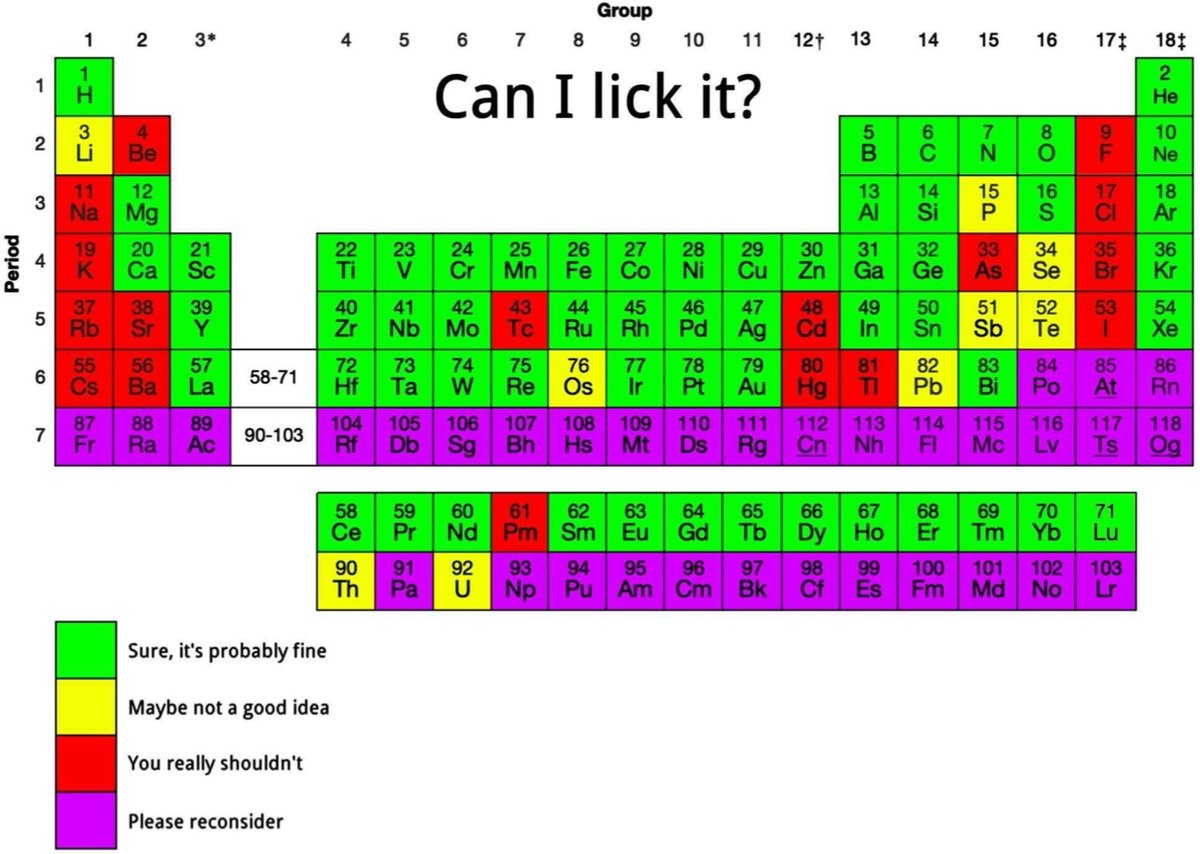
Is the periodic table yummy? Well, it depends on the element. But if you’ve ever wondered if a little taste of xenon or iridium would do you any harm, this periodic table is for you.
Steve Mould’s videos are always entertaining and informative but this one is also a little bit mind-blowing. If you build a circular trough with just the right dimensions and fill it with lighter fluid, a flame will travel around it. And other shapes will do other things — the effect created by the star/octopus shape is especially cool. The effect is an example of an excitable medium:
An excitable medium is a nonlinear dynamical system which has the capacity to propagate a wave of some description, and which cannot support the passing of another wave until a certain amount of time has passed (known as the refractory time).
A forest is an example of an excitable medium: if a wildfire burns through the forest, no fire can return to a burnt spot until the vegetation has gone through its refractory period and regrown.
Other examples:
Normal and pathological activities in the heart and brain can be modelled as excitable media. A group of spectators at a sporting event are an excitable medium, as can be observed in a Mexican wave (so-called from its initial appearance in the 1986 World Cup in Mexico).
Really fascinating piece by Michael Habib in Scientific American about how amazing feathers are: they come in so many different shapes and sizes and do so many things (insulate, keep dry, flying, noise dampening, etc. etc. etc.) And I loved the opening anecdote:
In October 2022 a bird with the code name B6 set a new world record that few people outside the field of ornithology noticed. Over the course of 11 days, B6, a young Bar-tailed Godwit, flew from its hatching ground in Alaska to its wintering ground in Tasmania, covering 8,425 miles without taking a single break. For comparison, there is only one commercial aircraft that can fly that far nonstop, a Boeing 777 with a 213-foot wingspan and one of the most powerful jet engines in the world. During its journey, B6-an animal that could perch comfortably on your shoulder-did not land, did not eat, did not drink and did not stop flapping, sustaining an average ground speed of 30 miles per hour 24 hours a day as it winged its way to the other end of the world.
Many factors contributed to this astonishing feat of athleticism-muscle power, a high metabolic rate and a physiological tolerance for elevated cortisol levels, among other things. B6’s odyssey is also a triumph of the remarkable mechanical properties of some of the most easily recognized yet enigmatic structures in the biological world: feathers. Feathers kept B6 warm overnight while it flew above the Pacific Ocean. Feathers repelled rain along the way. Feathers formed the flight surfaces of the wings that kept B6 aloft and drove the bird forward for nearly 250 hours without failing.
Ok, I said no more eclipse posts (maybe) and then posted like two or three more, but really this is the last one — maybe! In 1973, a group of scientists witnessed the longest ever total solar eclipse by flying in the shadow (umbra) of the moon in a Concorde prototype for 74 minutes over the Sahara desert. From the abstract of a paper in Nature about the flight:
On June 30, 1973, Concorde 001 intercepted the path of a solar eclipse over North Africa, Flying at Mach 2.05 the aircraft provided seven observers from France, Britain and the United States with 74 min of totality bounded by extended second (7 min) and third (12 min) contacts. The former permitted searches for time variations of much longer period than previously possible and the latter provided an opportunity for chromospheric observations of improved height resolution. The altitude, which varied between 16,200 and 17,700 m, freed the observations from the usual weather problems and greatly reduced atmospheric absorption and sky noise in regions of the infrared.
Mach 2.05 = 1573 mph = 2531 km/h. 17,700 m = 58,000 ft. They added portholes to the roof of the plane for better viewing and data gathering. This page on Xavier Jubier’s site contains lots of amazing details about the flight, including a map of the flight’s path compared to the umbra, photos of the retrofitted plane, and a graph of the umbra’s velocity across the surface of the Earth (which shows that for at least part of the eclipse, the Concorde was actually outrunning the moon’s shadow).
By flying inside the umbral shadow cone of the Moon at the same speed, the Concorde was going to stay in the darkness for nearly 74 minutes, the time for astronomers and physicists on board to do all the experiences they could imagine to complete during this incredible period of black Sun. They were able to achieve in one hour and fifteen minutes what would have taken decades by observing fifteen total solar eclipses from places that would have not necessarily gotten clear skies.
Ok, one last post about the total solar eclipse and then I’m done talking about it. (Maybe.)
There are so many mind-blowing things about eclipses but the one I can’t stop thinking about is the nearly impossible coincidence that the sun and the moon are the same relative size in the sky. If the moon were a little bit smaller or farther away, we wouldn’t have total eclipses where you can look directly at the sun, see the corona, the sky goes dark, you see a sunset effect all around the horizon, etc. That is some spooky magical shit. Ted Underwood put it this way:
Random accident that the moon and sun are the same apparent size here. If we had interstellar tourism, this is the One Thing that everyone would know about the Earth, and when they visited they wouldn’t want to see anything else. “We also have museums?” we’d say.
The moon is slowly drifting away from the Earth and total eclipses will gradually get rarer and rarer until, hundreds of millions of years from now, they will stop completely.1 That we’re all here right now, getting to experience this magical thing? Like, what?! If a science fiction writer made this up for a story, we’d say it’s too much.
And yet, for me at least, the coincidences don’t stop there.
When I saw my first total eclipse in 2017, we had to drive for 3.5 hours through three different rainstorms to find some clear skies. When we finally stopped, 40 minutes before totality, it was in a town so small that it’s not even called a town anymore: Rayville, Missouri. Yep, we found the sun in Rayville. What are the odds?
And then this year, on April 8th, the path of totality went right over my house in Vermont. In the past 70 years in Vermont prior to 2024, it’s been overcast about 50% of the time and only mostly sunny in 13 of those years. This year? Not a cloud in the sky when I woke up Monday morning.
I watched with a group of people in a big field in Colchester, including my friend Caroline and her dog, Stella (a name derived from the Latin word for star). There were a bunch of other groups watching in the field too and after totality had thrilled us all, they trickled back to their cars and homes. Our group stayed and I watched the last little bit of the moon slip past the sun through my telescope — it was officially over.
A large nearby group of folks with a couple of dogs left shortly after that. One of the dogs came over for a sniff and one of our party asked the guy what the dog’s name was. “Luna.”
I am sure, hundreds of millions of years ago, when the moon was closer to the Earth, total eclipses were a whole other level of whoaaaaa — lasting for 10-20 minutes at a time, completely blocking out any light from the sun, total darkness all around, etc.↩
Well, the total solar eclipse was once again completely awesome. I didn’t have to go chasing all over tarnation this time, the telescope worked out amazingly well, and I got to share it with a bunch of first-timers, both in-person and via text. I’m going to share some thoughts, photos, and videos from others around the internet in an even bloggier fashion than usual. Here we go.
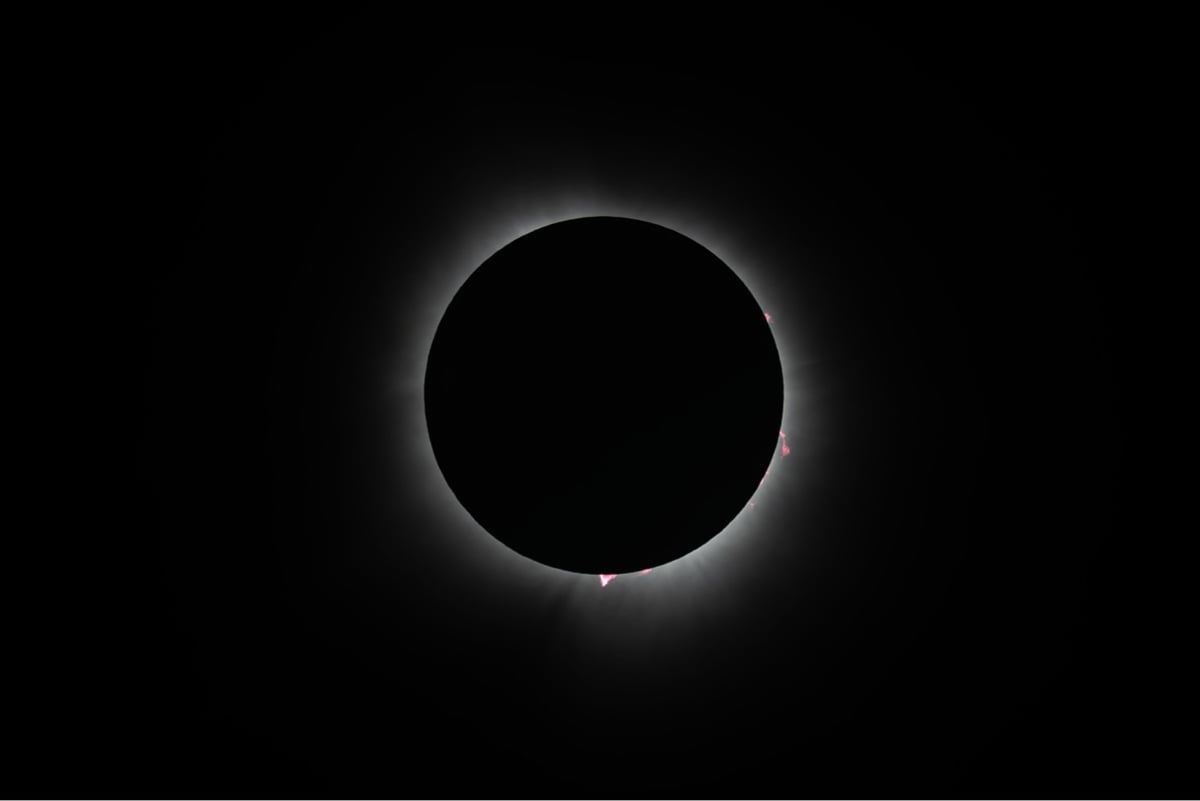
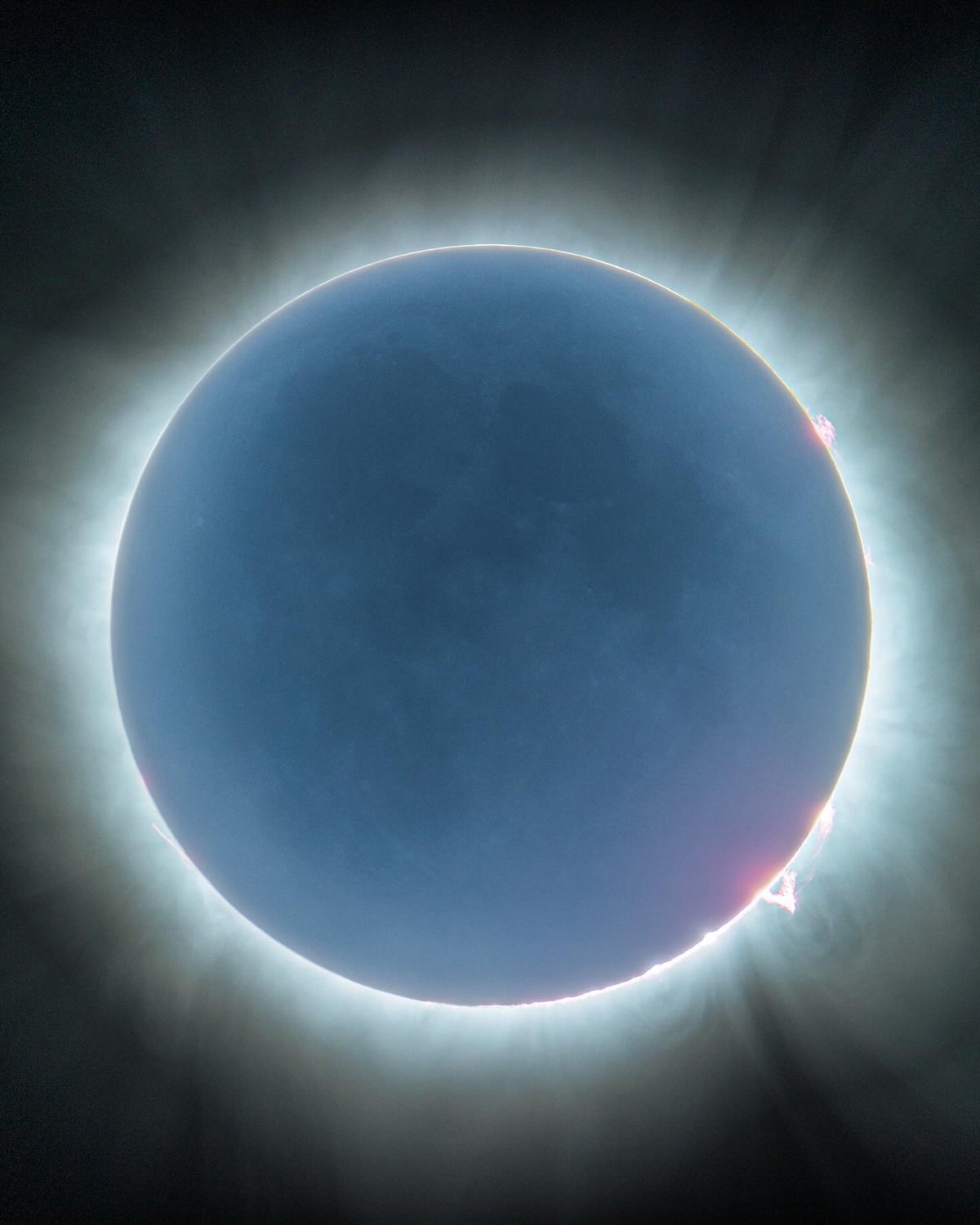
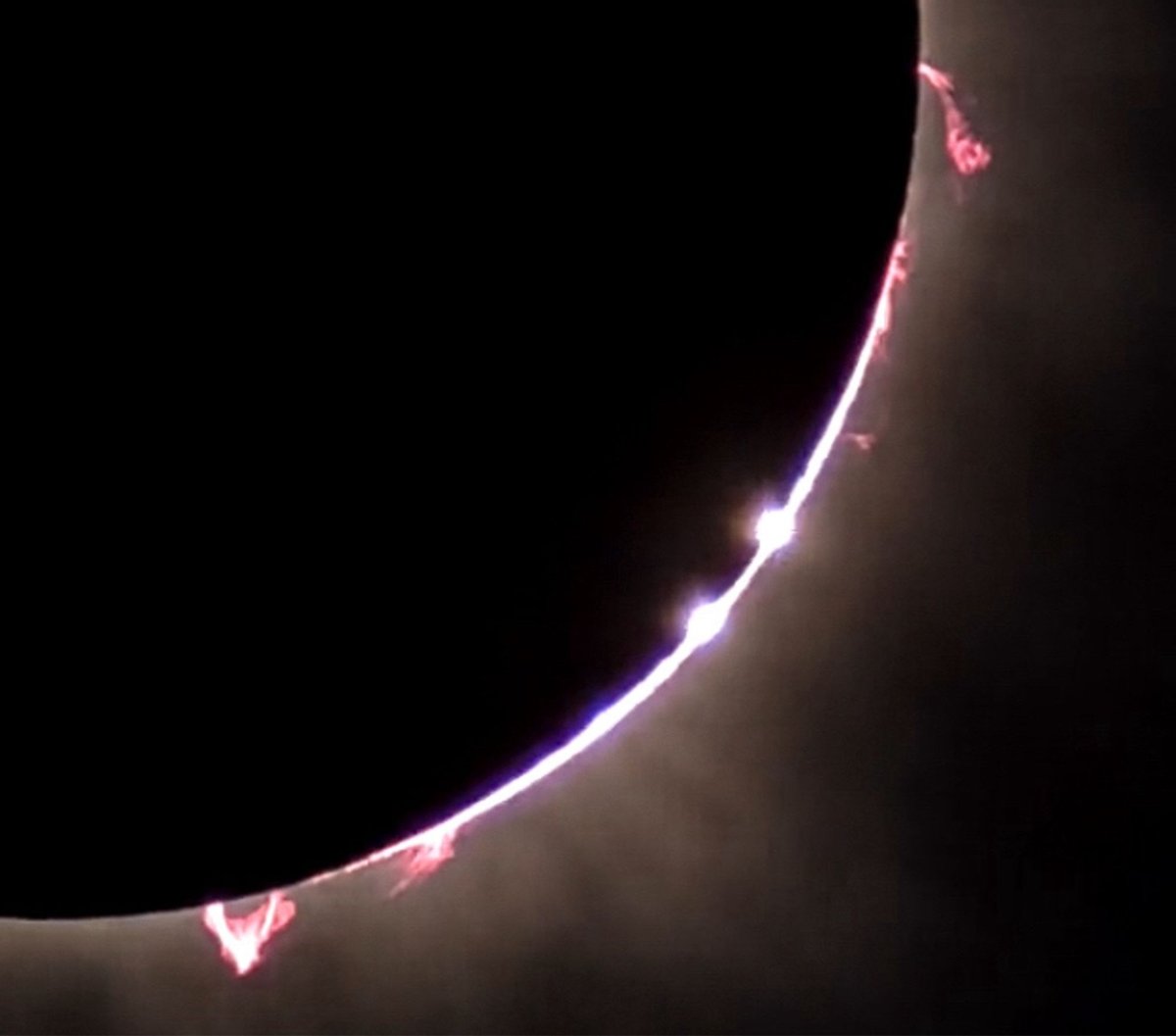
Quick solar prominence explainer interlude: if you had a clear look at totality, you may have noticed some orange bits poking out around the moon. NASA: What is a solar prominence?
A solar prominence (also known as a filament when viewed against the solar disk) is a large, bright feature extending outward from the Sun’s surface. Prominences are anchored to the Sun’s surface in the photosphere, and extend outwards into the Sun’s hot outer atmosphere, called the corona. A prominence forms over timescales of about a day, and stable prominences may persist in the corona for several months, looping hundreds of thousands of miles into space. Scientists are still researching how and why prominences are formed.
The red-glowing looped material is plasma, a hot gas comprised of electrically charged hydrogen and helium. The prominence plasma flows along a tangled and twisted structure of magnetic fields generated by the sun’s internal dynamo. An erupting prominence occurs when such a structure becomes unstable and bursts outward, releasing the plasma.
A timelapse video of totality from Scientific American:
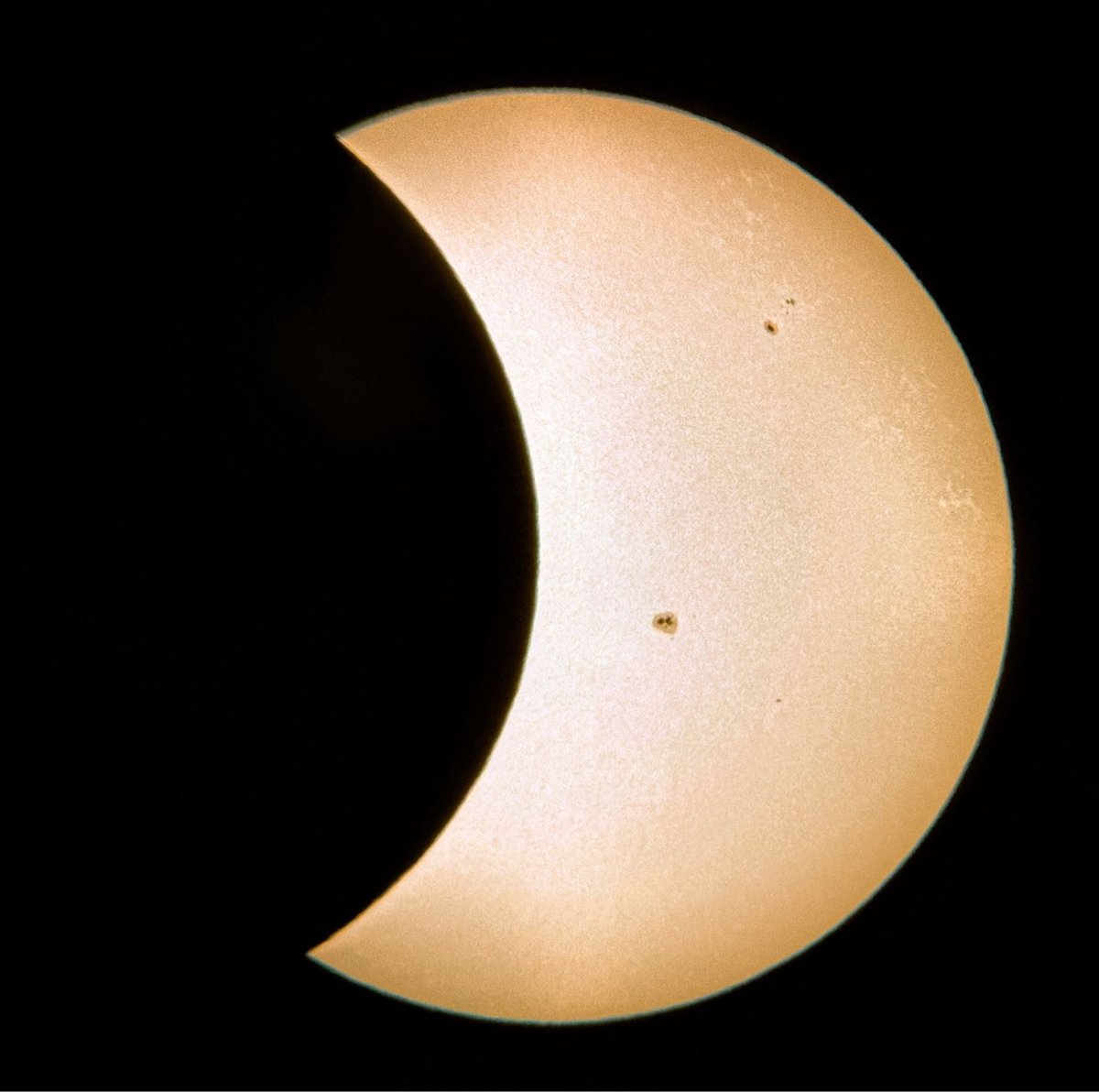
A sunspot is simply a region on the surface of the sun-called the photosphere-that is temporarily cool and dark compared to surrounding regions. Solar measurements reveal that the average surface temperature of the sun is 6000° Celsius and that sunspots are about 1500° Celsius cooler than the area surrounding them (still very hot), and can last anywhere from a few hours to a few months. Sunspots expand and contract as they move across the surface of the sun and can be as large as 80,000 km in diameter.
Sunspots are magnetic regions on the sun with magnetic field strengths thousands of times stronger than the Earth’s magnetic field, and often appear in pairs that are aligned in an east-west direction. One set will have a positive or north magnetic field while the other set will have a negative or south magnetic field. The field is strongest in the darker parts of the sunspots — called the umbra. The field is weaker and more horizontal in the lighter part-the penumbra. Overall, sunspots have a magnetic field that is about 1000 times stronger than the surrounding photosphere.
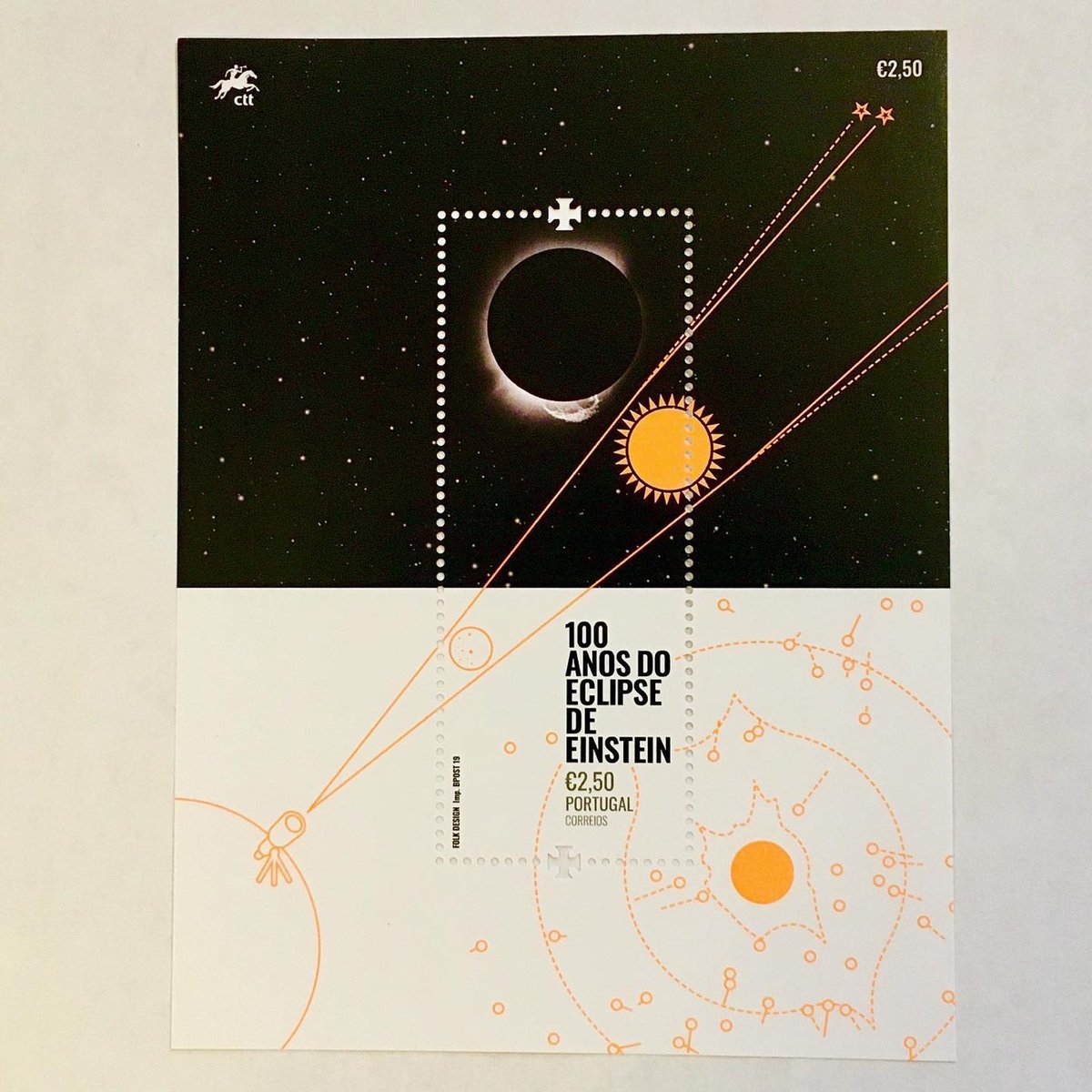
This Instagram account has a lovingly assembled collection of solar eclipse stamps from around the world (Aruba, Bhutan, Chile, Romania, Kenya, and even North Korea).
Total solar eclipses occur because the moon and the sun have the same apparent size in Earth’s sky — the sun is about 400 times wider than the moon, but the moon is about 400 times closer.
But the moon is slowly moving away from Earth by about 1-1/2 inches (4 centimeters) per year, according to the NASA statement. As a result, total solar eclipses will cease to exist in the very distant future, because the apparent size of the moon in Earth’s sky will be too small to cover the sun completely.
“Over time, the number and frequency of total solar eclipses will decrease,” Vondrak said in the statement. “About 600 million years from now, Earth will experience the beauty and drama of a total solar eclipse for the last time.”
Ok, that’s all for now. Depending on what else I come across, I might update this post periodically throughout the day. I know some of you who were lucky enough to see the total eclipse shared your experiences in the comments of yesterday’s post but feel free to do so here as well.
In 1900, celebrated magician (and astronomy enthusiast) Nevil Maskelyne travelled to North Carolina to film a solar eclipse on May 28, 1900. The Royal Astronomical Society and the British Film Institute reckon this is “the first surviving astronomical film in the world”.
In 1898 he travelled to India to photograph an eclipse. He succeeded but the film can was stolen on his return journey home.
It was not an easy feat to film. Maskelyne had to make a special telescopic adapter for his camera to capture the event. This is the only film by Maskelyne that we know to have survived.
The original film fragment held in The Royal Astronomical Society’s archive has been painstakingly scanned and restored in 4K by conservation experts at the BFI National Archive, who have reassembled and retimed the film frame by frame. The film is part of BFI Player’s recently released Victorian Film collection, viewers are now able to experience this first film of a solar eclipse since the event was originally captured over a century ago.
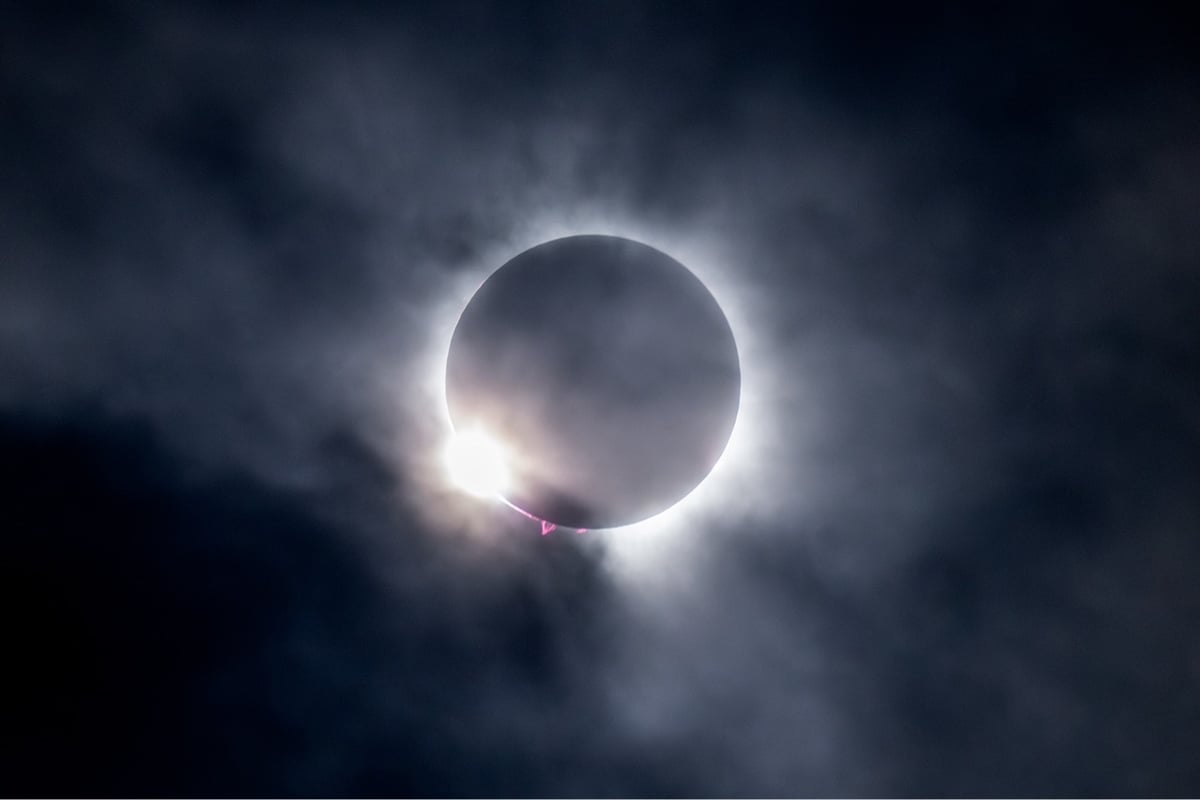
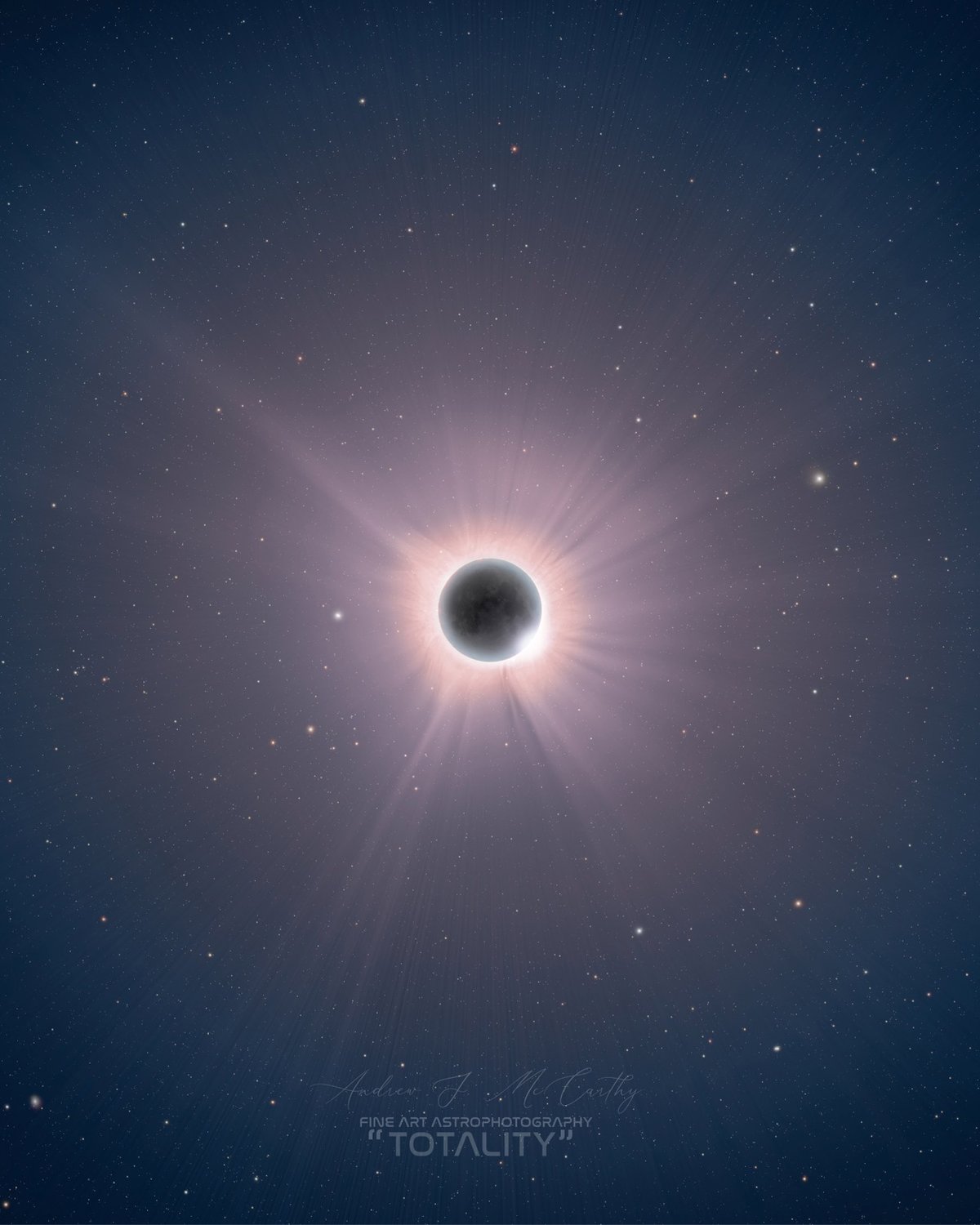
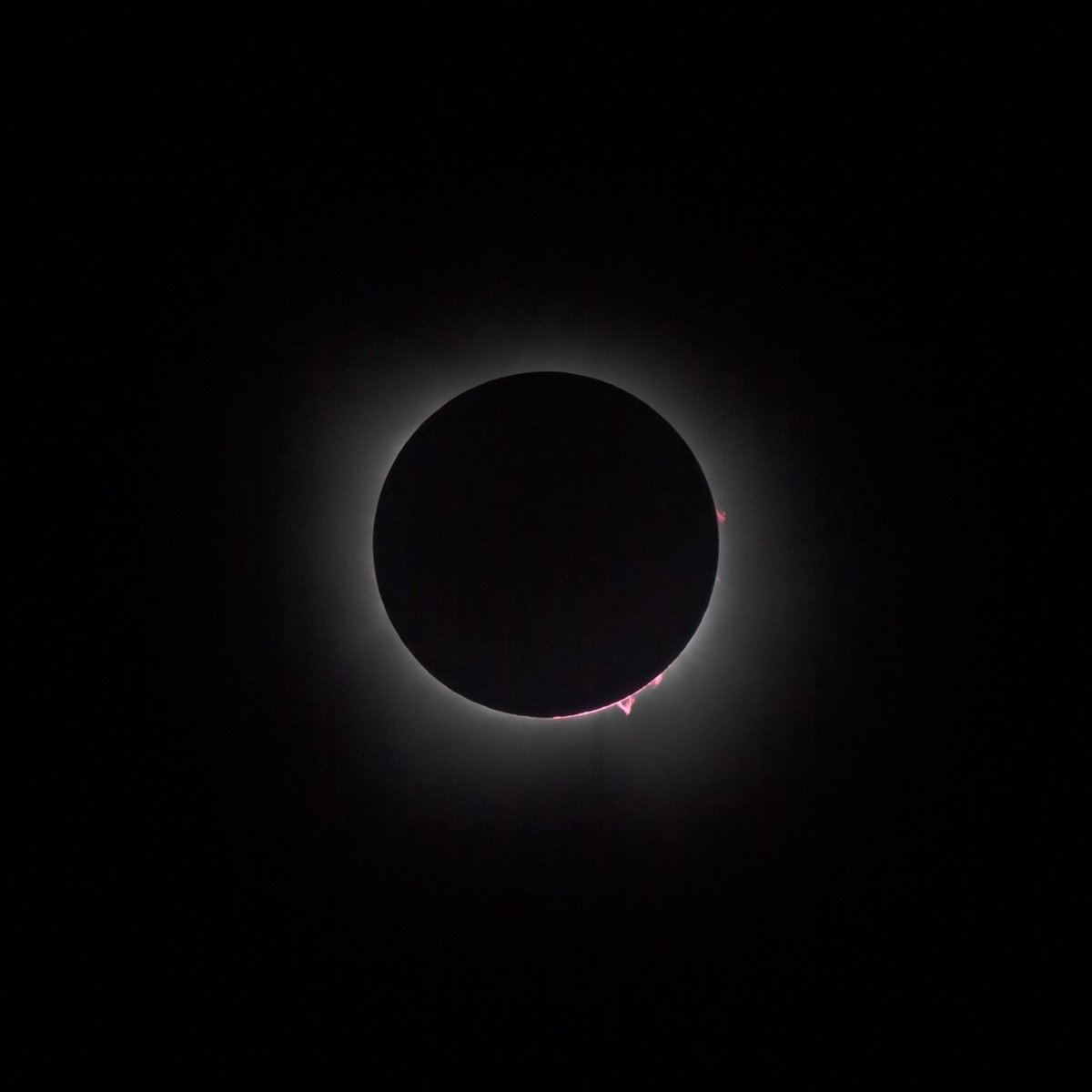
We saw the Baily’s beads and the diamond ring effect. And then…sorry, words are insufficient here. When the Moon finally slipped completely in front of the Sun and the sky went dark, I don’t even know how to describe it. The world stopped and time with it. During totality, Mouser took the photo at the top of the page. I’d seen photos like that before but had assumed that the beautifully wispy corona had been enhanced with filters in Photoshop. But no…that is actually what it looks like in the sky when viewing it with the naked eye (albeit smaller). Hands down, it was the most incredible natural event I’ve ever seen.
I’m not sure exactly what I expected, but this wasn’t it. I’d seen photos of coronas around suns, but this wasn’t that. And I’d expected that those photos, like many astronomical pictures, are long exposure, other wavelengths, and otherwise capturing things the naked eye can’t see. I thought there might be a glow of light in a circle, or nothing, or, I don’t know. What I did not expect was an unholy horror sucking the life and light and warmth out of the universe with long reaching arms, that what I’d seen in pictures was not an exaggeration but a failure to capture the extent of this thing that human eyes, and not cameras, are uniquely suited to absorb the horror of.
I had seen a partial eclipse in 1970. A partial eclipse is very interesting. It bears almost no relation to a total eclipse. Seeing a partial eclipse bears the same relation to seeing a total eclipse as kissing a man does to marrying him, or as flying in an airplane does to falling out of an airplane. Although the one experience precedes the other, it in no way prepares you for it.
I am so looking forward to Monday and crossing my fingers for clear skies — the path of totality goes right over my house.
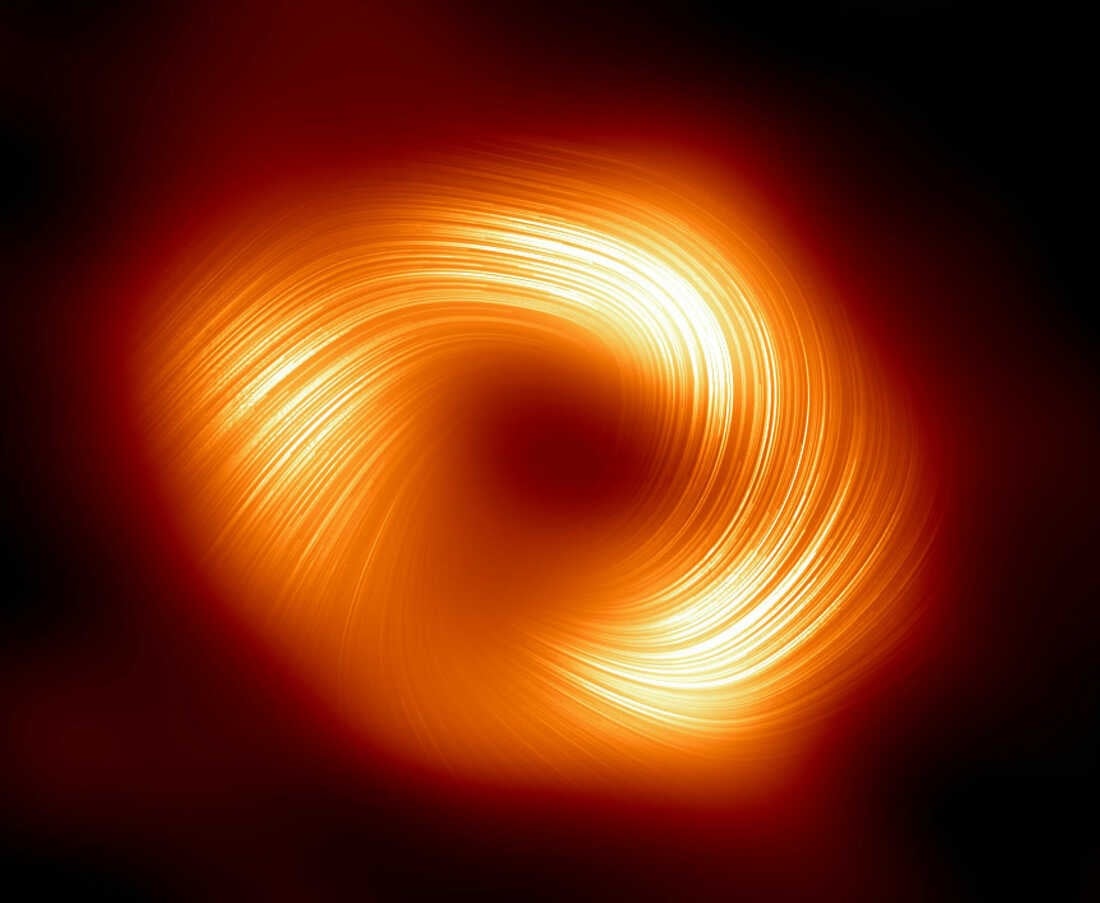
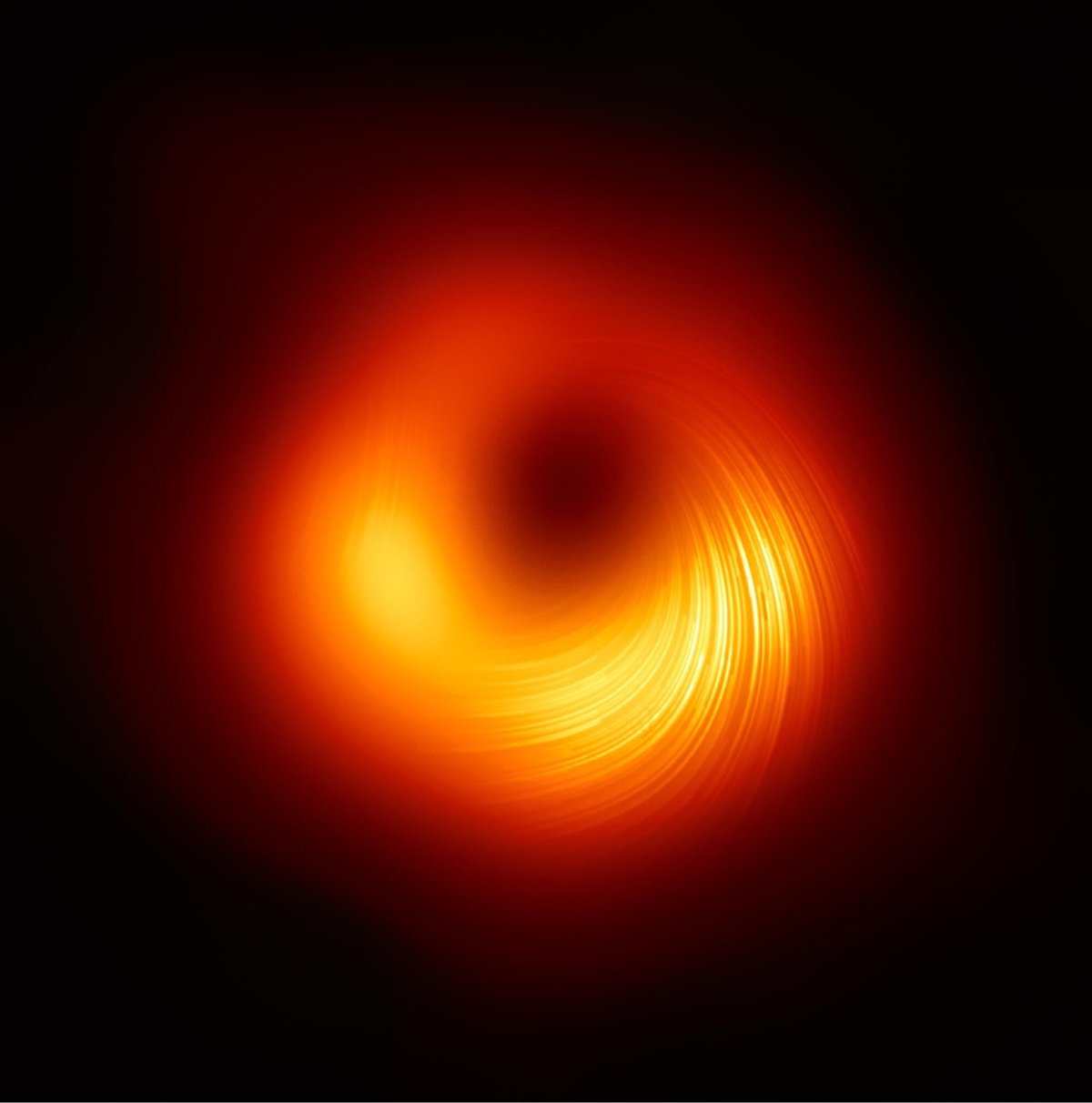
It’s been about five years since scientists captured the first blurry image of a black hole. Using what they learned from that experience, they’ve teased out some more detailed images of the black holes at the centers of the Milky Way galaxy (top) and the M87 galaxy (bottom). The process of collecting the data for these images is interesting:
The only way to “see” a black hole is to image the shadow created by light as it bends in response to the object’s powerful gravitational field. As Ars Science Editor John Timmer reported in 2019, the EHT isn’t a telescope in the traditional sense. Instead, it’s a collection of telescopes scattered around the globe. The EHT is created by interferometry, which uses light in the microwave regime of the electromagnetic spectrum captured at different locations. These recorded images are combined and processed to build an image with a resolution similar to that of a telescope the size of the most distant locations. Interferometry has been used at facilities like ALMA (the Atacama Large Millimeter/submillimeter Array) in northern Chile, where telescopes can be spread across 16 km of desert.
In theory, there’s no upper limit on the size of the array, but to determine which photons originated simultaneously at the source, you need very precise location and timing information on each of the sites. And you still have to gather sufficient photons to see anything at all. So atomic clocks were installed at many of the locations, and exact GPS measurements were built up over time. For the EHT, the large collecting area of ALMA-combined with choosing a wavelength in which supermassive black holes are very bright-ensured sufficient photons.
While this idea may initially sound somewhat mundane, it is anything but. The result is surprising because Sgr A*’s mass is about 4.3 million times that of the Sun, while M87*’s is about 6.5 billion times that of the Sun. Despite the significant difference in mass between the two supermassive black holes, the fact that their magnetic fields behave similarly and are both well-organized is an incredible discovery.
In this Crash Course video, author and “TB-hater” John Green takes a deep dive into tuberculosis.
This is the story of the deadliest infectious disease of all time. It’s been with us for 3 million years, since before humans were homo sapiens. We have evidence of it in the mummies of ancient Egypt, and it’s mentioned in the Hebrew Bible.
We’ve made extraordinary medical advances. Vaccines, antibiotics, and clean water have saved millions of lives. And yet despite that, in 2022, this disease killed more people than malaria, typhoid, cholera, homicide, and war…combined.
It has gone by many names. In ancient China, it was known as huaifu, meaning “destroyed palace.” In ancient Hebrew, “schachepheth,” meaning wasting away. The 19th-century term: “consumption,” for the way it seemed to consume the body. Today, we call it tuberculosis.
My teen daughter doesn’t care for crosswords or the Spelling Bee, but she does try to play Connections every day. We were working on this one together a few days ago and when I suggested SNAIL GALAXY CYCLONE SUNFLOWER as a group, she said “I was thinking spirals but sunflowers are round”. Which prompted a discussion about the Fibonacci sequence and the golden ratio (which she’d covered in math class) and a search for videos that explained how the sequence pops up in nature and, specifically, sunflowers.
As beautiful as the sunflower is, isn’t it even lovelier knowing there is a deep mathematical order to it?
I have a friend who’s an artist and has sometimes taken a view which I don’t agree with very well. He’ll hold up a flower and say “look how beautiful it is,” and I’ll agree. Then he says “I as an artist can see how beautiful this is but you as a scientist take this all apart and it becomes a dull thing,” and I think that he’s kind of nutty.
First of all, the beauty that he sees is available to other people and to me too, I believe. Although I may not be quite as refined aesthetically as he is … I can appreciate the beauty of a flower. At the same time, I see much more about the flower than he sees.
I could imagine the cells in there, the complicated actions inside, which also have a beauty. I mean it’s not just beauty at this dimension, at one centimeter; there’s also beauty at smaller dimensions, the inner structure, also the processes. The fact that the colors in the flower evolved in order to attract insects to pollinate it is interesting; it means that insects can see the color. It adds a question: does this aesthetic sense also exist in the lower forms? Why is it aesthetic? All kinds of interesting questions which the science knowledge only adds to the excitement, the mystery and the awe of a flower. It only adds. I don’t understand how it subtracts.
Games, language, mathematics, the beauty of flowers, science, time spent together — Connections indeed.
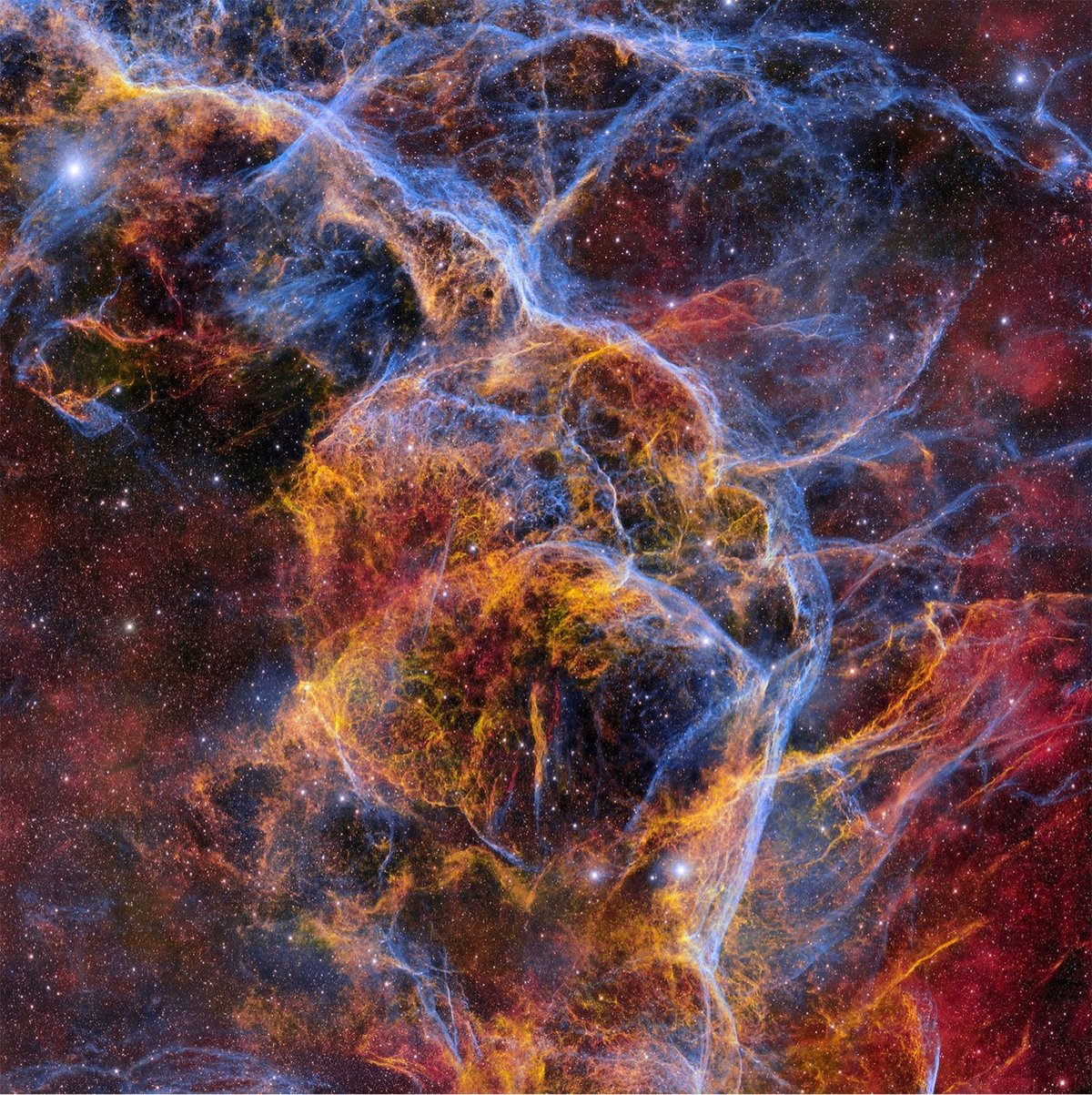
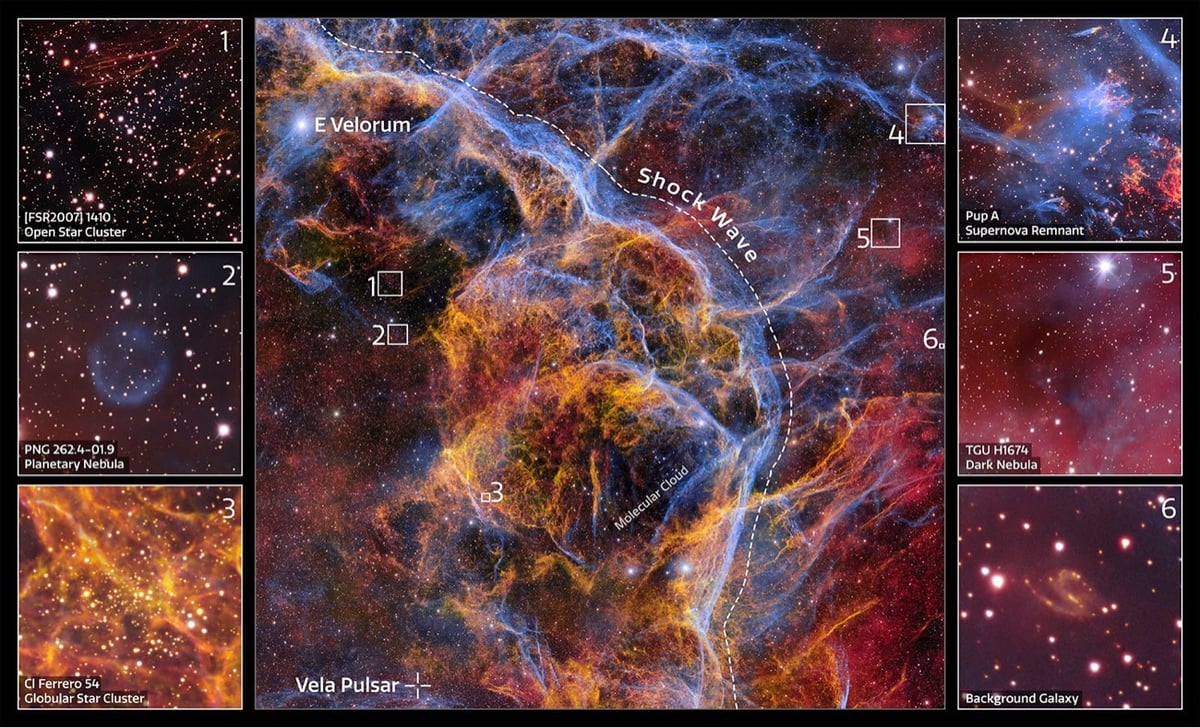
The Vela Supernova remnant, located about 800 light-years away from Earth, is the cosmic corpse of a massive star that exploded 11,000 years ago. It is one of the closest supernova remnants to Earth and the perfect subject for the remarkable Dark Energy Camera.
The supernova is a vast cosmic structure about 100 light-years across. For context, one would have to travel around the Earth 200 million times to have traveled a single light-year.
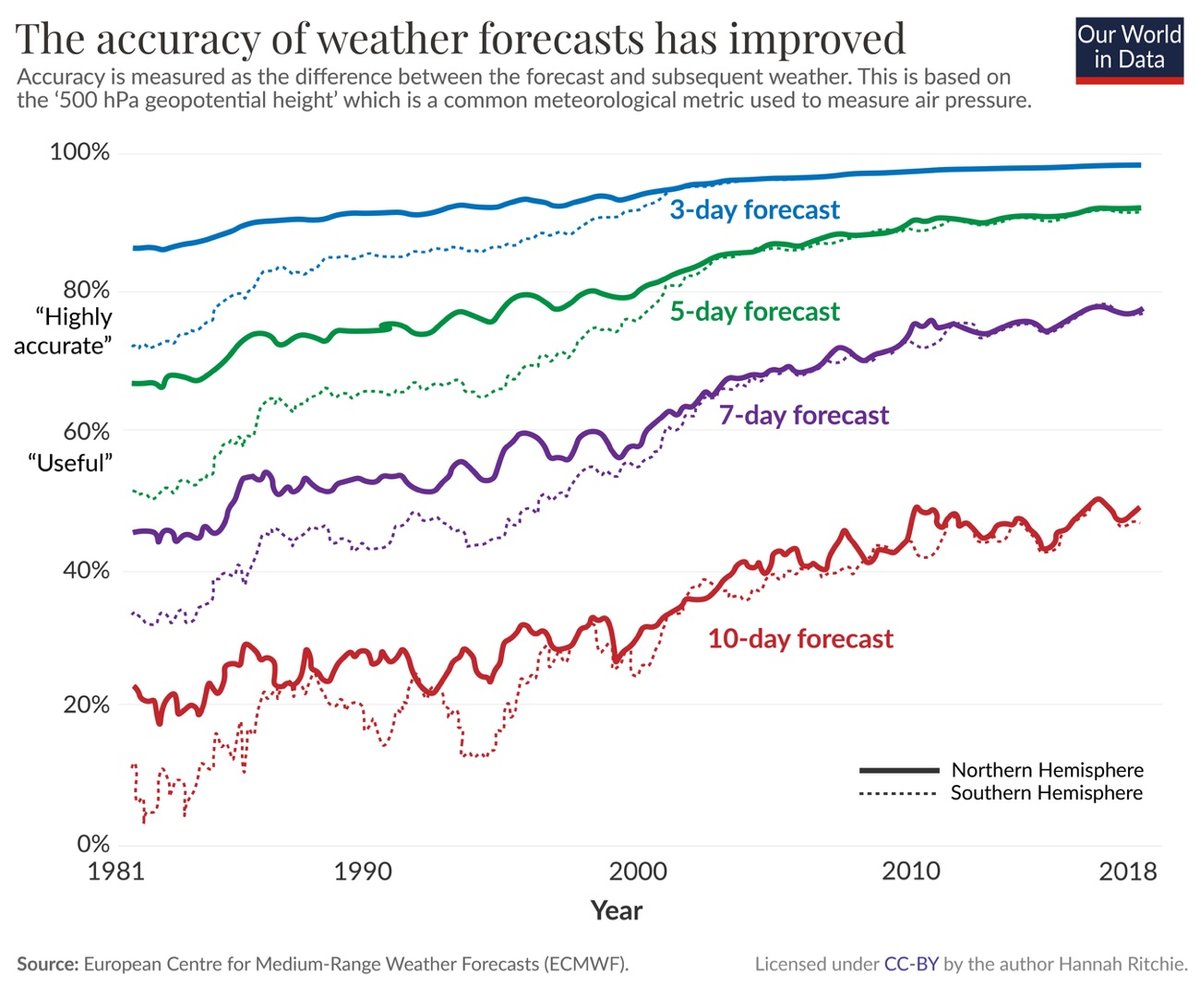
You may not have noticed, but weather forecasts — temperature, precipitation, hurricane tracks — have improved greatly over the past few decades.
Dr. Hannah Ritchie of Our World in Data explains why.
The first big change is that the data has improved. More extensive and higher-resolution observations can be used as inputs into the weather models. This is because we have more and better satellite data, and because land-based stations are covering many more areas around the globe, and at a higher density. The precision of these instruments has improved, too.
These observations are then fed into numerical prediction models to forecast the weather. That brings us to the next two developments. The computers on which these models are run have gotten much faster. Faster speeds are crucial: the Met Office now chunks the world into grids of smaller and smaller squares. While they once modeled the world in 90-kilometer-wide squares, they are now down to a grid of 1.5-kilometer squares. That means many more calculations need to be run to get this high-resolution map. The methods to turn the observations into model outputs have also improved. We’ve gone from very simple visions of the world to methods that can capture the complexity of these systems in detail.
The final crucial factor is how these forecasts are communicated. Not long ago, you could only get daily updates in the daily newspaper. With the rise of radio and TV, you could get a few notices per day. Now, we can get minute-by-minute updates online or on our smartphones.
If you’re in the US, you can see how accurate the weather forecast is in your area by using ForecastAdvisor.
Using a scale model of the solar system the size of New York City and some dazzling visual effects, Epic Spaceman explains that black holes are generally smaller than you might think (because they’re so dense) — even the supermassive black hole at the center of our galaxy. But when you consider some of the biggest black holes we’ve discovered…wow.
I didn’t know what to expect from this 1937 video explanation of how wire photos were transmitted to newspapers, but a double stunt sequence featuring an airplane and a death-defying photographer was not anywhere on my bingo card. This starts kinda slow but it picks up once they get into the completely fascinating explanation of how they sent photographs across the country using ordinary telephone lines. The whole setup was portable and they just hacked into a wire on a telephone pole, asked the operator to clear the line, and sent a photo scan via an analog modem. Ingenious!
The Wikipedia page about wire photos is worth a read — French designers argued that the technology was responsible for an early form of fast fashion.
After World War II at haute couture shows in Paris, Frederick L. Milton would sketch runway designs and transmit his sketches via Bélinographe to his subscribers, who could then copy Parisian fashions. In 1955, four major French couturiers (Lanvin, Dior, Patou, and Jacques Fath) sued Milton for piracy, and the case went to the Appellate Division of the New York Supreme Court. Wirephoto enabled a speed of transmission that the French designers argued damaged their businesses.
Is the universe finite or infinite? If finite, what shape is it and how does that shape influence its overall size and properties? If it’s infinite, what meaning of “expanding” can be applied to it? I don’t know if this video provides any satisfying answers, but even being able to ponder these questions is thrilling.
Infinity gets much weirder though. As you travel with your spaceship in a straight line, you find new galaxies, stars and planets, new wonders, new weird stuff, probably new aliens and new lifeforms stranger than you could ever imagine. But after a long time, you might find the most special thing in the universe: Yourself. An exact copy of you watching this video right now.
How can that be? Well, everything in existence is made of a finite amount of different particles. And a finite number of different particles can only be combined in a finite number of ways. That number may be so large that it feels like infinity to our brains — but it is not really. If you have finite options to build things, but infinite space that is full of things in all directions forever, then it makes sense that by pure chance, there will likely be repetition.
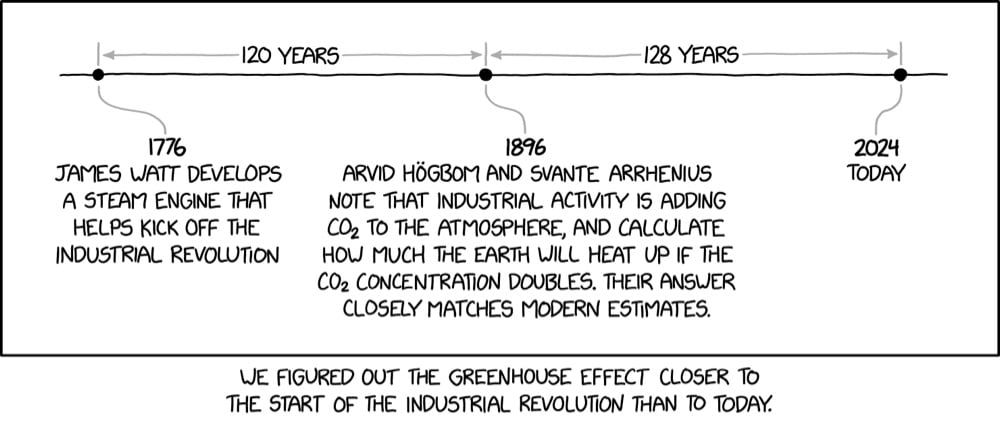
The warming effect of sunlight on different gases was examined in 1856 by Eunice Newton Foote, who described her experiments using glass tubes exposed to sunlight. The warming effect of the sun was greater for compressed air than for an evacuated tube and greater for moist air than dry air. “Thirdly, the highest effect of the sun’s rays I have found to be in carbonic acid gas.” (carbon dioxide) She continued: “An atmosphere of that gas would give to our earth a high temperature; and if, as some suppose, at one period of its history, the air had mixed with it a larger proportion than at present, an increased temperature from its action, as well as from an increased weight, must have necessarily resulted.”
Foote’s paper went largely unnoticed until it was rediscovered in the last decade. If you’re interested, the best thing I’ve read on the history of climate change is the 7th chapter of Charles Mann’s The Wizard and the Prophet.
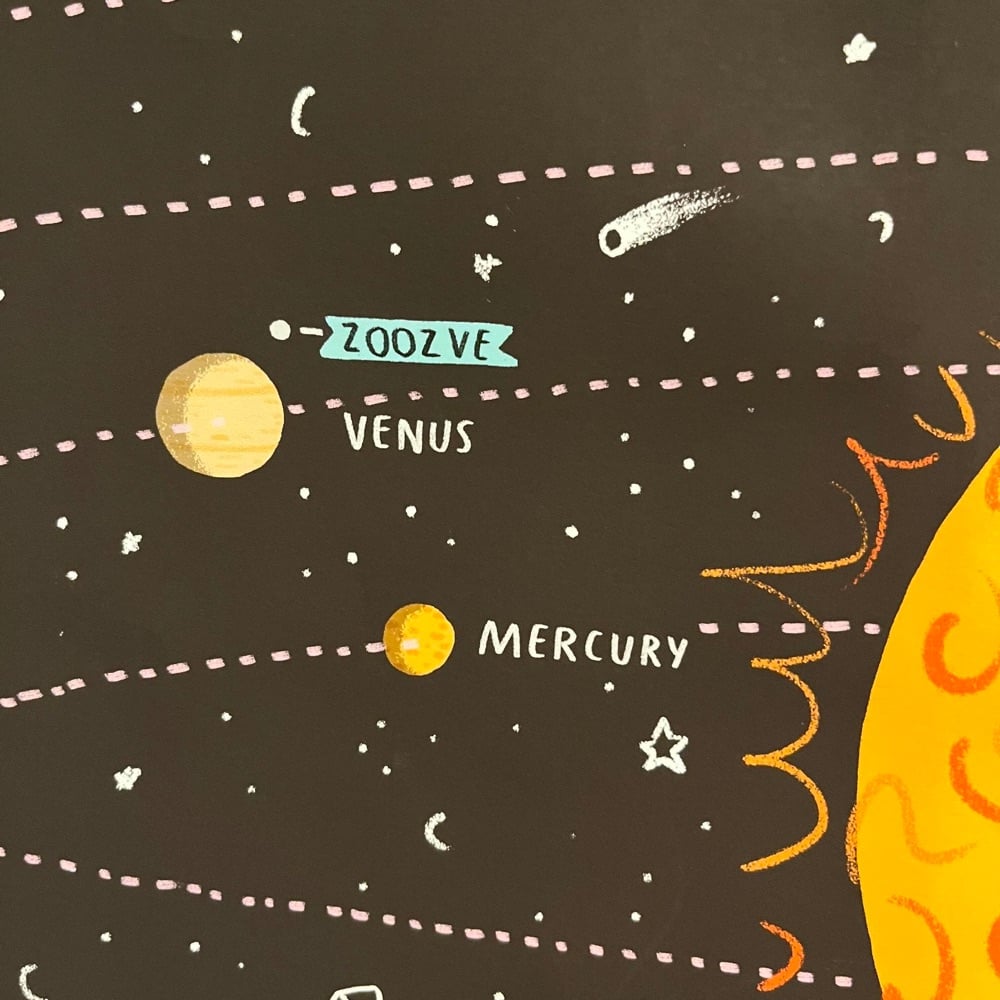
A couple of weeks ago, Radiolab aired an episode about a puzzling object on a children’s poster of the solar system: a Venusian moon called Zoozve. Venus doesn’t have any moons and “Zoozve” didn’t show up on Google at all, so co-host Latif Nasser went on a bit of a mission to find out what the heck this object was. He talked to someone at NASA, the poster’s designer, and various astronomers and physicists, including the person who had discovered Zoozve (aka 2002 VE68).
So begins a tiny mystery that leads to a newly discovered kind of object in our solar system, one that is simultaneously a moon, but also not a moon, and one that waltzes its way into asking one of the most profound questions about our universe: How predictable is it, really? And what does that mean for our place in it?
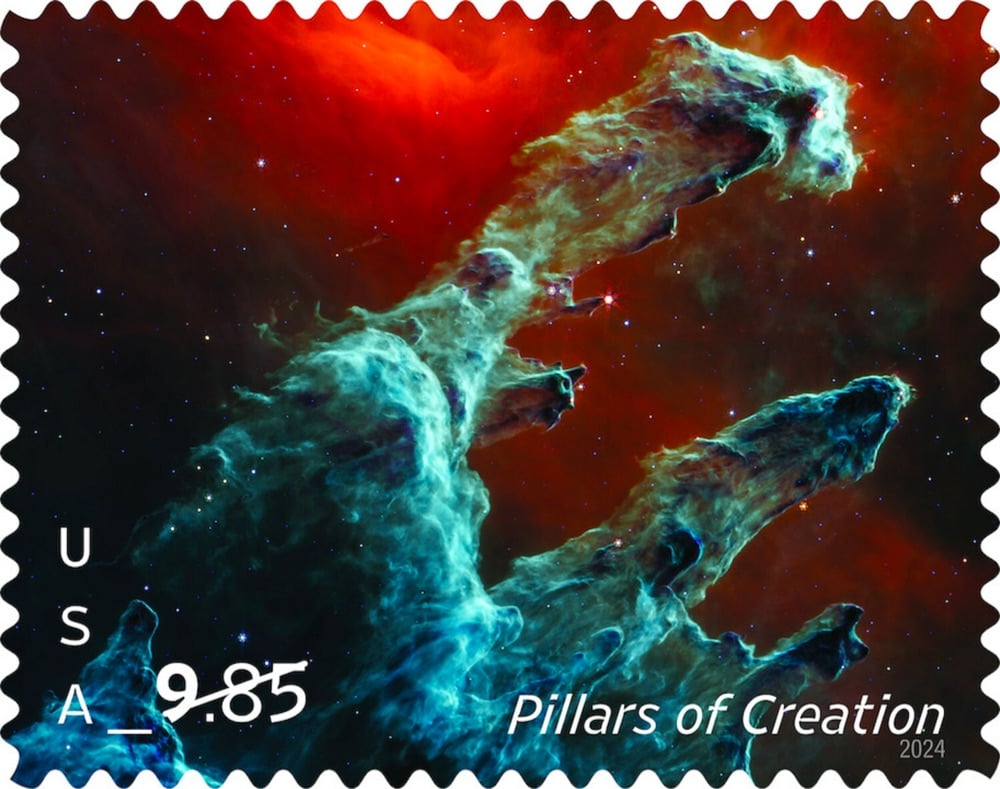
Captured by the James Webb Space Telescope, this extremely high-definition infrared image shows the magnificent Pillars of Creation formation within the Eagle Nebula. By assigning color to various wavelengths, the digitized image allows us to see a landscape otherwise invisible to the human eye. Red areas toward the end of the pillars show burgeoning stars ejecting raw materials as they form, while the relatively small red orbs scattered throughout the image show newly born stars.
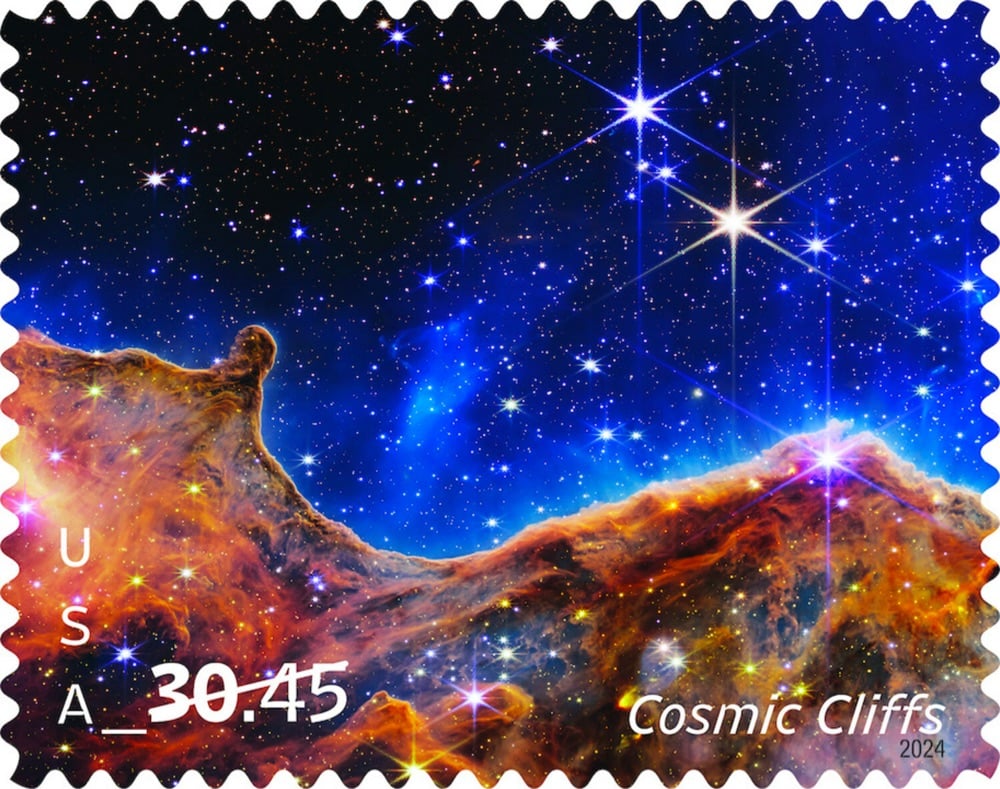
This remarkable image from the James Webb Space Telescope is a digitally colored depiction of the invisible bands of mid-infrared light emitted by the Cosmic Cliffs of the Carina Nebula. Red and yellow flares scattered throughout the cliffs show developing and newly born stars. The orange-and-brown clouds in the lower third of the image are swirls of dust and gas. Additional stars, in our Milky Way and in distant galaxies, appear in the blue and black regions above and beyond the nebula.
I’d missed that Randall Munroe has been doing videos based on his What If? website and books. The one I ran across the other day is about earthquakes:
Since we usually hear about earthquakes with ratings somewhere between 3 and 9, a lot of people probably think of 10 as the top of the scale and 0 as the bottom. In fact, there is no top or bottom to the scale!
Kurzgesagt’s latest video on the paradox of time is a bit more of a brain-bender than their usual videos. From the accompanying sources document:
This video summarizes in a narrative format two well-known theories about time: the so-called “block universe” and the “growing block”.
The block universe is an old theory of time which appears to be an unavoidable consequence of Einstein’s theory of special relativity. In philosophical contexts, basically the same idea is known as “eternalism”. Simplified, this theory posits that, although not apparent to our human perception, both the past and the future exist in the same way as the present does, and are therefore as real as the present is: The past still exists and the future exists already. As a consequence, time doesn’t “flow” (even if it looks so to us) and things in the universe don’t “happen” - the universe just “is”, hence the name “block universe”.
But then: “Quantum stuff is ruining everything again.” And so we have the growing block theory:
The Evolving/Growing Block: A relatively new alternative to the classical block universe theory, which asserts that the past may still exist but the present doesn’t yet, and all that in a way that is still compatible with Einstein’s relativity.
And there are still other theories about how time works:
Some scientists think that the idea of “now” only makes sense near you, but not in the universe as a whole. Others think that time itself doesn’t even exist — that the whole concept is an illusion of our human mind. And others think that time does exist, but that it’s not a fundamental feature of the universe. Rather, time may be something that emerges from a deeper level of reality, just like heat emerges from the motion of individual molecules or life emerges from the interactions of lifeless proteins.
The way to think about climate change now is through two interlinked concepts. The first is nonlinearity, the idea that change will happen by factors of multiplication, rather than addition. The second is the idea of “gray swan” events, which are both predictable and unprecedented. Together, these two ideas explain how we will face a rush of extremes, all scientifically imaginable but utterly new to human experience.
It’s the nonlinearity that’s always worried me about the climate crisis — and is the main source of my skepticism that it’s “fixable” at this point. Think about another nonlinear grey swan event: the Covid-19 pandemic. When was it possible to stop the whole thing in its tracks? When 10 people were infected? 50? 500? With a disease that spreads linearly, let’s say that stopping the spread when 20 people are infected is twice as hard as when 10 are infected — with nonlinear spread, it’s maybe 4x or 10x or 20x harder. When you reach a number like 20,000 or 100,000 infected over a wide area, it becomes nearly impossible to stop without extraordinary effort.
In thinking about the climate crisis, whatever time, effort, and expense halting global warming (and the myriad knock-on effects) may have required in 1990, let’s say it doubled by 2000. And then it didn’t just double again in the next ten years, it tripled. And then from 2010 to 2020, it quadrupled. An intact glacier in 1990 is waaaaay easier and cheaper to save than one in 2010 that’s 30% melted into the ocean; when it’s 75% melted in 2020, there’s really no way to get that fresh water back out of the ocean and into ice form.
It’s like the compounding interest on your student loans when you’re not making the minimum payments — not only does the amount you owe increase each month, the increase increases. And at a certain point, the balance is actually impossible to pay off at your current resource level.1 It’s hard to say where we are exactly on our climate repayment curve (and what the interest rate is), but we’ve not been making the minimum payments for awhile now and the ocean’s repossessing our glaciers and ice shelves and…
Think also of the story of the inventor of chess asking for a reward of a single rice grain on the first square of a chess board and double the amount on each successive square. After a week, he’s got only 127 grains. After four weeks, he’s got himself several thousand pounds of rice. Another week or two after that, he owns the whole kingdom. (And if the multiplication factor is only 1.2, he still gets the kingdom in fewer than 2 chess boards.)↩
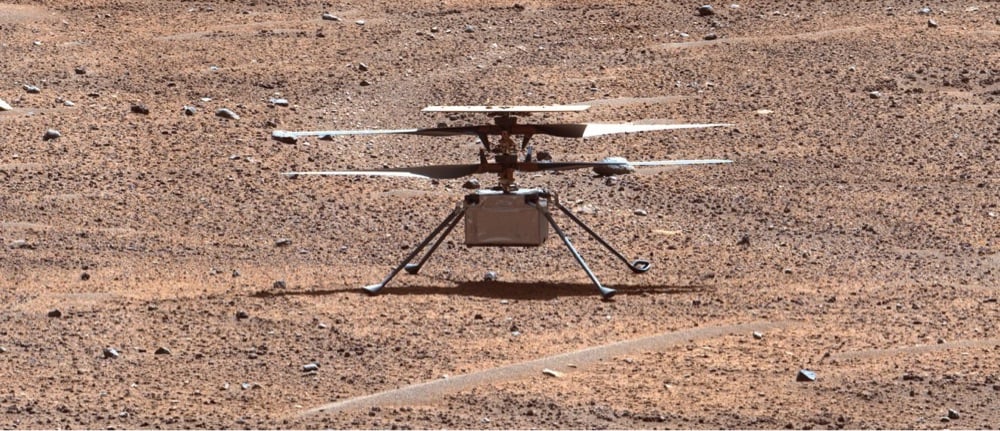
While the helicopter remains upright and in communication with ground controllers, imagery of its Jan. 18 flight sent to Earth this week indicates one or more of its rotor blades sustained damage during landing and it is no longer capable of flight.
Originally designed as a technology demonstration to perform up to five experimental test flights over 30 days, the first aircraft on another world operated from the Martian surface for almost three years, performed 72 flights, and flew more than 14 times farther than planned while logging more than two hours of total flight time.
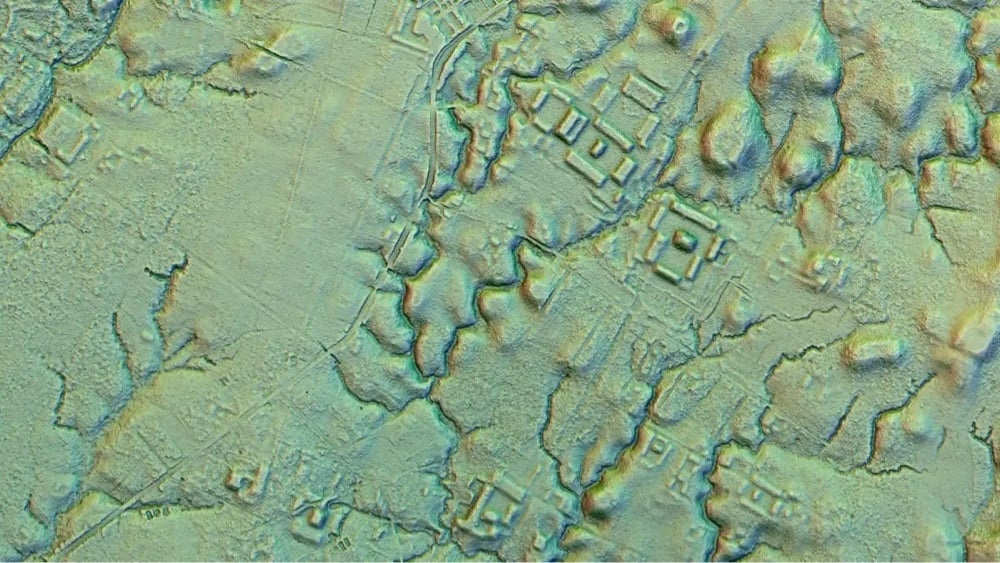
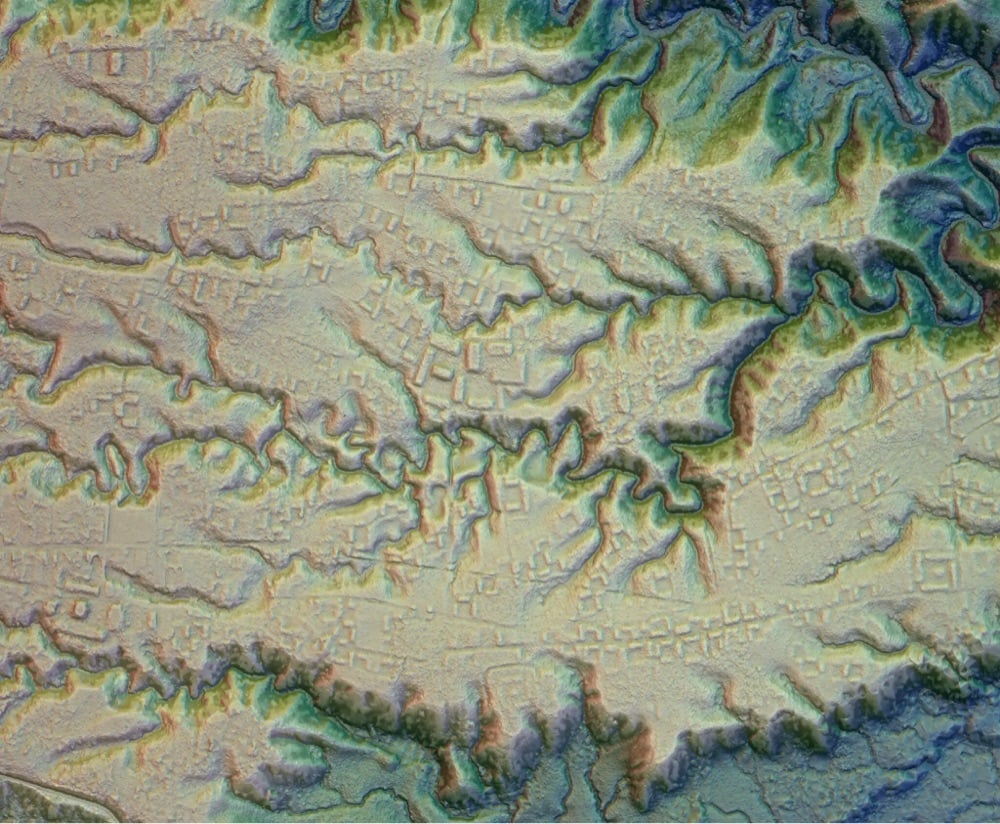
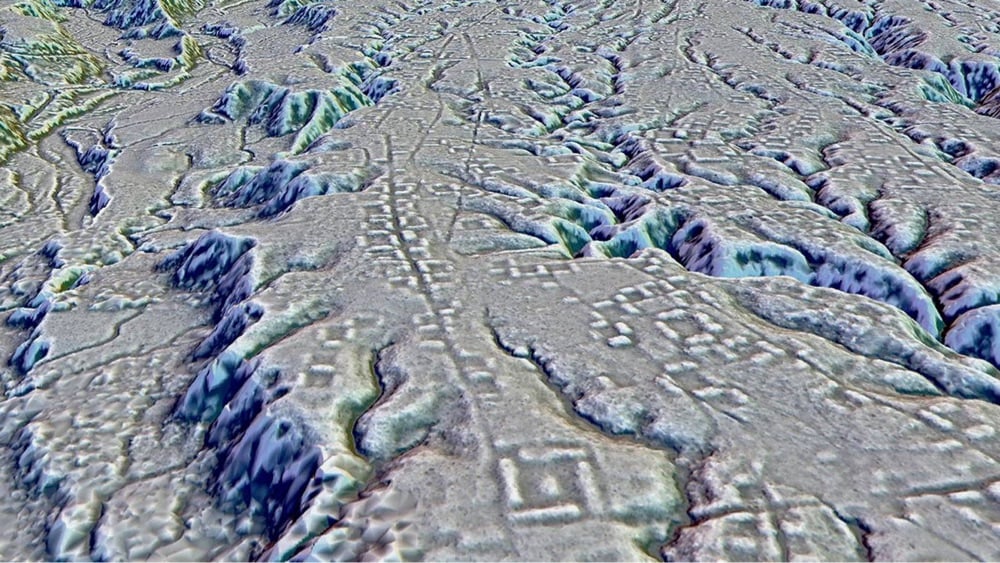
Using lidar, a team led by archaeologist Stéphen Rostain has found evidence of a network of cities in the Amazon dating back thousands of years. From the BBC:
Using airborne laser-scanning technology (Lidar), Rostain and his colleagues discovered a long-lost network of cities extending across 300sq km in the Ecuadorean Amazon, complete with plazas, ceremonial sites, drainage canals and roads that were built 2,500 years ago and had remained hidden for thousands of years. They also identified more than 6,000 rectangular earthen platforms believed to be homes and communal buildings in 15 urban centres surrounded by terraced agricultural fields.
The area may have been home to anywhere from 30,000 to hundreds of thousands of people:
“This discovery has proven there was an equivalent of Rome in Amazonia,” Rostain said. “The people living in these societies weren’t semi-nomadic people lost in the rainforest looking for food. They weren’t the small tribes of the Amazon we know today. They were highly specialised people: earthmovers, engineers, farmers, fishermen, priests, chiefs or kings. It was a stratified society, a specialised society, so there is certainly something of Rome.”
I still remember reading Charles Mann’s Earthmovers of the Amazon (which he turned into the excellent 1491) almost 25 years ago and being astounded to learn that civilizations in the Americas were older, larger, and more widespread than I’d been taught.
The other day I posted a quick note of appreciation for my trusty rice cooker. I have what you might call a fancy rice cooker — it has all sorts of different settings and “advanced Neuro Fuzzy logic technology” — and it cooks my rice perfectly, every time. I am sure it is an engineering marvel.
But this $20 one-button rice cooker also cooks rice perfectly, every time. And it does so using some very simple and clever engineering involving magnets:
This button thing is made of an alloy that has a Curie temperature just a bit higher than the boiling point of water. This allows it to function as a temperature-dependent kill switch. Thanks to the outer spring, it’s always held firmly in contact with the bottom of the pot, which ensures it and the pot are at nearly equal temperatures. So long as there’s liquid water sitting in that pot, the pot itself cannot get hotter than water’s boiling point.
This means that the button remains magnetic, and the magnet is able to overcome the force of the inner spring, so the device stays in cook mode. But, once the rice has absorbed all of the water (and/or once all the remaining water has boiled away) the energy being added to the pot by the heating element is no longer being absorbed as latent heat.
Now, the pot can quickly start to exceed the boiling point of water. And once it gets past the Curie point of that little sensing button, the magnet is no longer attracted to it, so the spring overcomes the magnet and… *click* the rice cooker switches back to the warming mode.
In a video for the Royal Society, physicist Brian Cox explains the science of snowflakes, from how they form to where their shape and symmetry comes from. Plus this bombshell: “Snowflakes aren’t actually white.” (via aeon)
I’ve posted more than a few size comparison videos here over the years — Powers of Ten is the obvious one — but this one from Kurzgesagt is one of the best, showing how big everything in the universe is compared to humans, who seemingly find themselves smack in the middle. This video does an excellent job illustrating the similarity of structures and interdependency across different scales — how blood vessels are like city streets for instance or how very tiny proteins can affect the entire Earth.
Mark Rober puts an octopus he bought from a pet store through an underwater maze to see if it can solve a bunch of puzzles to reach a motherlode of tasty shrimp at the end. This video paired well with a book I recently read, Ray Nayler’s Mountain in the Sea: “Humankind discovers intelligent life in an octopus species with its own language and culture, and sets off a high-stakes global competition to dominate the future.”
As for the name Rober gives the octopus… Sashimi? Really? Bros gotta bro, I guess. 🙄
These didn’t track as AI-generated at first…and then I tried to read the text — THE STANFORD PRESERIBENT. You can see the whole set on Bluesky (if you have access).
In the early days of the telegraph, station operators began sharing the local weather with each other. As the practice became more widespread, people started to realize that what happened in one location translated to later events in another location. Modern weather forecasting and the concept of weather systems were born.
The operators had discovered something both interesting and paradoxical, the writer Andrew Blum observes in his book The Weather Machine. The telegraph had collapsed time but, in doing so, it had somehow simultaneously created more of it. Now people could see what the future held before it happened; they could know that a storm was on its way hours before the rain started falling or the clouds appeared in the sky. This new, real-time information also did something else, Blum points out. It allowed weather to be visualized as a system, transforming static, localized pieces of data into one large and ever-shifting whole.





Stay Connected